monday.com Services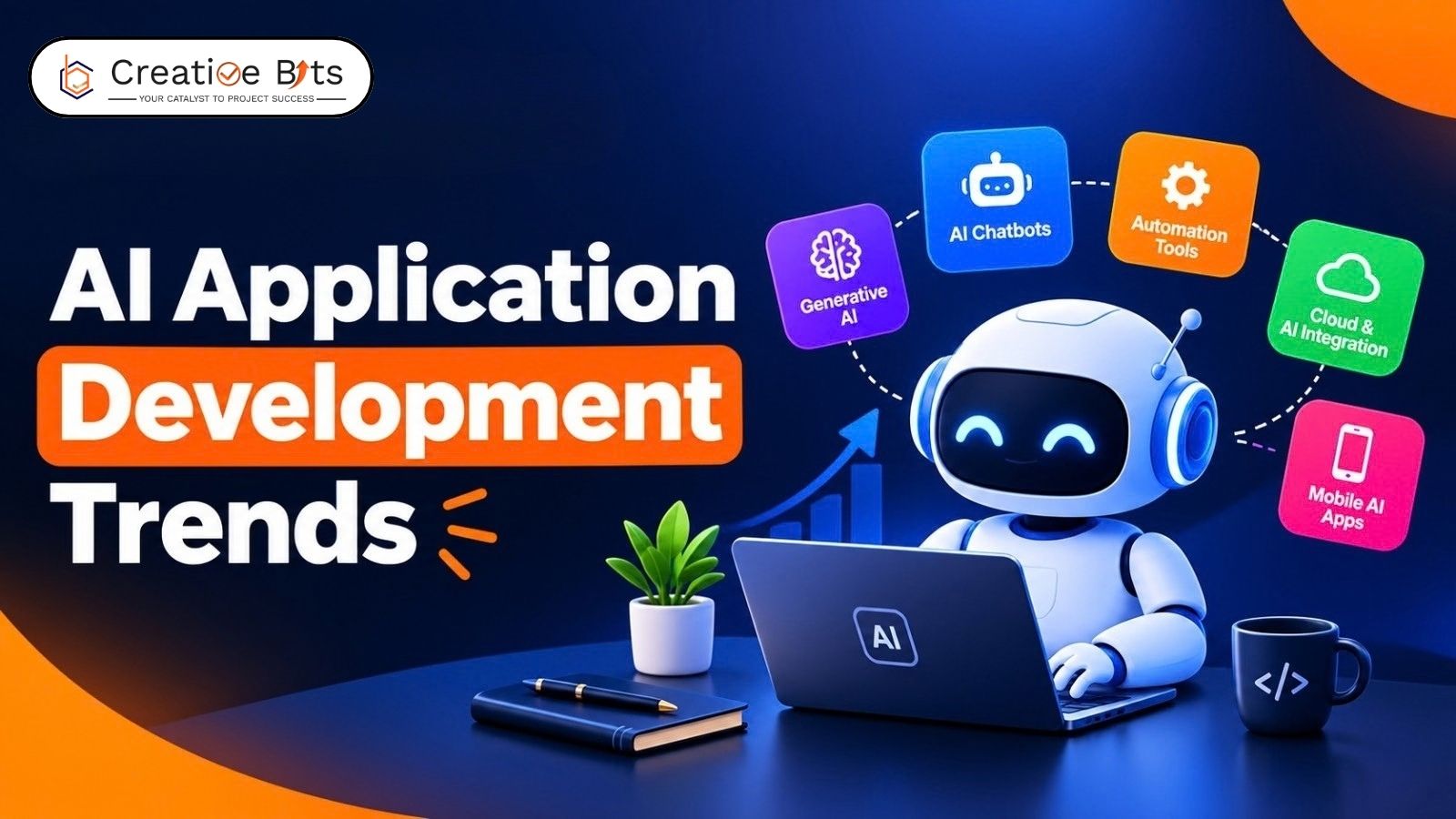
Which AI Application Development Trends Will Transform Your Business in 2026?
Five years ago, "adding AI" to an application meant bolting a chatbot onto a support page and calling it innovation.
That era is over. The AI application development trends driving 2026 are structural, not cosmetic; they change who builds software, how fast it ships, and what the finished product can actually decide on its own. Nearly 40% of all new applications now include AI features, and project requests keep climbing.
The gap between companies tracking these AI application development trends and companies reacting to them is widening fast. Here's what's actually moving.
AI Software Development Services
Before AI application development trends make sense, it helps to know what they deliver.
AI software development services cover the full path from idea to running system: strategy and feasibility, data preparation, model or agent development, integration into existing platforms, and ongoing monitoring. The AI application development trends below all show up somewhere in that chain, usually at the integration stage, which is where most projects quietly fail.
Three things separate a project that ships from one that stalls:
- Assess data readiness before building anything. Only about half of IT leaders fully trust their organization's data accuracy, and no model outperforms the data feeding it.
- Integration treated as the deliverable. A model sitting in isolation changes nothing. Wired into a CRM, ERP, or project board, the same model removes hours every week.
- Monitoring built into scope.Accuracy decays as data shifts. Retraining is a line item, not an afterthought.
Teams that get those three right adopt the latest AI application development trends early and cheaply. Teams that skip them end up with expensive pilots that never reach production.
What Are the Current Trends in AI Development?
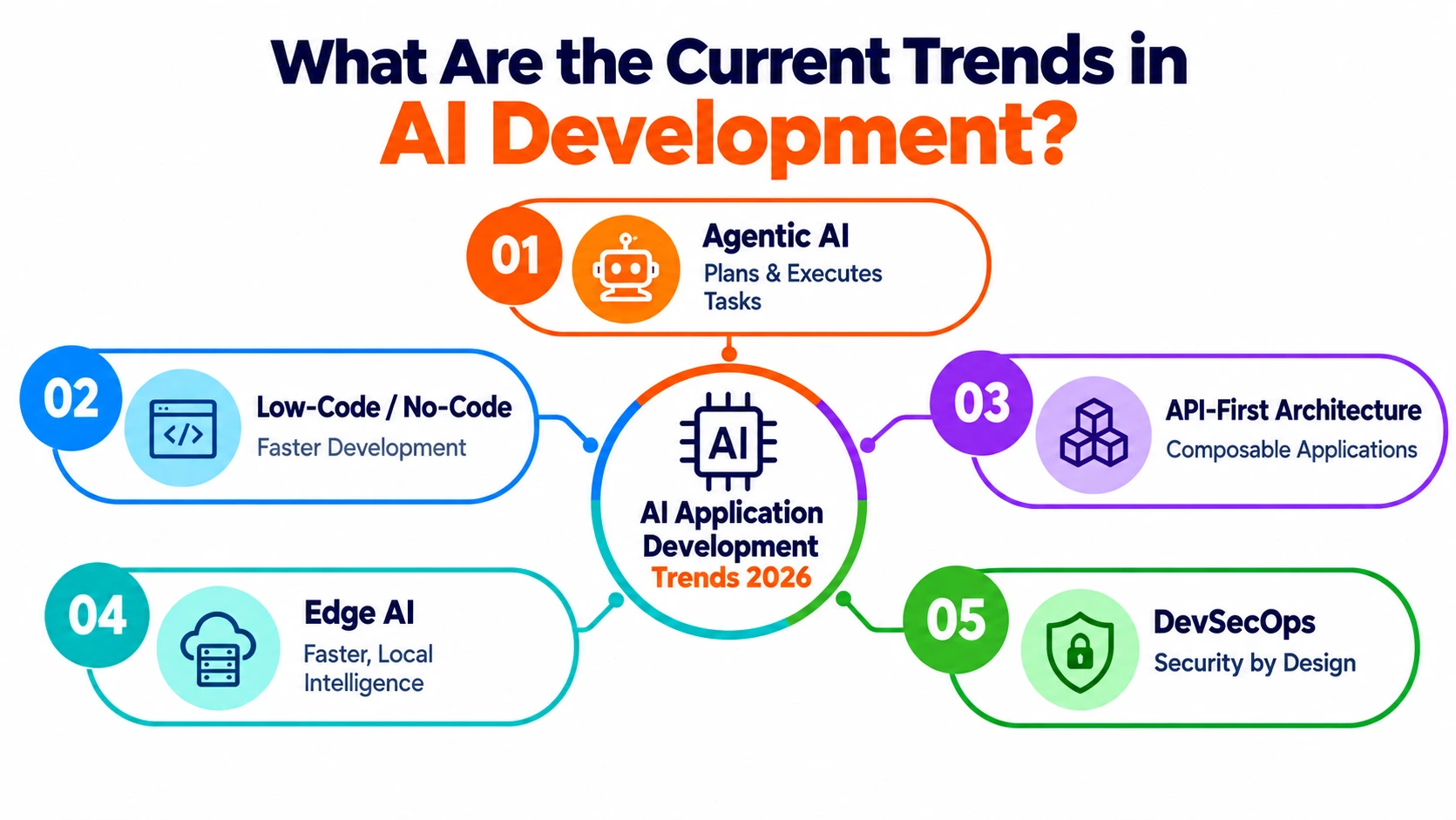
Look back at the timeline of AI application development trends, and the direction is obvious.
AI application development trends in 2020 were about proving feasibility: can a model classify this image, predict this number, understand this sentence? AI application development trends in 2023 moved to generative output: text, code, and images produced on demand. In 2026, the question is no longer whether AI can produce something. It's whether AI can decide and act.
The AI application development trends worth watching right now:
- Agentic AI: Software that plans, calls tools, and executes multi-step workflows without a human in every loop. By 2028, roughly a third of enterprise software is expected to include agentic capability.
- Low-code, no-code, and citizen development: Business users building the tools they need under governance, while engineers move up the stack to architecture and security. The low-code market is projected to pass $67 billion by 2030.
- Composable, API-first architecture: Applications assembled from reusable blocks rather than rewritten end to end, so a single component can be upgraded without touching the rest.
- Edge-native intelligence: Models run on the device or a nearby node instead of a distant data centre, cutting latency and keeping sensitive data local. This is also the honest answer to what the latest technology in mobile application development is.
- DevSecOps as default: Around 85% of IT teams now embed security throughout the build rather than bolting it on at the end.
- These are the AI application development trends that have moved from experiment to expectation.
What Are the Trends in AI in Software Development?
This is a different question from the AI application development trends above, and the distinction matters.
The trends above are about AI inside the product. These are about AI inside the process, how software gets built.
Roughly a third of developers already use AI for code generation, and executives at major tech firms report that 25–30% of their code now comes from AI tools. But the shift runs deeper than autocomplete:
- Test prioritisation and defect detection: Catch problems earlier in the cycle, before they reach production.
- Spec-driven development: Lets engineers describe what they need in plain language and review the implementation rather than typing every line.
- Predictive DevOps: Forecasts pipeline failures, timeline risk, and resource gaps before they bite.
- Knowledge reuse: surfaces reusable components and architectural patterns from past projects.
The developer role is changing with it: less hand-coding, more reviewing, orchestrating, and governing AI-assisted output, which is why roles in AI governance and risk are among the fastest-growing in the field. Anyone tracking mobile app development news has watched these AI application development trends play out across iOS and Android teams too.
Which AI Trend Is Trending Now?
If one of the AI application development trends defines this moment, it's agentic AI: software that acts rather than suggests.
The numbers behind it are striking. 83% of developers believe agents will sit at the centre of business and IT operations, 85% see them as the key to digital transformation, and 78% warn that companies without agents will lose their edge. Yet fewer than half of developers feel fully confident they understand how agents actually work, and 68% of dev teams say they lack the resources to deploy them at scale.
That gap between conviction and capability is the real story of 2026.
The same forces are redrawing the future of mobile apps. Progressive web apps bridge iOS and Android from one codebase. On-device models handle inference without a round trip to the cloud. New app trends for pictures, real-time enhancement, visual search, generative editing, and AR try-ons have moved from novelty to expectation. The 2026 mobile app development trends conversation is really about AI application development trends wearing different clothes.
Is mobile app development in demand? Yes, but the demand has shifted. Teams aren't hired to build screens anymore. They're hired to build intelligence that happens to have a screen.
Turning Trends Into Decisions
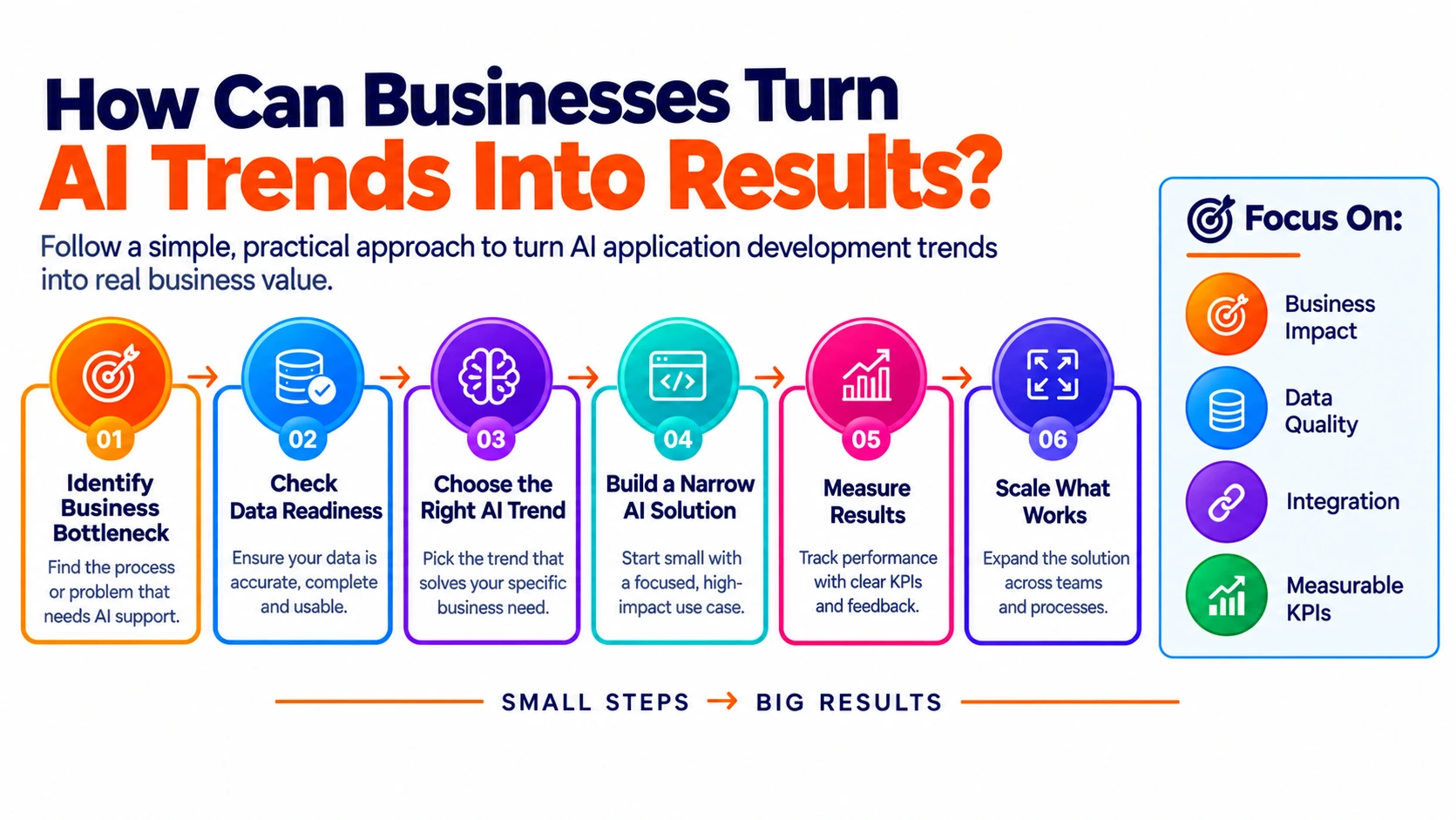
AI application development trends are only useful when they change what you do on Monday. The practical move isn't adopting every one of these AI application development trends at once. Pick the one bottleneck costing you the most hours, check whether your data can support an AI solution for it, and build something narrow that works, then widen. That beats a broad AI programme every time, and it's how AI application development trends turn into results.
2. How have AI application development trends changed since 2020?
AI application development trends in 2020 focused on proving models could work at all: classification, prediction and basic language understanding. AI application development trends in 2023 shifted to generative output. 2026 is about autonomous action and decision-making.
3. What are the current trends in AI development?
Agentic AI systems that execute multi-step workflows, low-code platforms opening development to non-engineers, API-first composable design, edge AI for low-latency processing, and DevSecOps as the default security model.
4. What are the trends in AI in software development specifically?
AI-assisted code generation, automated test prioritisation, spec-driven development where engineers describe intent rather than write every line, predictive DevOps, and ML-driven reuse of components and architecture patterns.
5. Which AI trend is trending now?
Agentic AI. Most developers expect agents to become central to operations, but a majority of teams also report lacking the resources and confidence to deploy them at scale.
6. What is the latest technology in mobile application development?
On-device AI inference, progressive web apps that work across platforms from one codebase, cross-platform frameworks, AI-assisted builds, and edge computing for real-time features without cloud round trips.
7. What are the mobile app development trends 2026 worth tracking?
AI-native features as default rather than add-ons, PWAs replacing some native builds, privacy-first on-device processing, and composable backends that let teams swap components without rewrites.
8. Is mobile app development in demand?
Yes, though the nature of demand has shifted. Teams building AI-enabled, integrated applications are in high demand; teams building static informational apps face more competition from no-code platforms.
9. What are the new app trends for pictures?
Real-time image enhancement, generative editing, visual search, AR try-on for retail, and on-device computer vision for classification and object detection without uploading images.
10. What is the future of mobile apps?
Fewer apps doing more, with intelligence embedded rather than bolted on. Expect agents that act on a user's behalf, cross-platform codebases, and on-device models handling what used to require a server.
11. How do I separate a real trend from hype?
Run a controlled pilot against a specific KPI, check whether the trend fits your existing architecture and skills, and judge adoption on measured impact rather than market noise.