monday.com Services
How Can AI Integration Services Improve Business Efficiency?
Artificial Intelligence is no longer an experimental technology—it has become a strategic business asset. Organizations across healthcare, finance, manufacturing, retail, logistics, education, and professional services are rapidly adopting AI integration services to automate repetitive processes, improve decision-making, enhance customer experiences, and increase operational efficiency.
However, implementing AI isn't simply about deploying a chatbot or integrating a large language model. Successful AI adoption requires seamless integration with existing business applications, enterprise workflows, cloud infrastructure, CRMs, ERPs, communication platforms, and internal databases. That's where professional AI integration services create measurable business value.
Businesses today are increasingly investing in Generative AI integration services to streamline content creation, customer support, workflow automation, intelligent reporting, predictive analytics, and knowledge management. Instead of replacing existing software, AI integration enhances current systems by making them smarter, faster, and more efficient.
According to enterprise AI consulting leaders, organizations achieve the greatest return on investment when AI is embedded directly into business processes with proper governance, orchestration, security, and scalable automation rather than deployed as isolated tools.
Whether you're looking for an AI integration tool, exploring AI integration examples, researching AI governance services, or searching for reliable AI integration services in Hyderabad, understanding how AI integration works is the first step toward building an intelligent enterprise.
At Creative Bits, we help organizations integrate AI into real business workflows—not just as standalone technology, but as practical solutions that automate operations, simplify collaboration, improve productivity, and deliver measurable business outcomes through custom AI development, workflow automation, project management solutions, and enterprise integrations.
What is AI Integration Service?
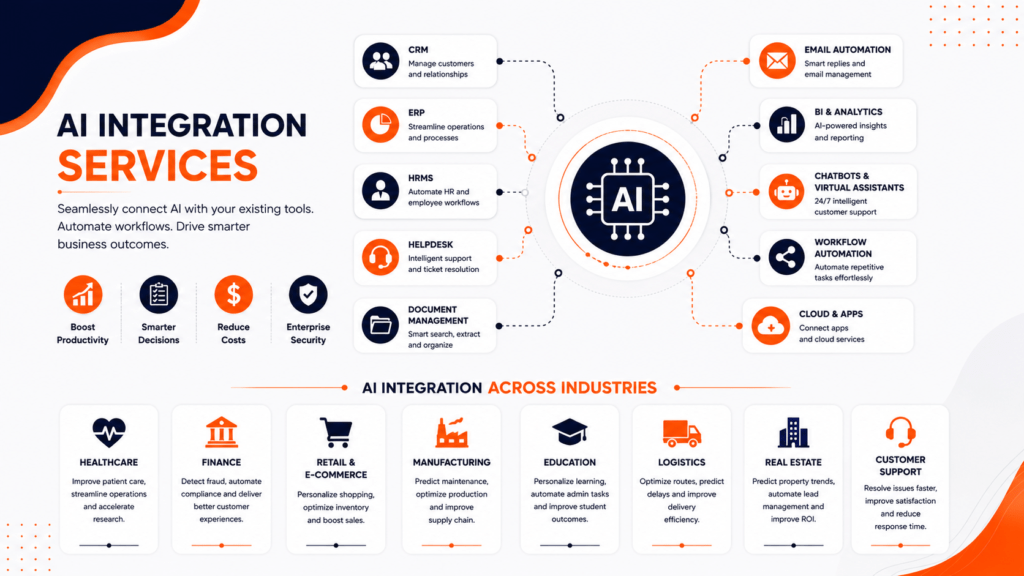
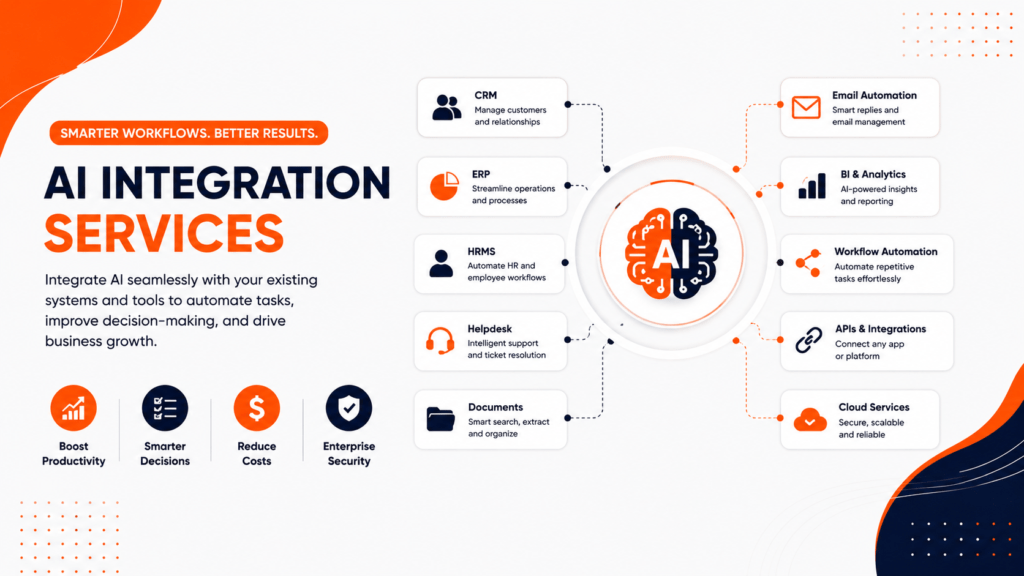
AI integration services refer to the process of connecting Artificial Intelligence technologies with existing business systems, applications, software platforms, databases, and workflows to automate tasks, improve decision-making, and create intelligent business operations.
Unlike building an AI model from scratch, AI integration focuses on making AI work with the tools your business already uses.
For example, an organization may integrate AI into:
- Customer Relationship Management (CRM)
- Enterprise Resource Planning (ERP)
- HR Management Systems
- Helpdesk Software
- Project Management Platforms
- Email Automation
- Business Intelligence Dashboards
- Document Management Systems
- Internal Knowledge Bases
- Workflow Automation Platforms
The objective is simple: enable AI to analyze information, make recommendations, automate repetitive tasks, and assist employees without disrupting existing operations.
How AI Integration Works
A successful AI integration project generally follows these stages:
1. Business Assessment
Experts identify repetitive workflows, operational bottlenecks, and opportunities where AI can create measurable value.
2. Data Preparation
Since AI relies on quality data, businesses organize structured and unstructured information from multiple sources before implementation.
3. Platform Integration
AI models are integrated with existing applications through APIs, cloud services, middleware, or workflow automation platforms.
4. Workflow Automation
Businesses automate repetitive tasks such as:
- Customer support
- Email classification
- Invoice processing
- Document extraction
- Lead qualification
- Employee onboarding
- Report generation
- Appointment scheduling
5. AI Governance
Professional AI governance services ensure that AI systems remain secure, compliant, transparent, and aligned with organizational policies. Governance includes access control, monitoring, bias detection, audit trails, and performance tracking. Enterprise AI providers emphasize governance as a core component of scalable AI adoption.
Benefits of AI Integration Services
Businesses adopting AI integration services experience advantages across multiple departments.
Increased Productivity
Employees spend less time on repetitive administrative tasks and more time on strategic work.
Better Decision Making
AI analyzes large datasets in seconds, providing actionable insights that improve business planning.
Cost Reduction
Automation minimizes manual effort, reduces errors, and lowers operational costs.
Enhanced Customer Experience
AI-powered chatbots, intelligent assistants, and recommendation engines provide faster, more personalized support.
Scalable Operations
As businesses grow, AI-enabled workflows scale without requiring proportional increases in staffing.
Improved Data Utilization
Organizations often possess valuable data that remains underutilized. AI transforms this data into meaningful business intelligence.
Generative AI Integration Services: The Next Evolution
One of the fastest-growing areas of enterprise AI is Generative AI integration services.
Rather than functioning as standalone chatbots, modern generative AI solutions integrate directly into existing workflows to assist employees in completing everyday tasks.
Examples include:
- AI-powered document drafting
- Proposal generation
- Automated meeting summaries
- Knowledge assistants
- Customer service copilots
- Sales enablement assistants
- Intelligent workflow automation
- Code generation
- Marketing content creation
- Business report generation
When integrated correctly, generative AI becomes a collaborative digital assistant that works alongside employees rather than replacing them. Specializes in implementing practical AI solutions that connect with business workflows, automate repetitive operations, improve collaboration, and support data-driven decision-making through customized AI development and workflow automation services.
Real-World AI Integration Examples
Many organizations wonder what successful AI adoption actually looks like. Here are some practical AI integration examples:
Customer Support
AI chatbots answer common customer questions while routing complex issues to human agents.
Human Resources
AI screens resumes, schedules interviews, and assists recruiters in identifying qualified candidates.
Healthcare
AI supports medical documentation, appointment scheduling, patient communication, and administrative workflows.
Finance
AI automates invoice processing, fraud detection, expense management, and financial reporting.
Sales
AI scores leads, predicts customer behavior, recommends next actions, and personalizes outreach campaigns.
Manufacturing
AI predicts equipment failures, schedules preventive maintenance, and improves production efficiency.
Project Management
AI helps assign tasks, forecast project risks, automate reporting, and optimize team collaboration.
What Are the Top 10 AI Services?
As businesses continue to embrace digital transformation, AI integration services have become one of the most valuable investments for improving efficiency, reducing operational costs, and accelerating innovation. Modern AI solutions extend far beyond chatbots—they now power intelligent automation, predictive analytics, workflow optimization, and decision support across virtually every industry.
Below are the top 10 AI services that organizations are adopting to gain a competitive advantage.
1. AI Workflow Automation
AI-powered workflow automation streamlines repetitive business processes by connecting AI with existing software platforms, databases, and communication tools.
Typical use cases include:
- Employee onboarding
- Invoice approvals
- Ticket routing
- Document processing
- Procurement workflows
- Leave management
- Task assignments
- Compliance monitoring
Instead of manually handling repetitive tasks, AI automatically triggers actions, routes approvals, and updates systems in real time. This results in faster execution, fewer errors, and improved operational efficiency.
2. Generative AI Integration Services
Generative AI integration services have transformed how organizations create content, manage knowledge, and assist employees. Rather than using AI as a standalone application, businesses integrate it directly into their daily workflows.
Popular business applications include:
- AI writing assistants
- Meeting summary generation
- Proposal creation
- Email drafting
- Internal knowledge assistants
- Marketing content generation
- Technical documentation
- Customer response automation
When integrated with CRM systems, project management platforms, and document repositories, generative AI significantly enhances employee productivity while maintaining consistency and accuracy.
3. AI Chatbots and Virtual Assistants
Modern AI-powered virtual assistants provide instant, context-aware support for customers and employees.
Common applications include:
- 24/7 customer support
- IT help desks
- HR self-service portals
- Appointment scheduling
- FAQ automation
- Order tracking
- Product recommendations
Unlike traditional chatbots, today's AI assistants understand natural language, retain conversational context, and integrate with enterprise systems to deliver personalized responses.
4. Predictive Analytics Solutions
Predictive analytics leverages machine learning to identify patterns, forecast trends, and support informed decision-making.
Businesses use predictive AI for:
- Sales forecasting
- Demand planning
- Customer retention
- Fraud detection
- Inventory optimization
- Financial forecasting
- Risk assessment
By analyzing historical and real-time data, predictive models help organizations anticipate future outcomes and make proactive decisions.
5. AI Data Integration and Intelligence
One of the greatest challenges organizations face is managing information stored across multiple systems.
AI integration enables businesses to consolidate data from:
- CRM platforms
- ERP software
- Cloud storage
- Accounting systems
- Email platforms
- Customer support tools
- Marketing automation software
The result is a unified source of truth that supports real-time analytics, reporting, and strategic decision-making.
6. AI Integration Tool Implementation
Selecting the right AI integration tool is critical to a successful deployment. Businesses typically require platforms that connect AI models with existing applications without disrupting daily operations.
An effective AI integration tool should provide:
- API connectivity
- Workflow automation
- Secure data synchronization
- Cloud compatibility
- Role-based access controls
- Scalable architecture
- Low-code or no-code capabilities
- Performance monitoring
Organizations should evaluate tools based on their current technology stack, security requirements, and long-term scalability rather than choosing solutions based solely on popularity.
7. AI Governance Services
As AI adoption grows, responsible implementation becomes increasingly important. AI governance services help organizations ensure that AI systems remain secure, transparent, compliant, and aligned with business objectives.
Key governance practices include:
- Data privacy protection
- AI model monitoring
- Bias detection
- Regulatory compliance
- Access management
- Audit trails
- Risk assessment
- Ethical AI policies
Strong governance builds trust among employees, customers, and stakeholders while reducing operational and regulatory risks.
8. Custom AI Development
Every organization has unique workflows and business goals. Custom AI development focuses on building tailored solutions that address specific operational challenges.
Examples include:
- Industry-specific AI assistants
- Intelligent document processing
- Custom recommendation engines
- AI-powered dashboards
- Process optimization systems
- Knowledge management platforms
Customized solutions often deliver greater long-term value than generic, off-the-shelf applications because they align closely with business requirements.
9. AI Consulting and Integration Strategy
Successful AI implementation starts with a well-defined strategy. AI consultants help businesses identify high-impact opportunities, assess technical readiness, and develop practical implementation roadmaps.
Consulting services typically include:
- AI readiness assessments
- Business process analysis
- Technology selection
- Integration planning
- Change management
- ROI forecasting
- Pilot project development
A strategic approach minimizes implementation risks and maximizes business value.
10. AI Maintenance and Continuous Optimization
AI integration is not a one-time project. As business requirements evolve, AI systems require ongoing monitoring, optimization, and updates.
Maintenance activities include:
- Model performance evaluation
- Workflow optimization
- Security updates
- System monitoring
- API maintenance
- Data quality improvements
- Feature enhancements
Continuous optimization ensures AI continues to deliver measurable results over time.
AI Integration Services Hyderabad
The demand for AI integration services in Hyderabad has grown rapidly due to the city's thriving IT ecosystem, global technology companies, and innovation-driven startups. Businesses in Hyderabad are increasingly investing in AI-powered automation to modernize operations, improve customer experiences, and accelerate digital transformation.
Organizations in sectors such as healthcare, finance, manufacturing, retail, logistics, education, and software development are adopting AI to automate routine tasks, enhance analytics, and optimize business workflows.
When evaluating AI integration providers, businesses should look beyond technical expertise and consider factors such as:
- Experience with enterprise integrations
- Custom AI development capabilities
- Workflow automation expertise
- Security and compliance standards
- Post-deployment support
- Scalability of solutions
- Industry-specific experience
A trusted AI partner should understand both the technical and operational aspects of implementation, ensuring that AI delivers measurable business outcomes rather than functioning as an isolated technology.
How Creative Bits Delivers AI Integration Services
AI integration is designed around business outcomes—not just technology deployment. The company combines expertise in AI development, workflow automation, project management solutions, and enterprise system integration to help organizations streamline operations and improve productivity.
- Integrating AI with existing software ecosystems
- Automating repetitive business processes
- Developing custom AI-powered applications
- Connecting AI with CRM, ERP, and project management platforms
- Implementing workflow automation solutions
- Providing scalable AI architectures
- Supporting digital transformation initiatives
- Delivering ongoing optimization and technical support
This practical, business-first approach enables organizations to adopt AI confidently while maximizing return on investment.
Who Are the Big 4 AI Agents?
AI agents are intelligent software systems that can understand instructions, make decisions, and complete tasks with minimal human intervention. As organizations adopt AI integration services, AI agents are becoming an essential part of business operations, helping teams automate workflows, analyze data, and improve productivity.
While the AI landscape is constantly evolving, the following four categories represent the most widely used AI agents in modern enterprises:
1. Conversational AI Agents
Conversational AI agents interact with users through natural language. They are commonly used for customer support, employee assistance, and self-service portals.
Common use cases include:
- Customer support automation
- IT helpdesk assistance
- HR support
- Appointment scheduling
- FAQ management
- Internal knowledge assistants
When integrated with CRM platforms and business applications, these agents provide instant, context-aware responses while reducing manual workload.
2. Task Automation Agents
Task automation agents execute repetitive business activities without constant human intervention.
Examples include:
- Invoice processing
- Data entry
- Email classification
- Workflow approvals
- Document routing
- Report generation
Organizations implementing AI integration services often use these agents to improve efficiency and reduce operational costs.
3. Decision Support Agents
Decision support agents analyze large volumes of structured and unstructured data to help business leaders make informed decisions.
They assist with:
- Financial forecasting
- Sales predictions
- Inventory planning
- Risk analysis
- Customer behavior analysis
- Business intelligence
Rather than replacing human expertise, these agents provide actionable insights that support faster and more accurate decision-making.
4. Autonomous AI Agents
Autonomous agents perform complex, multi-step tasks with minimal supervision by combining reasoning, planning, and execution.
Examples include:
- Multi-step workflow automation
- Supply chain optimization
- Intelligent scheduling
- Automated project coordination
- AI-powered research assistants
As enterprise AI continues to mature, autonomous agents are expected to become a key component of intelligent business operations.
What Are the 7 Main Types of AI?
Artificial Intelligence is typically classified into seven major types based on its capabilities and functionality. Understanding these categories helps businesses choose the right technology when investing in AI integration services.
1. Reactive Machines
Reactive AI is the simplest form of artificial intelligence. It responds to specific inputs but cannot learn from previous experiences or store memories.
Example:
- Rule-based recommendation systems
- Basic game-playing AI
2. Limited Memory AI
Limited Memory AI can learn from historical data and use previous information to improve future decisions.
Examples include:
- Fraud detection
- Recommendation engines
- Autonomous driving assistance
- Predictive analytics
Most commercial AI applications today fall into this category.
3. Theory of Mind AI
Theory of Mind AI is a developing concept where AI understands human emotions, intentions, and social interactions.
Although research is progressing, this level of AI is not yet widely implemented in commercial environments.
4. Self-Aware AI
Self-aware AI is a hypothetical form of intelligence where machines possess consciousness and self-awareness.
Currently, no real-world AI system has achieved this capability.
5. Narrow AI (Weak AI)
Narrow AI is designed to perform specific tasks exceptionally well.
Examples include:
- Voice assistants
- Image recognition
- Spam filters
- Chatbots
- Language translation
Most business applications using AI integration services rely on Narrow AI.
6. General AI (AGI)
Artificial General Intelligence (AGI) refers to AI capable of performing any intellectual task that a human can perform.
AGI remains an area of active research and has not yet been achieved in practical business applications.
7. Super AI
Super AI represents a theoretical future stage where AI surpasses human intelligence across all domains.
While often discussed in research and science fiction, Super AI does not currently exist.
AI Integration Course: Building Skills for the Future
As AI adoption accelerates, professionals increasingly enroll in AI integration courses to build practical skills in artificial intelligence, automation, and enterprise system integration.
A comprehensive course typically covers:
- AI fundamentals
- Machine learning basics
- API integrations
- Workflow automation
- Prompt engineering
- Data analytics
- Cloud platforms
- AI governance
- Security and compliance
- Real-world implementation projects
These skills are valuable for software developers, business analysts, project managers, IT professionals, and digital transformation specialists looking to lead AI-driven initiatives.
AI Integration Jobs: Career Opportunities in a Growing Market
The rapid adoption of AI is driving strong demand for professionals with AI integration expertise. Organizations across industries are hiring talent to implement, manage, and optimize AI-powered solutions.
Common job roles include:
- AI Integration Engineer
- AI Solutions Architect
- Machine Learning Engineer
- AI Consultant
- Workflow Automation Specialist
- Data Engineer
- AI Product Manager
- Business Intelligence Analyst
- Prompt Engineer
- AI Operations Specialist
Professionals with knowledge of cloud computing, APIs, workflow automation, data integration, and AI governance are particularly well-positioned for these opportunities.
Conclusion
Artificial Intelligence is transforming the way organizations operate, compete, and innovate. However, the true value of AI lies not in standalone tools but in how effectively it is integrated into existing business systems and workflows.
Professional AI integration services help businesses connect AI with CRM platforms, ERP systems, project management software, communication tools, and enterprise applications to automate repetitive tasks, improve decision-making, and enhance customer experiences.
Whether your organization is exploring Generative AI integration services, implementing an advanced AI integration tool, evaluating AI governance services, or planning enterprise-wide automation, a strategic approach ensures long-term success.
At Creative Bits, we deliver practical AI solutions aligned with your business objectives. Our expertise spans AI development, workflow automation, project management solutions, enterprise integrations, and digital transformation. By combining innovative technology with a deep understanding of business processes, we help organizations unlock greater efficiency, improve collaboration, and achieve measurable results through intelligent AI integration.

2. What are Generative AI integration services?
Generative AI integration services embed AI-powered content generation, knowledge assistance, and automation capabilities into business platforms and workflows.
3. How do AI integration services benefit businesses?
They improve productivity, reduce manual work, enhance decision-making, lower operational costs, and deliver better customer experiences.
4. What is an AI integration tool?
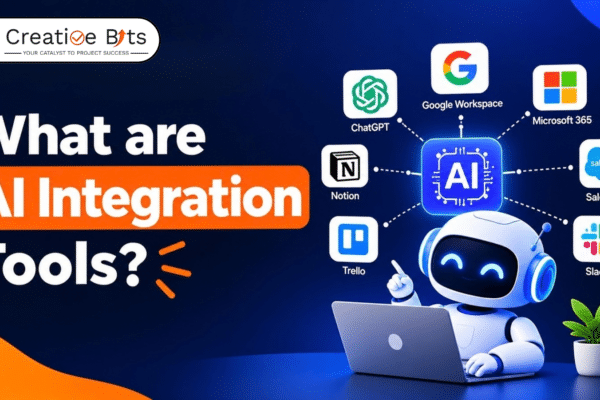
An AI integration tool enables businesses to connect AI models with software applications, databases, APIs, and workflow automation platforms.
5. Why are AI governance services important?
AI governance services ensure AI systems operate securely, ethically, transparently, and in compliance with organizational and regulatory requirements.
6. Which industries benefit most from AI integration services?
Healthcare, finance, retail, manufacturing, logistics, education, professional services, and technology companies all benefit from AI integration.
7. What skills are taught in an AI integration course?
Courses typically cover AI fundamentals, APIs, automation, machine learning, cloud platforms, prompt engineering, AI governance, and enterprise integration.