monday.com Services
Approval bottlenecks are silently draining your business of thousands of dollars every single day. That approval sitting in someone's inbox, the decision deferred to next week, the signature delayed for alignment — these micro-delays seem harmless in isolation. But when aggregated across departments and hierarchies, they carry a very tangible economic cost.
This phenomenon is best characterized as decision fatigue economics: the quantifiable cost of burdening decision-makers and choking execution through excessive approval bottlenecks. According to McKinsey & Company, knowledge workers waste up to 30 to 40 percent of their time waiting for decisions or clarifications instead of executing work. At scale, this friction converts directly to productivity losses, revenue erosion, and employee burnout.
While leaders often focus on optimizing tools or headcount, they overlook the approval workflow — one of the costliest inefficiencies in modern operations. At Creative Bits, we've helped organizations recover thousands of dollars per day lost not to wrong decisions, but to slow ones. The first step to fixing this cost is understanding and quantifying it.
The Hidden Economics of Approval Bottlenecks
Approval bottlenecks are not merely a psychological burden — they have direct economic implications. As approval layers multiply, cognitive load on managers grows, response times decline, and decision quality deteriorates. According to Harvard Business Review, executives make an average of 35,000 decisions annually, many of which are redundant approvals that could be delegated or automated. Each approval gate in a dependent workflow multiplies the delay.
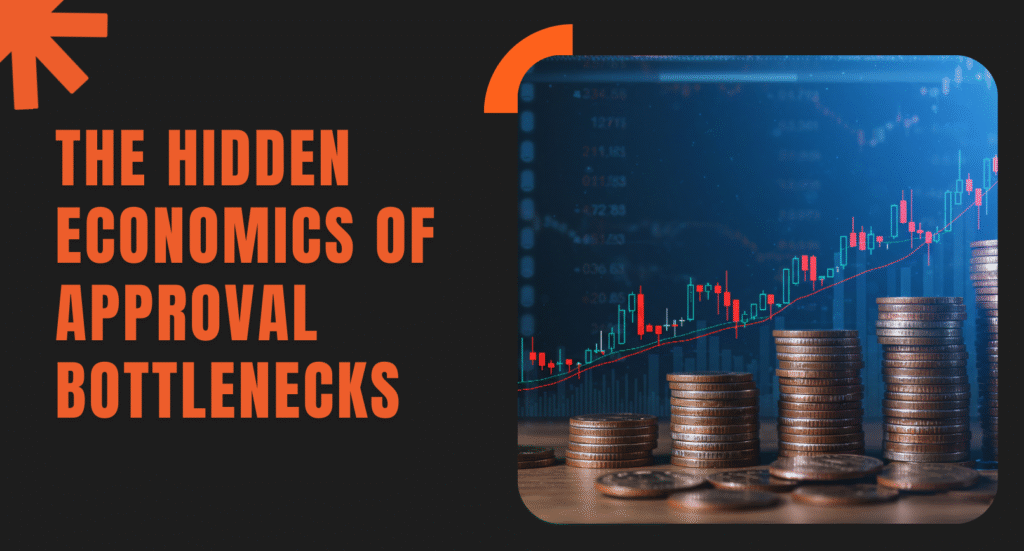
Consider a realistic scenario: A mid-sized organization with 100 knowledge workers at an average loaded cost of $60 per hour. If those workers spend just 30 minutes daily navigating approval bottlenecks, the daily cost exceeds $3,000. Annually, that's over $750,000 in lost productivity — before accounting for opportunity costs, missed market windows, and declining employee engagement.
Gartner reports that organizations with high decision friction execute strategic initiatives 20 percent slower than counterparts with streamlined governance models. Approval delays rarely exist in isolation — they cascade across teams, causing idle time, rework, and context switching. Decision fatigue becomes a silent tax, paid daily but seldom seen or questioned.
3 Patterns of Approval Bottlenecks That Drain Value
Approval bottlenecks follow predictable patterns regardless of industry. Recognizing these patterns is the first step toward elimination.
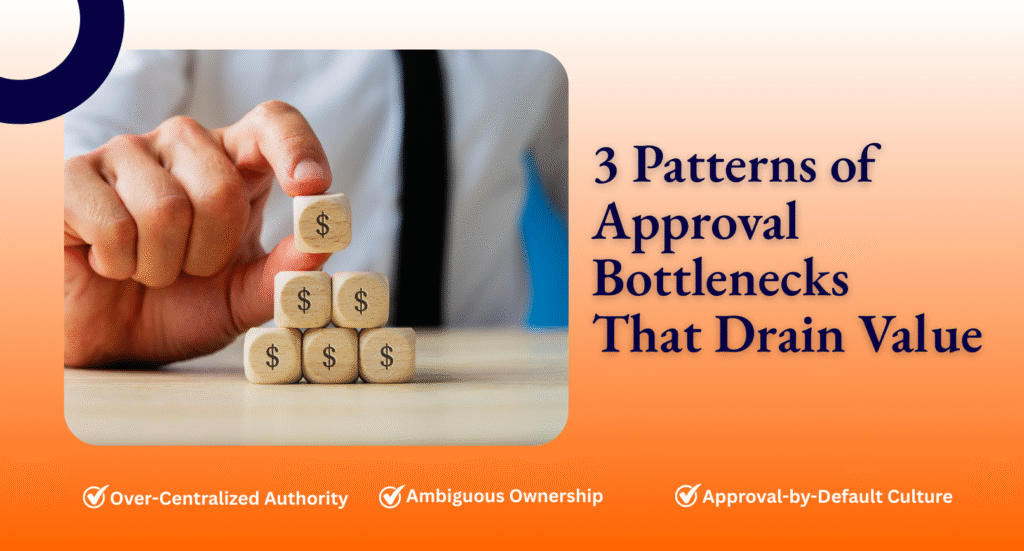
Pattern 1: Over-Centralized Authority — Too many decisions, whether strategic or operational, funnel upward to leadership. While intended to maintain control, this model overwhelms executives and stagnates execution. McKinsey & Company found that organizations pushing decision-making closer to the work reduce approval time by approximately 50 percent.
Pattern 2: Ambiguous Ownership — When decision ownership is unclear, approvals bounce endlessly between stakeholders seeking validation rather than taking responsibility. This ambiguity increases cycle time and erodes process confidence. Forrester Research identifies ambiguous decision rights as a leading cause of workflow delays in cross-functional teams.
Pattern 3: Approval-by-Default Culture — Systems requiring signoffs even for minimal-risk or repetitive actions create approval inflation, where the cost of approval exceeds the cost of the action itself. Employees learn to wait rather than decide, deepening dependency and slowing organizational metabolism.
These approval bottlenecks are rarely intentional — they become embedded in processes, tools, and culture, compounding as organizations grow without conscious intervention.
Eliminating Approval Bottlenecks Without Losing Governance
Solving approval bottlenecks isn't about eliminating governance — it's about redesigning it. High-performing organizations distinguish between strategic oversight and execution friction. This begins with decision classification: clearly defining which decisions require human approval, which can be rule-based, and which can be fully automated.
Bain & Company reports that organizations with clear decision frameworks reduce approval time by an average of 60 percent while achieving better compliance outcomes.
Workflow automation is critical. By embedding approval logic directly within systems — rather than relying on email or ad-hoc messaging — organizations maintain flow while preserving traceability. Platforms like monday.com enable conditional approvals based on thresholds, risk levels, or data validation rules. Low-risk decisions flow automatically; only exceptions escalate.
Reducing cognitive load on approvers also matters. Batching decisions, establishing clear SLAs, and using decision templates minimize mental burden and improve response times. Behavioral research confirms that reducing decision volume improves both quality and speed. Economically, fewer better decisions outperform numerous delayed ones.
Measuring Approval Bottlenecks: Making Decision Speed a KPI
What isn't measured cannot be improved. Yet few organizations track decision latency as a formal metric. Leading companies now treat decision speed as an operational KPI, monitoring average time-to-approval, rework frequency, and escalation rates. Gartner emphasizes that visibility into decision flow is a prerequisite for improving enterprise agility.
At Creative Bits, we help clients instrument their workflows to surface approval bottlenecks in real time. By mapping approval paths, identifying idle states, and calculating cost-per-delay, teams develop a shared language for improvement. This data-driven approach transforms governance from a control mechanism into a performance lever.
Once approval bottlenecks are visible, redesign becomes possible. Approval layers can be reduced, authority redistributed, and automation introduced with confidence. Over time, decision speed becomes a competitive advantage — enabling faster launches, quicker pivots, and more engaged teams.
Turn Approval Bottlenecks Into Competitive Advantage
Decision fatigue isn't an inevitable cost of growth — it's a design flaw. Approval bottlenecks that delay execution silently destroy value, demoralize teams, and stall momentum. Winning organizations aren't those with the most controls — they're those with the right controls.
At Creative Bits, we treat decision flow as an economic system. We measure the cost of delays, redesign approval architectures, and implement automation that accelerates without sacrificing accountability. The result: governance that enables rather than obstructs.