monday.com Services
Scenario planning for scale is no longer optional for organizations that want to grow without operational breakdowns. Most organizations do not fail because of an ineffective strategy. They fail because their structures cannot deal with success.
At the initial level, workflows are meant to be fast, flexible, and expeditious. Teams depend on informal coordination, improvised processes, and reactive decision-making. These systems are efficient until growth begins. The very workflows that once enabled agility become bottlenecks as demand grows.
This is where growth walls occur. Organizations find themselves caught by an inability to match operational capacity to business growth. Tasks begin to accumulate, response times increase, coordination spirals out of control, and mistakes compound. Research on scaling operations has consistently shown that most companies do not lose performance due to weak demand but rather to process inefficiencies that become visible under scale stress.
Scenario planning for scale addresses this challenge before it becomes a crisis. Instead of waiting until workflows collapse, organizations simulate expected performance at 2x, 5x, and 10x workloads. They recognise stress points early and redesign systems before inefficiencies become emergencies.
At Creative Bits, we treat scenario planning for scale as a foundational operational discipline. Scaling does not only mean adding resources. It means redesigning workflows to manage increasing complexity, volume, and speed simultaneously. This article breaks down how organizations can simulate scaling scenarios, identify breaking points, and take proactive steps to eliminate operational friction as they grow.
1. Why Workflows Fail Without Scenario Planning for Scale
Workflows that function well at a small scale often fail under increased demand because they were never designed for volume, variability, or coordination complexity. In the early stages, teams compensate for process gaps through communication and improvisation. As scale increases, this approach becomes unsustainable.
Research in operations management highlights that systems optimized for flexibility often lack the structure needed for scalability. When task volume doubles or triples, even minor inefficiencies become significant constraints.
One common issue is dependency overload. Tasks that rely on specific individuals or approval steps create bottlenecks when volume increases. What was once a manageable queue becomes a backlog that delays execution across the entire system.
Another challenge is communication saturation. As team size and activity grow, the number of interactions increases exponentially. Without structured workflows, communication channels become overloaded, leading to missed updates and coordination failures.
Manual processes also become limiting factors. Tasks requiring human intervention at every step cannot scale efficiently. Research by MITSloan on digital transformation emphasizes that organizations must transition from manual to system-driven processes to sustain growth. These issues are rarely visible at a small scale. They surface only when systems are pushed beyond their original capacity. Scenario planning for scale allows organizations to uncover these weaknesses before they impact performance.
2. Modeling Scale: The 2x, 5x, and 10x Framework
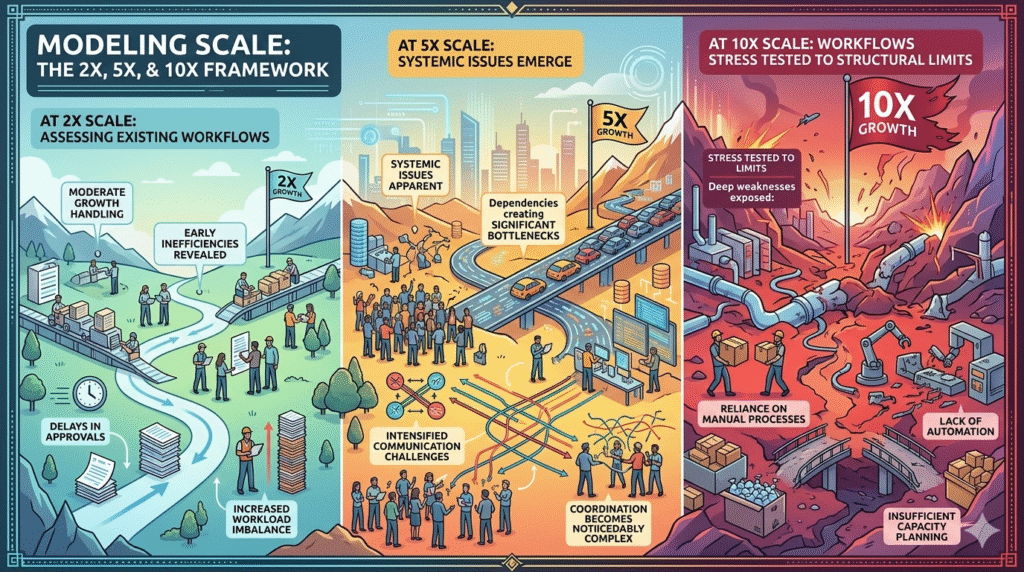
Effective scenario planning for scale begins with modeling how workflows behave under increased demand. The most practical approach involves testing processes at multiple levels, typically 2x, 5x, and 10x the current workload.
At 2x scale, organizations assess whether existing workflows can handle moderate growth. This stage often reveals early inefficiencies such as delays in approvals or increased workload imbalance.
At 5x scale, systemic issues become more apparent. Dependencies that were manageable at lower volumes begin creating significant bottlenecks. Communication challenges intensify, and coordination becomes noticeably more complex.
At 10x scale, workflows are stress tested to their structural limits. This stage exposes deep weaknesses, including reliance on manual processes, lack of automation, and insufficient capacity planning.
Research by Harvard Business Impact on scenario planning emphasizes the importance of modeling multiple growth trajectories to understand system resilience. By simulating different levels of demand, organizations identify which processes are robust and which require redesign.
The goal is not to predict exact future conditions but to understand how systems respond to increased pressure. This shifts planning from reactive problem-solving to proactive system design.
At Creative Bits, we integrate scenario modeling into workflow audits, enabling teams to visualize how tasks, approvals, and communication flows evolve under scale.
3. Identifying Breaking Points Through Scenario Planning for Scale
Once scenarios are modeled, the next step is identifying breaking points, the specific areas where workflows fail under increased demand. These points typically occur at intersections of high volume and limited capacity.
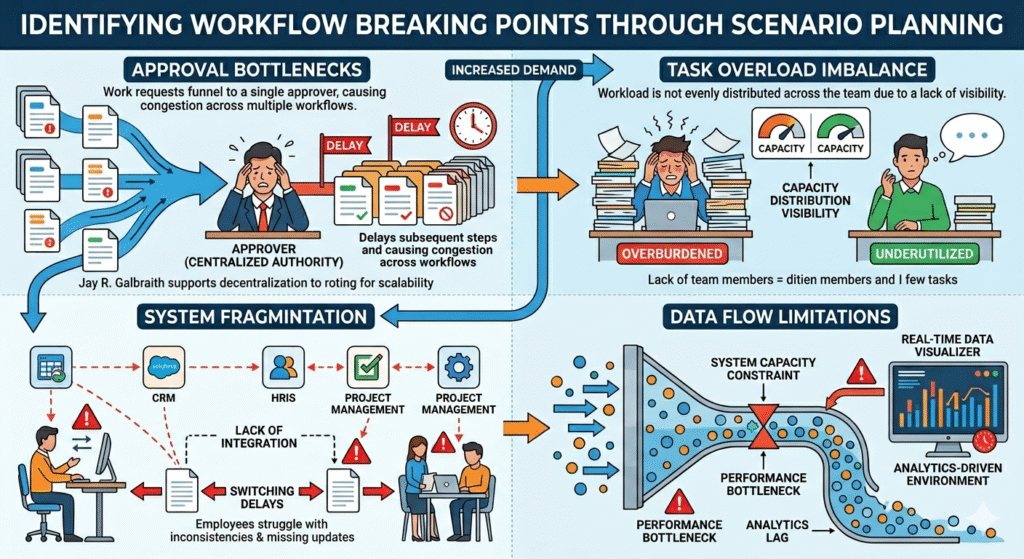
Approval bottlenecks are one of the most common breaking points. When decision-making authority is centralized, increased demand overwhelms approvers, delaying progress across multiple workflows. Jay R. Galbraith suggests that decentralizing decision-making improves scalability and responsiveness.
Task overload imbalance is another frequent issue. As workload increases, some team members become overburdened while others remain underutilized. Without visibility into capacity distribution, organizations struggle to allocate resources effectively.
System fragmentation amplifies inefficiencies at scale. When workflows span multiple tools without integration, employees constantly switch between platforms, increasing the risk of errors and missed updates.
Data flow limitations also create constraints. Systems that cannot process or display increased data volumes effectively become performance bottlenecks, particularly in analytics-driven environments where real-time insights are critical.
Identifying these breaking points requires both quantitative and qualitative analysis. Metrics such as task completion time, queue length, and error rates reveal system performance. Employee feedback uncovers hidden inefficiencies not visible in data alone. By mapping these stress points, organizations gain a clear understanding of where intervention is needed.
4. Designing Preventive Solutions for Scalable Operations
The final stage of scenario planning for scale involves redesigning workflows to address identified weaknesses. Preventive solutions focus on increasing system capacity, reducing dependencies, and improving process efficiency.
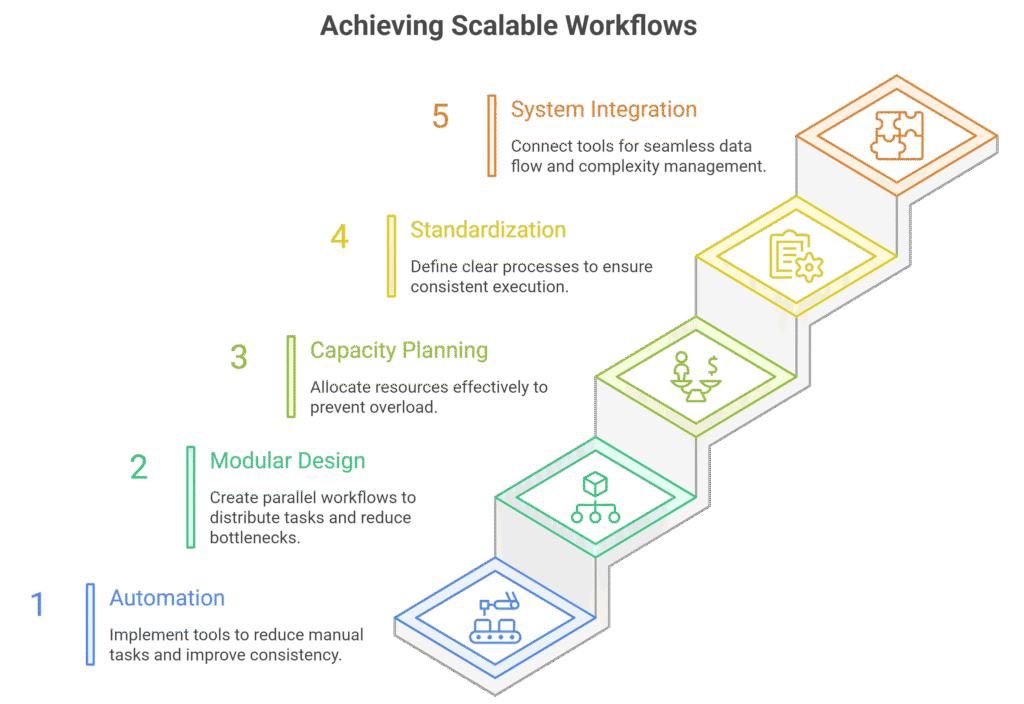
Automation is a key strategy. Repetitive tasks requiring manual intervention can be automated, reducing workload and improving consistency. Workflow automation tools like monday.com and Make enable organizations to handle higher volumes without proportionally increasing resources.
Modular workflow design replaces linear processes with parallel workflows that distribute tasks across multiple teams or systems. This reduces bottlenecks and significantly improves throughput.
Capacity planning plays a critical role. By understanding workload distribution, organizations allocate resources more effectively and prevent overload in specific areas. Wallace J. Hopp and Mark L. Spearman highlight that proactive capacity planning improves both efficiency and employee well-being.
Standardization is equally important. Clearly defined processes reduce variability and ensure consistent execution across teams. Documentation and structured workflows enable employees to follow best practices without relying on informal communication.
System integration improves scalability. When tools are connected and data flows seamlessly, organizations manage increased complexity without additional friction.
At Creative Bits, we design scalable workflow architectures that combine automation, standardization, and integration. The goal is not just to handle growth but to enable it.
Scenario Planning for Scale Means Scaling Without Breaking
Growth is often seen as a success indicator, but without the right systems in place, it can quickly become a source of operational strain. Scenario planning for scale allows organizations to anticipate challenges and redesign workflows before inefficiencies become critical.
By modeling workflows at 2x, 5x, and 10x scale, identifying breaking points, and implementing preventive solutions, organizations build systems that are resilient, efficient, and adaptable.
The most successful organizations do not wait for workflows to fail. They test, refine, and strengthen their systems in advance.
At Creative Bits, we help teams design workflows that scale seamlessly with growth. Because sustainable success is not just about increasing output, it is about building systems that can handle it.