monday.com Services
How Can Generative AI Integration Unlock Real Business Growth?
A successful generative AI integration starts by mapping existing workflows and identifying where AI can genuinely remove friction, whether that's a support inbox, reporting process, repetitive data entry, or internal knowledge task. Generative AI integration helps close that gap by connecting AI to the systems your team already relies on, instead of bolting on another disconnected tool that lives outside everyone's actual workflow.
Generative AI Integration Services USA
Across the US, demand for generative AI integration services has shifted noticeably in the past year, away from standalone chatbots and toward AI that's embedded directly inside CRMs, project tools, and reporting systems. American businesses researching this space are increasingly asking not "can we build an AI tool" but "can this actually plug into what we already run," which is exactly the shift that separates a working integration from a shelved pilot.
What Generative AI Integration Actually Involves
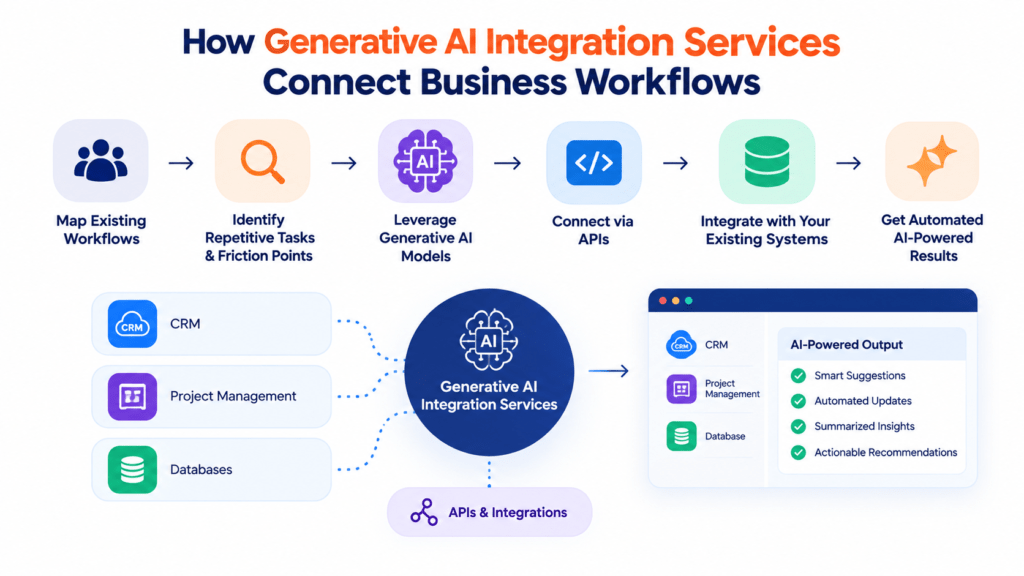
Good integration starts by mapping existing workflows, then deciding where AI genuinely removes friction: a support inbox, a reporting process, repetitive data entry. Generative AI developers handle the technical side: connecting models to your CRM, project boards, or databases through APIs, so the AI works with real data instead of generic prompts that ignore your business context entirely.
Generative AI Consulting vs. Hands-On Development
There's a real difference between generative AI consulting and hands-on build work. Consulting, sometimes called gen AI consulting services, is the strategy phase: identifying which processes are worth automating and what ROI looks like before a single line of code gets written. Development is where it actually gets built and rolled out. The strongest partners offer both, so strategy doesn't sit unused in a slide deck while a separate team builds something else entirely.
AI Copilots and AI Agents: Where the Real Gains Show Up
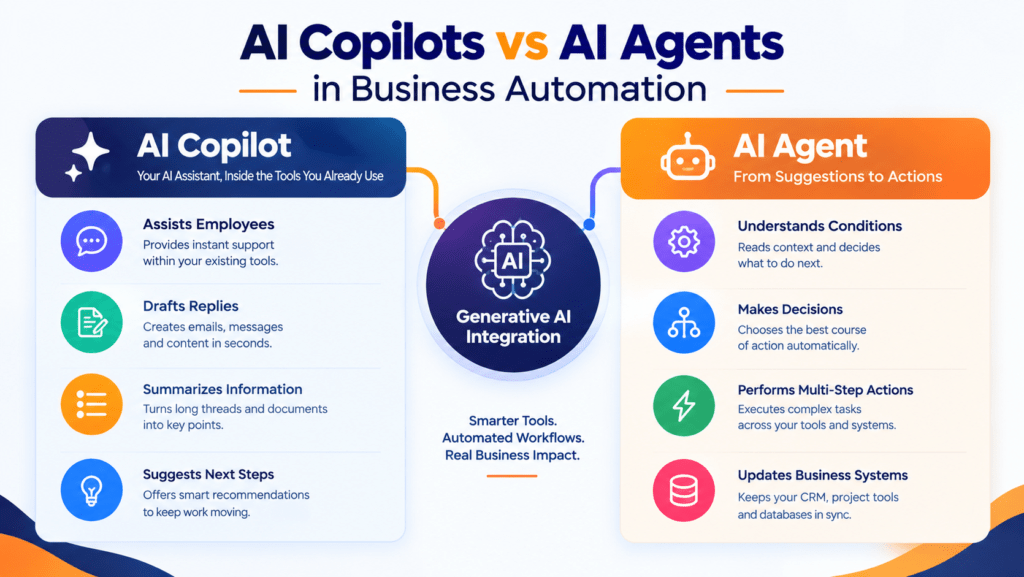
Two categories tend to deliver the fastest wins. AI Copilot development services embed an assistant directly inside a tool your team already uses, drafting replies, summarizing threads, suggesting next steps without switching apps. AI agent development services go a step further, letting AI take multi-step actions on its own, like updating a task board once a condition is met. This is usually where a Gen AI agency starts when a client wants automation people will actually adopt, not another dashboard nobody opens.
What Is the 30% Rule in AI?
It's an informal benchmark circulating in enterprise AI circles: well-scoped generative AI integration can cut time spent on a repetitive task by roughly 30%, without needing to replace the underlying system entirely. It's not a guarantee, but it's a useful sanity check when evaluating whether a proposed AI project is realistic or oversold by a vendor.
Who Are the Big 4 in AI?
Depending on who you ask, this usually points to the four labs whose models power most enterprise AI work today: OpenAI, Google DeepMind, Anthropic, and Meta AI. Most generative AI integration services sit on top of one or more of these models rather than building foundation models from scratch, which keeps projects faster and considerably more cost-effective for most businesses.
What Are Examples of AI Integration?
A few common ones: AI-drafted replies inside a support inbox, automatic summarization of long project threads, AI-assisted resume screening during hiring, and AI-generated first drafts of reports or product descriptions. The common thread is that the AI sits inside an existing tool or workflow; it doesn't ask the team to learn an entirely new system just to get the benefit.
What Are the Top 3 AI Providers?
For most businesses integrating generative AI today, the practical shortlist comes down to OpenAI (GPT models), Anthropic (Claude), and Google (Gemini), the three most widely supported across enterprise tools, copilots, and API ecosystems right now, regardless of which integration partner you eventually choose.
How Can AI Integration Fit Into Existing Workflows?
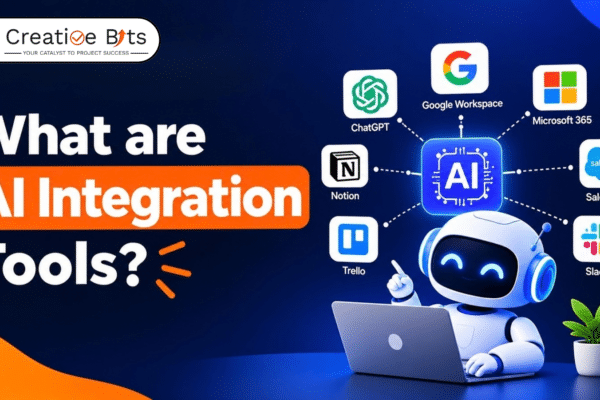
Rather than taking away the tools that your company relies on currently, AI can be integrated into these processes and make them even more effective. Integrating AI assistants and copilots with workflow apps such as monday.com, Make, n8n, and Zapier will enable the team to integrate AI into their processes. This way, companies can build upon their workflows and find opportunities for automation and AI integration.
This is what I would include in the essay since it provides a completely new perspective and describes how AI can be integrated rather than providing yet another explanation as to why it is important.
2. How is generative AI consulting different from development?
Consulting identifies which processes are worth automating and estimates ROI; development is the actual build, integration, and rollout that follows.
3. What do generative AI developers actually build?
The connective layer, APIs, data pipelines, and interfaces that let an AI model read from and act on your existing systems.
4. What's the difference between an AI copilot and an AI agent?
A copilot assists a human inside a tool, like drafting a reply for review. An agent can take multi-step actions on its own with less manual oversight.
5. What is the 30% rule in AI integration?
A rough industry benchmark suggests that well-scoped AI automation can cut time spent on a specific task by about 30%, useful for sanity-checking expectations, not a guarantee.
6. Who are considered the "Big 4" in AI?
OpenAI, Google DeepMind, Anthropic, and Meta AI, the four labs whose models underpin most enterprise generative AI tools today.
7. What are some real examples of AI integration in business?
AI-drafted support replies, automated thread summaries, AI-assisted resume screening, and AI-generated first-draft reports or content.
8. What are the top AI providers businesses rely on?
OpenAI, Anthropic, and Google are the three most widely supported providers across enterprise copilots, agents, and API tooling.