monday.com Services
No-code workflow automation is redefining how enterprises design, deploy, and scale business processes. For decades, building workflows at the enterprise level demanded deep technical expertise. IT teams were the gatekeepers of process automation, responsible for designing, implementing, and maintaining every system. While this model offered control and scalability, it also introduced significant bottlenecks. Even simple workflow adjustments required weeks or months of approvals before business teams could see results.
That era is ending. In 2026, the rise of no-code workflow automation platforms has shifted process design from centralized IT departments to empowered business users. Non-technical teams can now leverage tools like monday.com, Zapier, and Airtable to build complex, production-grade workflows using visual interfaces, automation recipes, and modular integrations.
This shift is part of a broader trend of technology democratization. Gartner projects that over 70 percent of new applications developed by organizations will use low-code or no-code technologies by 2026, compared to less than 25 percent in 2020. The implications for how organizations plan, execute, and grow are profound.
At Creative Bits, we view no-code workflow automation not as a productivity shortcut but as a structural transformation in how workflows are formed and optimized. It enables faster iteration, reduces IT dependency, and empowers the teams closest to the work to build their own systems.
1. The Shift from IT-Centric to Business-Led No-Code Workflow Automation
Traditional workflow automation relied on centralized systems controlled by IT departments. While effective for large-scale infrastructure, this model struggled to keep pace with the dynamic requirements of business teams. Change requests passed through multiple approval layers, causing delays and reducing organizational agility.
No-code workflow automation platforms are reversing this model entirely. Business users can now design workflows through drag-and-drop interfaces and logic blocks, dramatically reducing time-to-implementation and enabling teams to adjust processes in real time.
Research on digital transformation confirms that empowering non-technical users to build applications is a critical driver of organizational agility and innovation. Decentralized process design enables faster decisions and supports continuous improvement.
However, this shift demands a change in mindset. Organizations must stop viewing automation as a purely technical function and start treating it as an operational capability. Business teams need training not just on no-code tools, but on the principles of effective workflow design. At Creative Bits, we emphasize that no-code does not mean no thinking. Strong workflow design still requires analysis, structure, and strategic intent.
2. Visual Workflow Builders: Designing Enterprise Processes Without Code
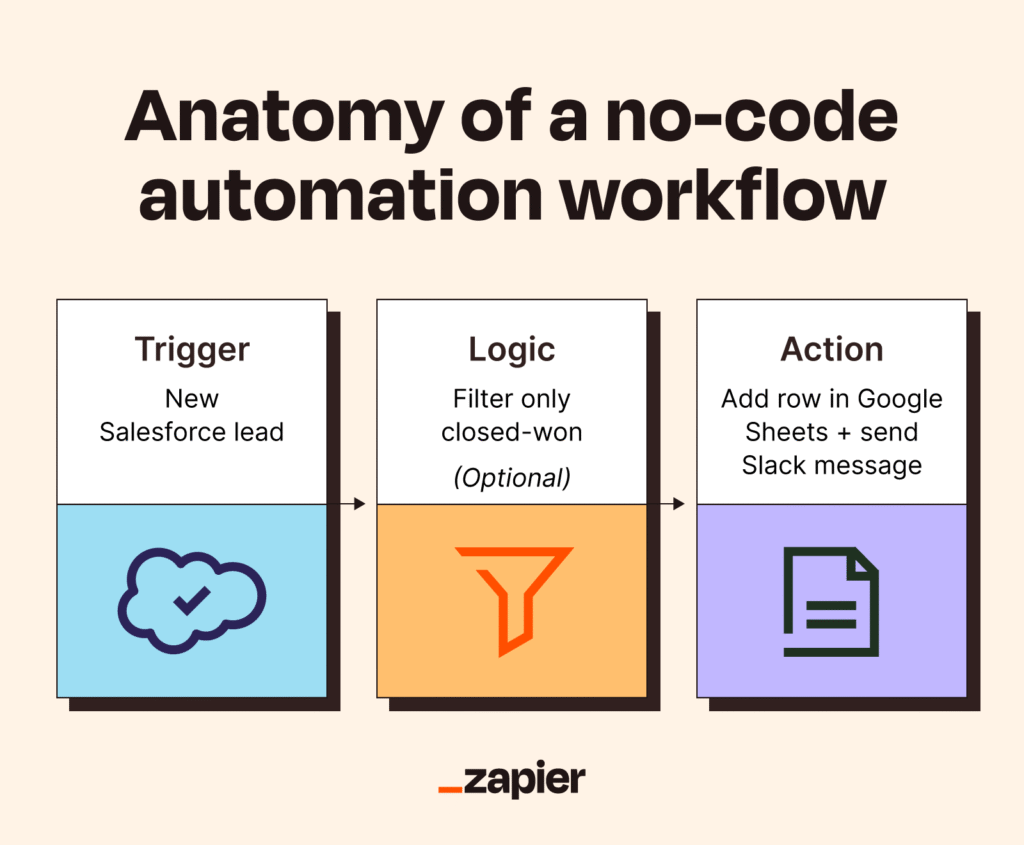
Visual workflow builders are a defining feature of no-code workflow automation platforms. These interfaces allow users to map processes as graphical elements rather than writing code. A typical visual builder represents workflows as sequences of triggers, actions, and conditions.
For example, a workflow might begin with a trigger such as a task status change, followed by actions like assigning a team member, sending a notification, or updating a database record. Platforms like monday.com offer intuitive automation builders that let users define workflows through simple logic statements, often with pre-built templates that can be customized for specific use cases.
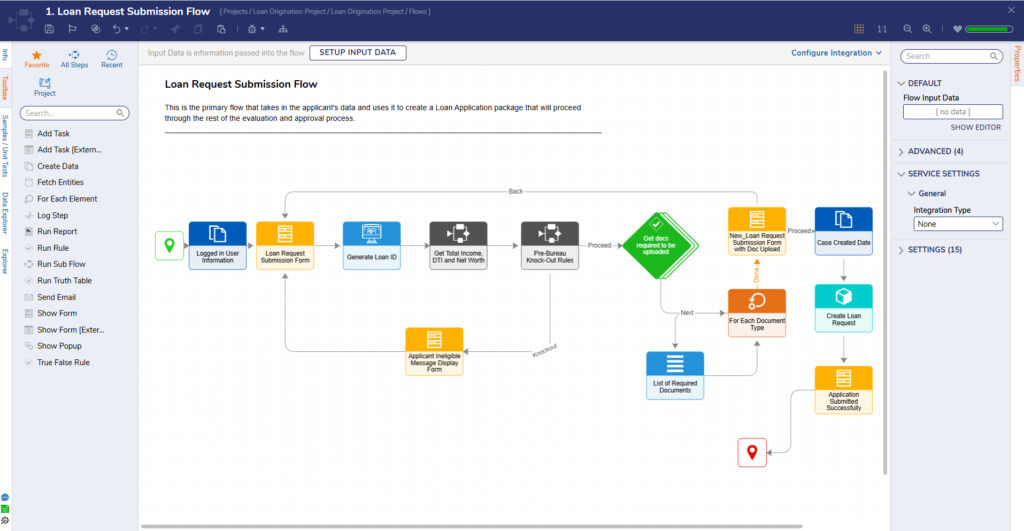
The primary advantage of visual builders is accessibility. Users can view the entire workflow structure at a glance, making it easier to identify inefficiencies and optimize processes. This transparency also improves collaboration, as team members can understand and contribute to workflow design without technical expertise.
Research by ScienceDirect in human-centered system design suggests that visual representations enhance comprehension of complex systems and reduce error rates. By making workflows visible and interactive, no-code workflow automation platforms transform process design from documentation into execution.
3. No-Code Workflow Automation Through Modular Recipes and Integrations
Automation recipes are another cornerstone of no-code workflow automation. These pre-defined logic templates allow users to implement common workflow patterns instantly. A typical recipe might specify that when a task is marked complete, a notification is sent to the manager, and the next task is automatically assigned. Users can layer multiple recipes to construct sophisticated, multi-step workflows.
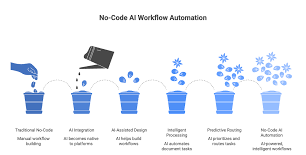
This modular approach simplifies process design significantly. Instead of building workflows from scratch through code, users assemble them from reusable components. This reduces development time and promotes consistency across the organization. Research by the World Journal of Advanced Research and Reviews on modular systems confirms that reusable components enhance scalability and adaptability, enabling organizations to evolve their workflows as requirements change.
Modular automation is especially valuable at enterprise scale. Organizations managing diverse processes across multiple departments with varying requirements benefit from a standardized foundation that can be tailored to each context.
Integrations extend this value further. No-code workflow automation platforms connect with third-party applications, including CRM systems, communication platforms, and analytics dashboards, enabling workflows that span multiple systems and deliver continuous, end-to-end process coverage. At Creative Bits, we architect workflows to leverage modular automation, balancing standardization with the flexibility each team needs.
4. Governance, Scalability, and the Risks of No-Code Workflow Automation
For all its advantages, no-code workflow automation introduces new challenges that organizations must address proactively. As more users gain the ability to build workflows, ensuring consistency, security, and scalability becomes critical.
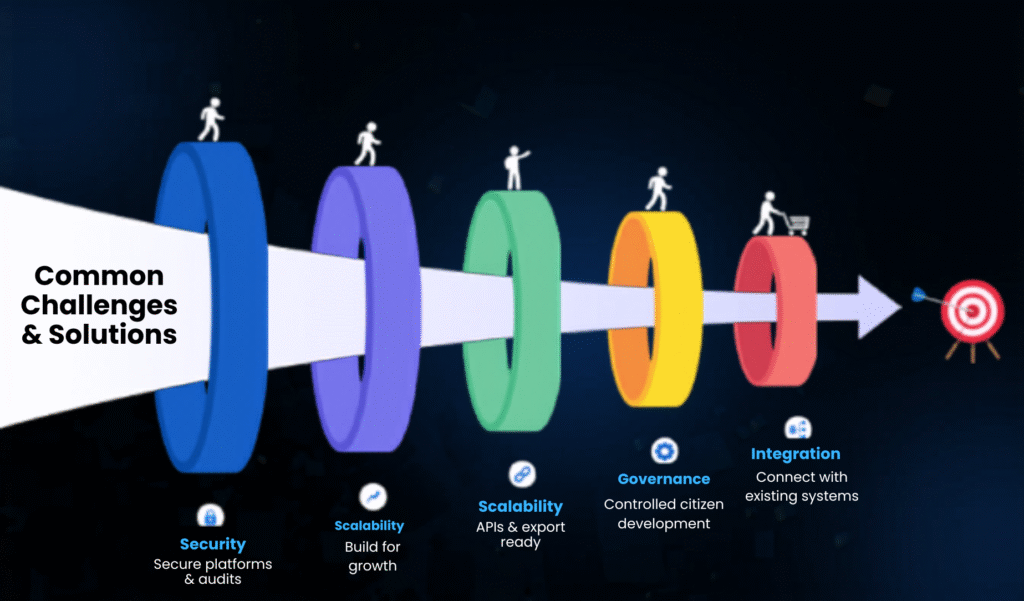
Workflow fragmentation is a primary risk. Without governance, different teams may create overlapping or conflicting processes, leading to inefficiency and confusion. Organizations should establish clear guidelines covering naming conventions, documentation standards, and approval workflows for new automations.
Scalability requires equal attention. Workflows that perform well at a small scale can degrade under increased volume. Organizations need to design automation systems that handle growth without sacrificing performance.
Security and compliance also demand focus. Automated workflows often involve sensitive data and system integrations. Proper access controls and data protection measures are non-negotiable. Research on digital governance emphasizes that decentralized systems require structured oversight to remain effective and secure.
At Creative Bits, we advocate a hybrid approach to no-code workflow automation: empowering teams to build workflows independently while maintaining centralized governance to ensure alignment, quality, and compliance.
5. Real-World Impact: How No-Code Workflow Automation Delivers Enterprise Results
The organizations succeeding with no-code workflow automation in 2026 share common traits. They treat automation as a business strategy, not a technology project. They invest in training their teams to design effective workflows. And they balance the speed of decentralized process design with the discipline of centralized governance.
The measurable outcomes include faster time-to-implementation for new processes, reduced dependency on IT for routine workflow changes, improved cross-departmental collaboration through transparent process design, and the ability to continuously iterate and optimize without development cycles.
These results compound over time. Teams that own their workflows respond faster to changing market conditions, identify process inefficiencies sooner, and deliver better outcomes for their organizations.
Democratizing No-Code Workflow Automation Without Losing Control
No-code workflow automation represents a fundamental shift in how enterprises design and manage processes. It enables business users to build workflows without IT dependency, delivering greater agility, faster response times, and a culture of continuous improvement.
But success depends entirely on implementation. Visual workflow builders and automation recipes are powerful tools, but they must be supported by clear governance, strategic design, and organizational commitment.
The enterprises that will lead in 2026 are not simply adopting no-code tools. They are integrating them into a cohesive operational framework that balances speed with structure.
At Creative Bits, we design no-code workflows that are scalable, efficient, and business-driven. The future of work is not merely automated. It is intelligently crafted.