monday.com Services
Which AI Application Development Services Actually Reach Production?
Gartner found that only 48% of AI projects reach production, and the typical journey from prototype to live takes about eight months.
That number should shape how you buy AI application development services. Not the demo, not the model, whether the thing ships. More than half of AI work dies somewhere between a working prototype and a system people use, and the reasons are consistent enough to plan around.
Here's the full AI application development lifecycle, where projects die, and what separates the half that make it.
What Are the Key Steps in AI Application Development, from Strategy and Planning to Deployment?
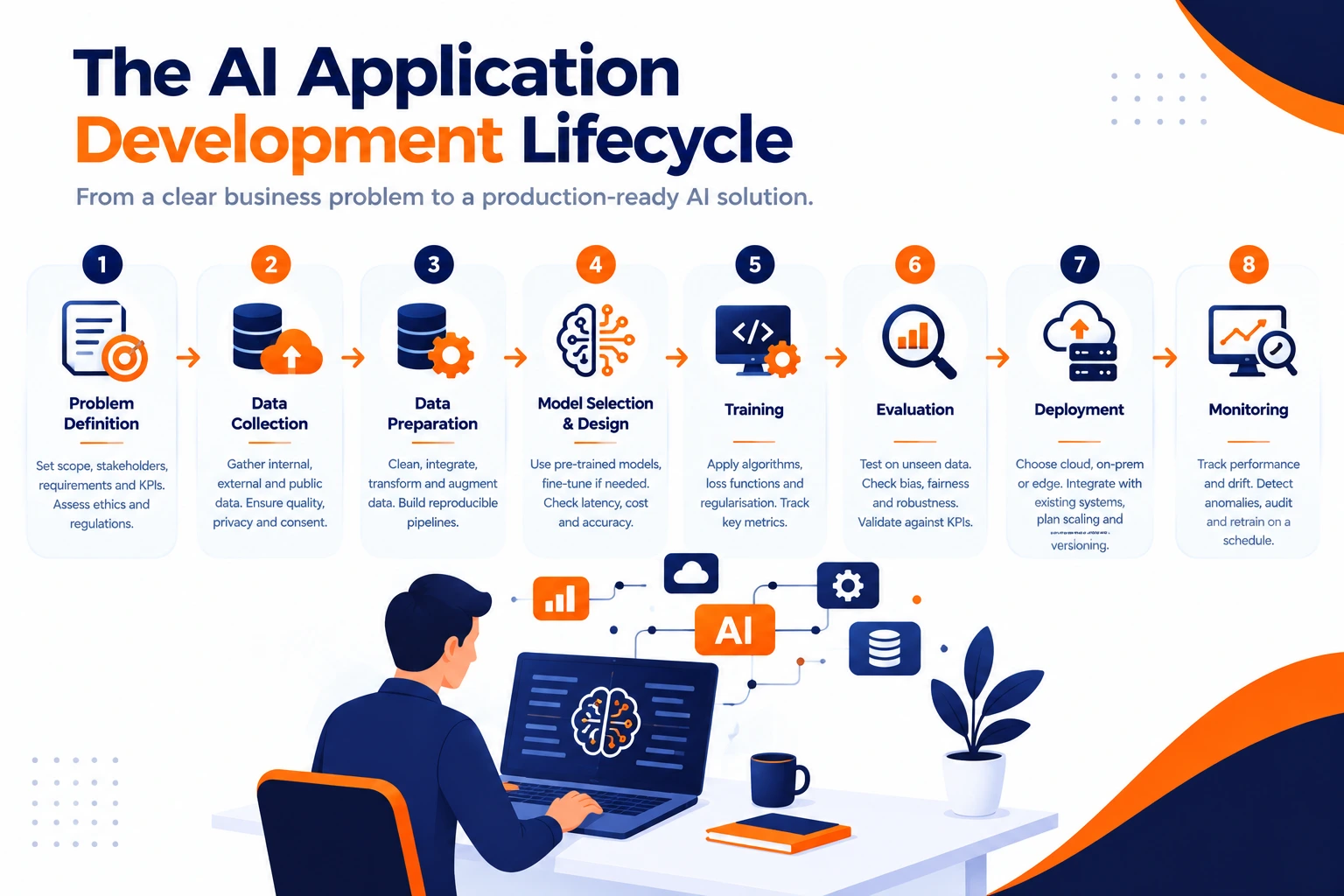
Published lifecycles vary in wording but converge on eight stages. Credible AI application development services follow all of them.
- Problem definition. Scope, stakeholders, requirements, feasibility, and measurable KPIs. Ethical impact and regulatory obligations assessed now, not later. Define what success looks like at launch and at 90 days.
- Data collection. Identify and acquire from internal, external, and public sources. Label where needed, assess quality, and establish governance, privacy, and consent practices.
- Data preparation. Clean, integrate, transform, augment, and version inside reproducible pipelines. Published guidance consistently calls this the most time-consuming phase of AI application development.
- Model selection and design. Start with pre-trained models and fine-tune only when necessary. Measure latency, cost, and accuracy on representative samples before committing—Prioritise interpretability.
- Training. Suitable algorithms, loss functions, and regularisation, with checkpoints saved and metrics tracked: accuracy, precision, recall, F1.
- Evaluation. Test on genuinely unseen data. Cross-validate, check bias and fairness across groups, test robustness against adversarial inputs, and send the model back if it misses the KPI.
- Deployment. Choose cloud, on-premises, or edge. Containerise, serve through an API, integrate with existing systems, plan scaling, and manage versions with working rollbacks.
- Monitoring. Track performance and drift, detect anomalies, audit for compliance, retrain on a schedule.
A practical scoping rule worth borrowing: limit the first release to two to four AI features. AI application development services that scope a platform rather than a feature set are the ones still in prototype at month twelve.
What Are the Different Stages of Artificial Intelligence Development?
Two different questions get confused here, and separating them matters when you are evaluating AI application development services.
Capability stages describe how advanced the technology is. The common framing is three:
- Narrow AI (ANI), excellent at one defined task. Everything commercially available today.
- General AI (AGI), human-level competence across arbitrary domains. Not available.
- Super AI (ASI), beyond human capability. Hypothetical.
Some frameworks expand this to include reactive machines (no memory) and limited-memory machines (use recent data to inform decisions). Published versions differ, so treat any specific count as one convention rather than settled fact.
So what stage of AI development are we in? Limited-memory narrow AI, firmly. Everything your business can buy or commission does one defined job using recent context. Any vendor implying their AI application development services deliver general intelligence is selling a story.
That's not a practical limitation. Narrow AI applied to a specific, high-volume business problem is where nearly all measured value comes from today.
What Are the 5 Highest-Value AI Applications in Business?
Published AI application development deployments cluster around five patterns, ordered by how reliably they pay back.
- Document and data extraction. Unstructured input- invoices, contracts, forms, emails- is converted into structured fields that feed existing rules: highest reliability, shortest payback, and the most common first project.
- Classification and routing. Support tickets triaged, leads scored, requests routed to the right person automatically.
- Prediction and forecasting. Demand, churn, equipment failure, fraud. Supervised learning on data you already hold.
- Conversational interfaces. Support and self-service grounded in your own documentation rather than general web content.
- Content and code generation with human review. Drafts, summaries, documentation, tests- people edit rather than produce.
The common thread across all five: they automate a high-volume task where someone currently reads something and decides what happens next. That's the pattern good AI application development services look for first, and the reason they ask about your processes before your preferred model.
What Does It Take to Get an AI Application Into Production?
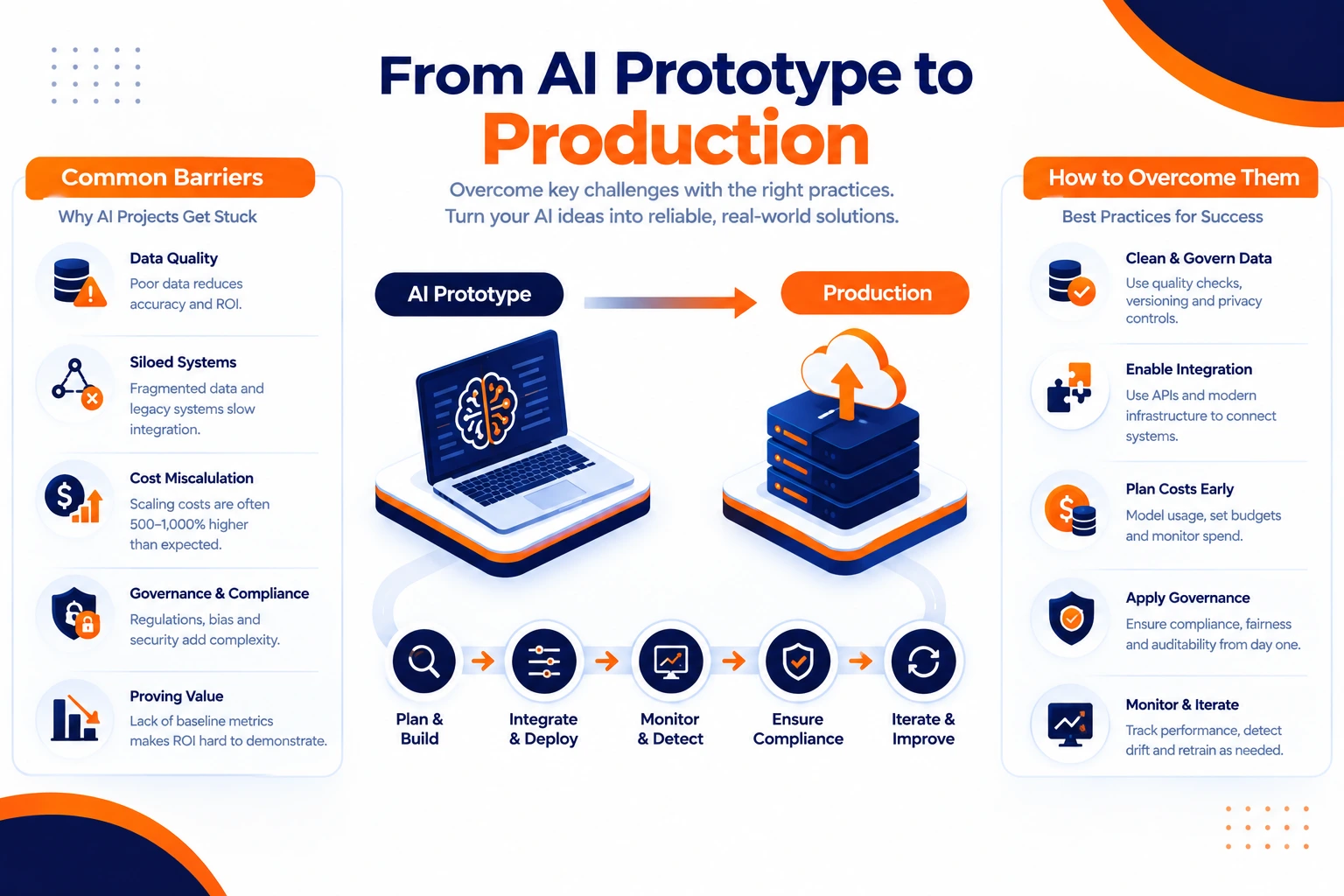
This is where the 48% figure gets decided, and the barriers to AI application development are well documented.
Demonstrating value. The single biggest obstacle, cited by 49% of surveyed organisations. Capture baseline numbers before anything launches, or you can't prove the return, however well the model performs.
Data quality. Poor data significantly reduces ROI, and no amount of model sophistication compensates.
Siloed systems. Legacy infrastructure and fragmented data slow integration, consistently the longest pole in any AI application development project.
Cost miscalculation. Gartner notes cost estimation errors as high as 500–1,000% when scaling is poorly understood. Worth sitting with: an AI application that costs what you expected at pilot volume can cost ten times that in production.
Governance gaps. Forrester found fewer than 34% of organisations had implemented AI governance at all.
What the successful half of AI application development projects do differently:
- Containerise and version so models move consistently between environments
- Serve through APIs with scaling and latency controls
- Monitor accuracy, latency and resource use, with drift detection and automated rollback
- Automate evaluations and run them on every model change, treating metrics as alerting signals rather than launch checks
- Gate production deploys behind human review and log every action for auditability
- Apply FinOps practices to control spend and governance at platform level rather than per application
Mature AI application development services build failure recovery deliberately, retries, fallbacks, human escalation, and test those paths as rigorously as the happy path.
Can You Learn AI App Development Yourself?
Partly. The honest split in AI application development is clear.
What you can learn quickly. An AI app development course can cover the fundamentals in weeks, and low-code and no-code builders let non-developers ship a working AI feature. Plenty of AI app development free tiers exist for prototyping, and pre-trained models mean nobody has to train from scratch anymore. For a single feature on top of an existing model API, this route genuinely works.
What still needs help. Data pipelines and governance. Integration with legacy systems that lack APIs. Anything with a compliance obligation attached. Production monitoring, drift detection and retraining. Cost modelling at scale: the 500–1,000% error range is not a beginner mistake; it catches experienced teams.
A useful technique before committing either way: build the same small app on two shortlisted platforms. Integration friction that feature comparisons hide shows up immediately.
The practical answer for most businesses: prototype in-house to prove the idea is worth building, then bring in AI application development services for the data, integration, and governance work, which is where the eight months and the 52% failure rate actually live.
Scope Small, Measure First
Pick one high-volume decision. Define success in numbers. Capture the baseline. Limit the first AI application development release to a handful of features, and build monitoring in from day one rather than after launch.
Creative Bits maps the process before the tooling, the order that keeps AI application development out of the half that never ships. Process mapping, build, real-world testing.