monday.com Services

What Do Generative AI Development Services Really Cost in 2026?
One documented app went from roughly $2,000 to $20,000 a month in compute, same app, just more use.
That tenfold jump is what makes generative AI development services priced differently from ordinary software. The build is a known quantity. The running cost scales with usage, and without quotas and caching, it climbs fast enough to break a budget nobody revisited.
So here's an honest breakdown of generative AI development costs: what builds cost, what drives the number, what each model strategy costs, and what you will pay every month.
All figures below are published market ranges from industry sources, not quotes. Treat them as orientation.
How Much Does Generative AI Development Cost?
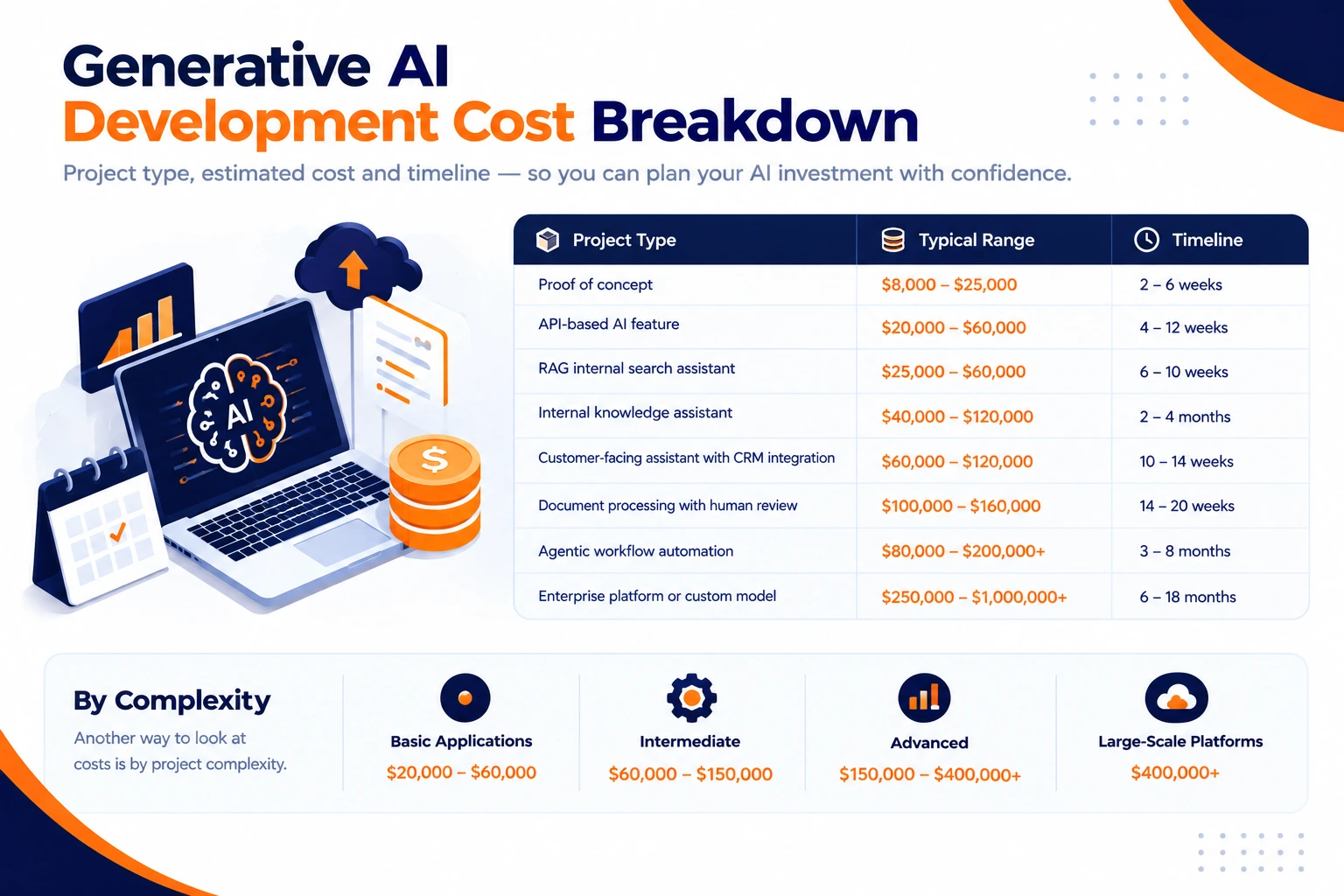
Published ranges for generative AI development services are reasonably consistent by project type.
| Project type | Typical range | Timeline |
| Proof of concept | 8,000–25,000 | 2–6 weeks |
| API-based AI feature | 20,000–60,000 | 4–12 weeks |
| RAG internal search assistant | 25,000–60,000 | 6–10 weeks |
| Internal knowledge assistant | 40,000–120,000 | 2–4 months |
| Customer-facing assistant with CRM integration | 60,000–120,000 | 10–14 weeks |
| Document processing with human review | 100,000–160,000 | 14–20 weeks |
| Agentic workflow automation | 80,000–200,000+ | 3–8 months |
| Enterprise platform or custom model | 250,000–1,000,000+ | 6–18 months |
One useful reality check: across a sample of verified providers, the median average project size came out around $26,300, with median minimums near $3,200. Most generative AI development services engagements are considerably smaller than the enterprise figures that dominate published guides.
By complexity rather than type: basic applications 20,000–~$ 60,000, intermediate 60,000–~$ 150,000, advanced 150,000–~$ 400,000+, and large-scale platforms beyond that.
What Drives Generative AI Pricing Up or Down?
Seven factors move generative AI development pricing, and the first dominates.
Data readiness. Data engineering can consume 30–50% of total project cost. Clean, accessible, well-governed data is the biggest lever on your generative AI development budget, and no model choice can compensate for its absence.
Scope depth. More departments, more languages, more workflows. Each integration into your existing stack typically adds 5–10% to a generative AI development quote.
Model strategy. Hosted API, fine-tuned, or custom-trained. The next section covers the cost of each.
Compliance and security. Regulated work adds audit trails, consent handling, and encryption; published estimates put this at roughly 10–25% extra. Healthcare, fintech, legal, and government all carry it.
User volume and latency targets. Token volume, concurrency, and response-time expectations drive ongoing generative AI development spend more than build cost does.
Team model. Published international rates run roughly 25–$ 75 per hour depending on seniority and region, versus a US median of around $65 per hour before benefits and overhead. One worked example put 960 engineering hours at 33,600–48,000 offshore versus around $96,000 onshore.
Pricing structure. Fixed-price, time and materials, dedicated team, usage-based, and outcome-based arrangements all change the final figure for identical work. Ask which one any generative AI development services proposal uses before comparing it to another.
Build, Buy or Fine-Tune: What Does Each Path Cost?
The generative AI development ladder, cheapest first. Most projects should stop lower on it than they think.
Hosted API, prompt engineering only. Lowest build cost, variable token fees. Covers a surprising share of real business needs and is where every project should start.
RAG, retrieval over your own documents. Published implementation cost of roughly 20,000–100,000 as a component. This is the cost-efficient default for anything knowledge-based, and it handles proprietary data without training anything.
Fine-tuning. Added to other work, roughly 30,000–80,000 and about three months. Published figures for fine-tuning a large language model run 20,000–200,000+ depending on scope. Justified when tone, format or domain language genuinely matters and prompting can't get there.
Custom-trained model. Highest upfront cost, most control. Published model training cost ranges from a few thousand dollars for simple models to millions for frontier systems, with some reportedly exceeding $100 million.
The honest guidance from every source: nobody should be training from scratch for an ordinary business problem. If a generative AI development services proposal is priced as though it requires custom training for document classification, ask exactly what requires it.
For comparison, AI SaaS pricing for per-seat generative tools sits far below any of this. If your problem is standard, that's the recommendation.
What Will It Cost to Run Every Month?
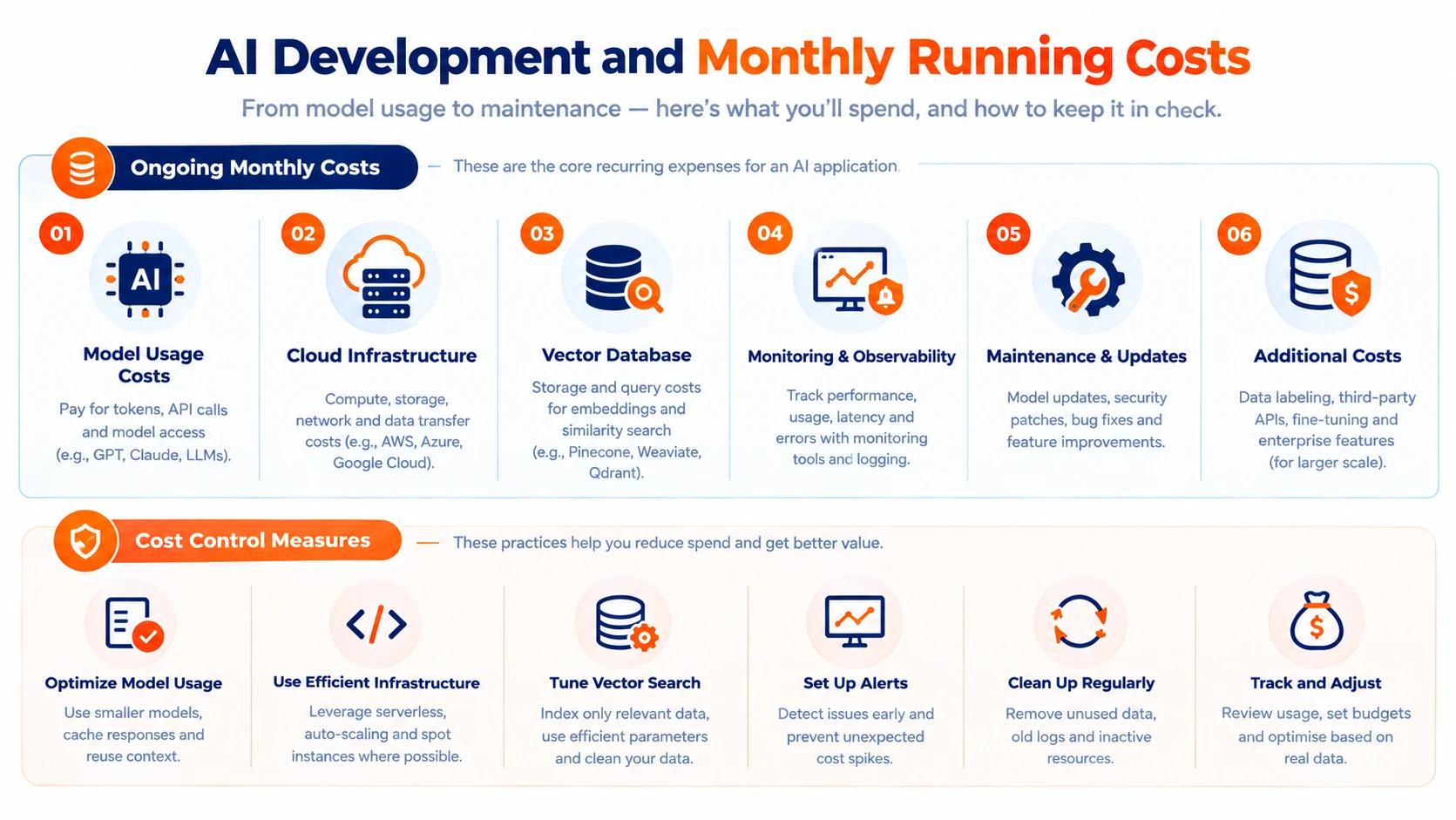
Running cost is where generative AI development differs most from conventional software, and where budgets break.
Model usage. Billed per million input and output tokens. At 100,000 queries a month, published October 2026 list prices worked out at roughly $215 on a small model, around $1,100 on a mid-tier model, and about $2,200 on a top-tier one. Same workload, ten-fold spread, model selection is a cost decision, not just a quality one.
Infrastructure and vector database. Free tiers exist, rising to 50–500 monthly minimums.
Monitoring and evaluation. Roughly 200–800 a month.
Maintenance and retraining. 15–30% of initial build cost annually. One enterprise example reported around 25%. Other analyses put general AI maintenance at 10–25% of total project expenses.
Altogether, a typical mid-sized internal assistant runs around 500–2,000 monthly. But recall the opening figure: an app serving 10,000 queries a day went from about $2,000 to $20,000 monthly in compute. Quotas, caching and response reuse aren't optimisations; they're budget controls.
How Do You Build a Realistic AI Development Budget?
Most tools marketed as AI development cost calculators only model the build, the part that doesn't surprise anyone. Build your own figure instead.
Published generative AI development line items for a mid-sized build:
- Discovery and feasibility: 4,000–15,000
- UX and service design: 5,000–40,000
- Data engineering and pipelines: 10,000–80,000
- App and API development: 15,000–100,000
- Infrastructure and compute: 5,000–50,000+
- Testing, QA, and security: 5,000–25,000
- MLOps and monitoring: 10,000–40,000
- Launch and maintenance: 5,000–$ 25,000+
Then add three years of running costs at your realistic query volume, plus annual maintenance at 20% of build, plus the compliance premium if it applies.
Set that total against hours saved multiplied by loaded hourly cost, annualised. If payback lands beyond 24 months, scope smaller. That calculation, not a vendor's calculator, turns generative AI development services into a decision rather than a hope.
Get a Real Number Before You Commit
Start with a proof of concept at the 8,000–25,000 end of generative AI development. Prove the value on real data. Capture baseline numbers before anything launches, because without them, you can't prove the return at any price.
Creative Bits scopes from your process rather than from a tier list: process mapping, build, real-world testing, in that order.