monday.com Services
The AI handoff problem is the quiet reason most enterprise AI workflows fail to deliver the ROI they promised. By now, every operations leader has heard the pitch. Deploy AI to handle the repetitive work. Free your team for higher-value tasks. Watch productivity climb. And yet, according to McKinsey's State of AI 2025 report, only a small percentage of enterprises have seen meaningful enterprise-wide bottom-line impact from generative AI investments, despite widespread adoption.
The model isn't broken. The handoff is.
In 2026, the conversation about enterprise AI has shifted. The question is no longer "do we have AI?" Every organization does. The question is "Why does our AI still need so much human babysitting?" That gap, the space between what AI completes on its own and what it kicks back to a person, is where productivity quietly leaks. It is where the promised cost savings dissolve, where adoption stalls, and where leadership starts to wonder if the AI investment was worth it.
This is the AI handoff problem, and it is the next major operational challenge for mid-market enterprises. In this article, we break down the 6 most common friction points where AI workflows hand work back to humans, why each one happens, and how to redesign them so your AI investment actually scales.
Why the AI Handoff Problem Is the Defining Operational Challenge of 2026
For most of 2024 and 2025, enterprises focused on building AI capability. They piloted models. They tested copilots. They added Gen AI features to existing workflows. The result is that nearly every business operation today has some AI in it, summarizing tickets, drafting replies, classifying documents, predicting churn, or generating content.
But capability is not continuity.
When an AI workflow can complete 90% of a task on its own, the remaining 10% often consumes more human attention than the original manual process did. Why? Because exceptions are harder than rules. Edge cases require judgment. And every time an AI workflow pauses to ask a human, "What should I do here?", you have introduced a handoff, and every handoff is a cost. This is closely related to a concept we've explored before in our analysis of Automation Debt and the hidden costs of "timesaving" workflows.
The AI handoff problem is structural. It is not about model performance. It is about workflow design. And until operations leaders treat it as such, AI ROI will continue to underperform expectations.
The 6 Friction Points Where AI Workflows Hand Work Back to Humans
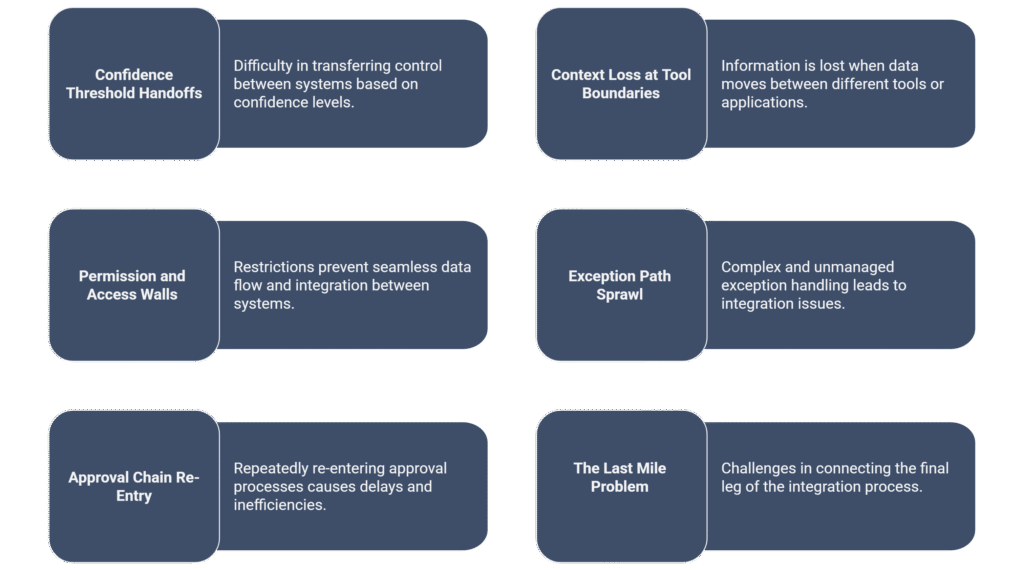
Below are the six most common handoff friction points we see across enterprise AI deployments, along with how to address each one.
1. Confidence Threshold Handoffs
The most common handoff happens when an AI system is configured to escalate anything it is not "confident" about to a human reviewer. On paper, this sounds responsible. In practice, it often means 30% to 50% of cases get routed to humans, even when the AI's tentative answer would have been correct.
This happens because confidence thresholds are usually set conservatively at launch and never tuned afterward. Teams are afraid to raise the threshold because no one wants to be the person who lets a wrong answer through. So the AI keeps escalating, and humans keep clearing the queue. Research from Stanford's Human-Centered AI Institute consistently shows that calibration of human-AI confidence thresholds is one of the most underinvested levers in enterprise AI performance.
The fix: Treat confidence thresholds as living parameters. Run monthly reviews of escalated cases. Identify the patterns where the AI was right but escalated anyway. Gradually raise the threshold for those categories. Most enterprises can reduce confidence-based handoffs by 40% to 60% within a quarter, without measurable accuracy loss.
2. Context Loss at Tool Boundaries
Your AI summarizes a customer call. Excellent. But the summary lives in the call platform, not in the CRM, not in the ticketing system, and not in the account manager's inbox. So a human still has to copy the summary, paste it into the right system, tag it correctly, and route it to the right owner.
This is context loss at tool boundaries, and it is one of the most overlooked AI handoff problems. The AI did the work. The handoff failed because the systems do not talk to each other.
The fix: Audit every AI workflow for the moment it crosses from one tool to another. That is your handoff risk point. Use integration platforms like Make, n8n, or Zapier, or native APIs, to push AI outputs directly into the system where the next action happens. We've covered the broader architectural principle in The 4-Layer Integration Stack framework, which addresses how to build systems that don't break at tool boundaries.
3. Permission and Access Walls
An AI agent is supposed to update a record, send an email, or close a ticket, but it does not have permission to do so. So it stops, generates a notification, and asks a human to complete the action. The human reads the AI's recommendation, logs into the system, and does what the AI was supposed to do.
This is one of the most expensive handoffs because it duplicates the work. The AI did the analysis. The human re-did the execution.
The fix: Provision AI agents with the same access rights as the human roles they replace. This requires partnership between operations, IT, and security, and it requires a clear AI governance policy. The NIST AI Risk Management Framework provides a useful structure for defining agent permissions in a way that's both auditable and secure. Most enterprises underestimate how much of their "AI workflow" is actually a human pasting AI outputs into systems the AI was never given access to.
4. Exception Path Sprawl
When an AI workflow is first designed, the happy path is clear. But as it runs, edge cases surface. Each one gets its own "if this, then escalate" rule. Over time, the exception paths multiply, and the proportion of cases that route to humans grows quietly but relentlessly.
We call this exception path sprawl. It is the AI version of automation debt, and it is one of the most predictable patterns we see in mature AI deployments. A workflow that started at 95% automation drops to 70% within a year, simply because exceptions were never consolidated or re-automated. This is structurally similar to the workflow bottleneck patterns we identified in past project history data, which are predictable if you know where to look.
The fix: Run a quarterly exception review. Identify the top 5 exception types by volume. For each one, decide whether to (a) re-automate it with a refined rule or model, (b) merge it back into the main path, or (c) deprecate it because it no longer occurs. Without this discipline, exception paths will eat your AI ROI.
5. Approval Chain Re-Entry
The AI drafts the proposal. The AI prices the deal. The AI generates the customer reply. But before any of it reaches the customer, a human has to review, approve, and send. And often, a second human has to approve after the first. And sometimes a third, depending on the deal size.
This is approval chain re-entry, and it is where AI productivity gains often go to die. The AI compressed a four-hour task into four minutes. But the approval chain still takes three days. We've quantified the cost of these stalls in Decision Fatigue Economics: How Approval Bottlenecks Cost Your Business Every Day.
The fix: Rethink approval thresholds in the AI era. If the AI is consistently producing approval-ready outputs, raise the auto-approval threshold for low-risk categories. Reserve human approval for cases that genuinely require judgment, escalation, or strategic input. The goal is not to remove humans from approvals. The goal is to remove them from approvals that no longer require human thought.
6. The Last Mile Problem
AI completes 95% of the workflow. The final 5%, the actual action, sending the email, posting the deal, closing the ticket, publishing the content, almost always requires a human click. Not because the AI cannot do it, but because no one ever updated the workflow to let the AI finish.
This is the last mile problem, and it is the most psychological of all AI handoffs. Teams are comfortable letting AI think. They are less comfortable letting AI take the final action. So they leave a manual step at the end, "just to be safe."
The fix: Distinguish between "needs human judgment" and "feels safer with a human in the loop." The first is legitimate. The second is friction disguised as control. Anthropic's guidance on building with AI agents emphasizes designing for end-to-end task completion on reversible actions, while preserving human review for irreversible or high-stakes ones. For reversible actions (drafts, internal updates, low-risk publishes), let the AI complete the workflow end-to-end. For irreversible actions (external communications, financial transactions, legal commitments), keep the human, but make the approval take seconds, not minutes.
The AI Handoff Audit: A 4-Step Framework for Diagnosing Workflow Leaks
Identifying handoffs is one thing. Fixing them systematically requires a framework. At Creative Bits, we use a four-step AI Handoff Audit to help operations teams diagnose where their workflows are leaking ROI. This builds on our broader work helping enterprises implement AI agents for 24/7 project coordination.
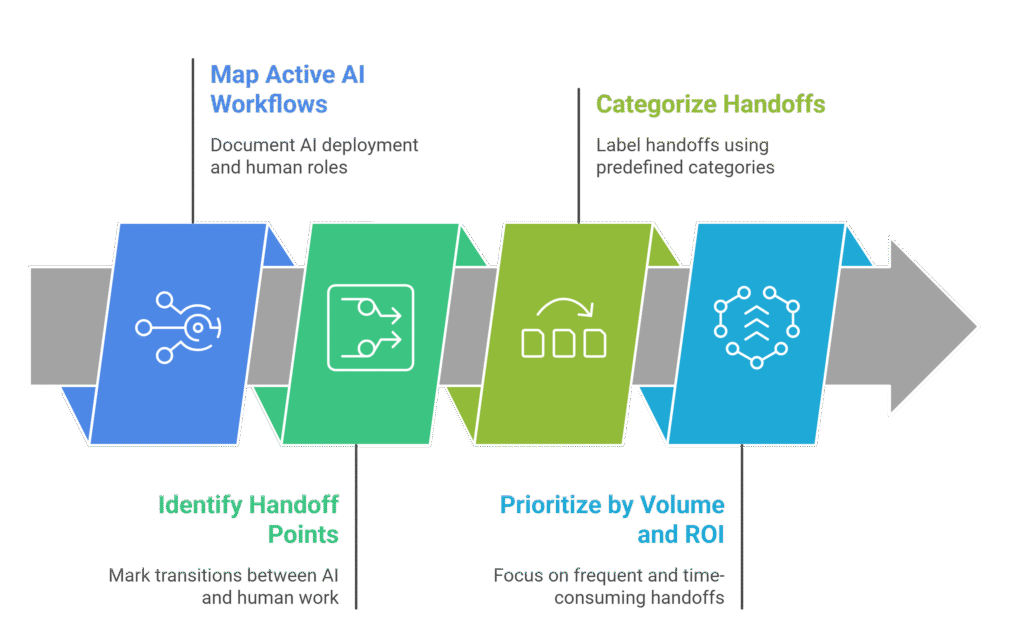
- Step 1: Map every active AI workflow. Document where AI is currently deployed, what it does, and what the human's role is in each workflow.
- Step 2: Identify every handoff point. For each workflow, mark every moment when work transitions from AI to human or human to AI. These are your friction points.
- Step 3: Categorize each handoff. Use the 6 categories above (confidence threshold, context loss, permission walls, exception sprawl, approval re-entry, last mile) to label each handoff. This reveals where your patterns concentrate.
- Step 4: Prioritize by volume and ROI. Not every handoff is worth fixing. Focus on the ones that occur most frequently and consume the most human time. These are where your ROI recovery is highest.
A typical AI handoff audit takes 2-4 weeks for a mid-market enterprise and surfaces somewhere between 8 and 20 fixable handoffs across the workflow portfolio. Most organizations find that addressing just the top 3 reduces human touch time on AI workflows by 25%-40%.
What This Means for Mid-Market Enterprise Operations
The AI handoff problem is not a sign that AI is overhyped. It is a sign that AI workflows were designed for a moment, the moment of capability, rather than for a sustained operating model.
In 2024, the strategic question was "where can we apply AI?" In 2026, the strategic question is "where are our AI workflows still depending on humans, and is that dependency necessary or accidental?"
The enterprises that pull ahead in the next 18 months will not be the ones with the most AI. They will be the ones whose AI workflows have the fewest unnecessary handoffs and the highest sustained automation rates over time. That is where compounding ROI lives. Gartner's enterprise AI research consistently flags workflow integration and process redesign, not model selection, as the leading determinants of AI value realization.
Treating AI handoffs as a discipline (auditing them, classifying them, eliminating the unnecessary ones, and protecting the legitimate ones) is what separates enterprises whose AI investments grow more valuable over time from enterprises whose AI investments quietly plateau.
The Takeaway
AI doesn't fail at the model. It fails at the handoff.
Every workflow has friction points where AI hands work back to humans. Some are necessary. Most are accidental, the byproduct of cautious launch settings, disconnected systems, or workflows that were never finished. The job of an operations leader in 2026 is to know which handoffs are which and to systematically reduce the accidental ones.
That is how AI investment compounds. That is how productivity actually shifts. And that is the conversation enterprises should be having right now, before another year of "we have AI" turns into another year of "but it didn't move the needle."
Are you ready to find the handoffs costing your operations the most?
At Creative Bits, we help mid-market enterprises run AI Handoff Audits across their workflow portfolios, identifying where human touch points can be eliminated, refined, or restructured to recover the ROI your AI was supposed to deliver. Learn more about our AI Development & Solutions services.