monday.com Services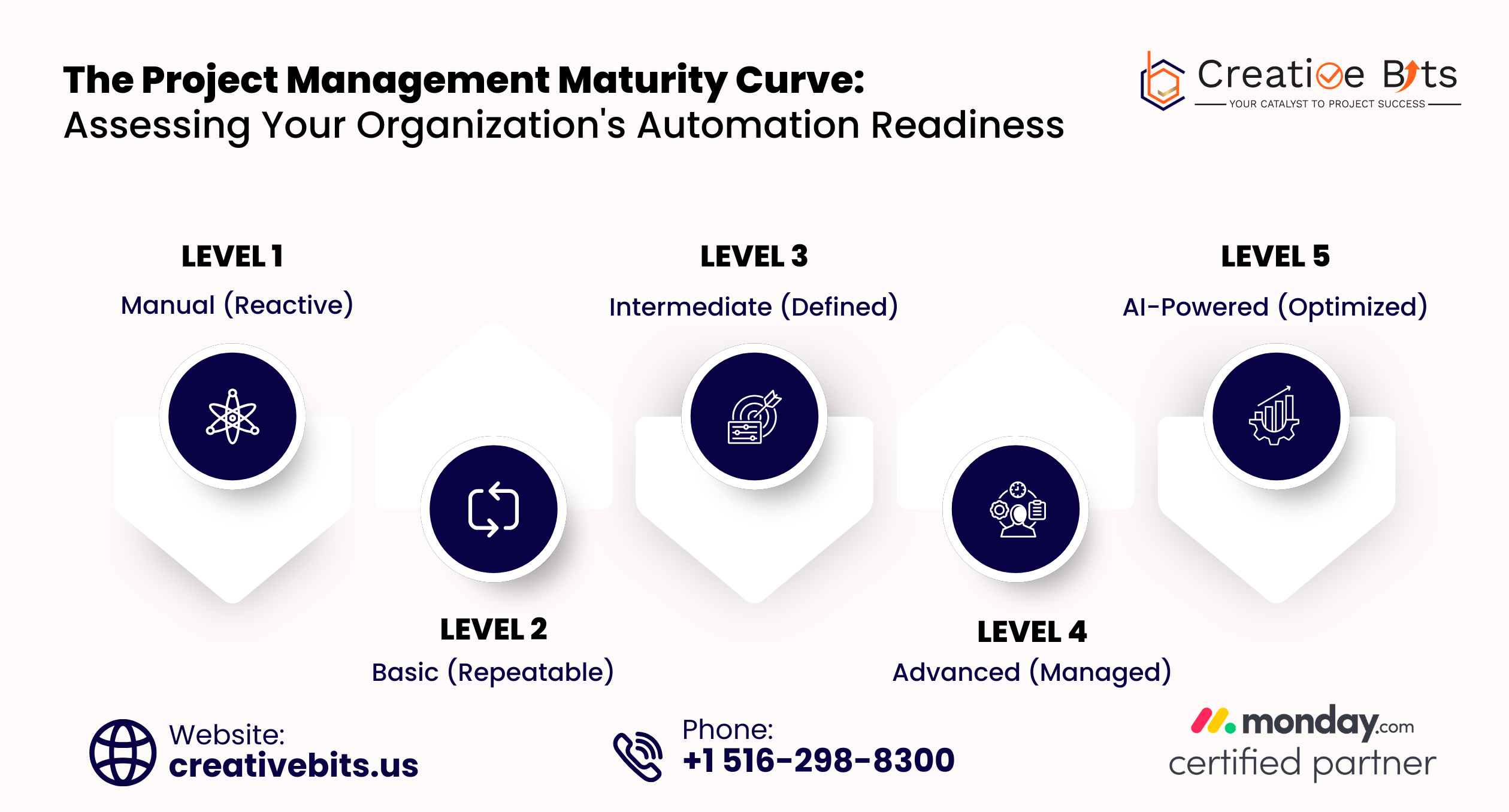
Project management maturity is the quiet variable that explains why two companies with the same tools get wildly different results. One runs projects that ship predictably, on budget, with calm teams. The other lurches from fire to fire, drowning in status meetings and missed deadlines, despite owning the same software.
The difference is rarely the tool. It is where each organization sits on the project management maturity curve, and whether they actually know it.
Most maturity frameworks trace back to a single origin. The Capability Maturity Model was developed in 1986 by Carnegie Mellon's Software Engineering Institute, so the US government could measure the capability of its software contractors. Four decades later, the same five-level logic underpins how we assess automation readiness, except the destination has changed. The top of the curve is no longer just "optimized." It is AI-powered.
This article maps the 5 levels of the project management maturity curve, helps you locate your organization honestly, and lays out the roadmap for moving up.
Why Project Management Maturity Matters More in the AI Era
A maturity model is, at its core, a mirror. It is a framework businesses use to self-evaluate their readiness for complex projects, placing each process somewhere on a scale from chaotic to continuously improving.
That mirror matters more now than it used to, because automation amplifies whatever it touches. Automate a mature, well-defined process, and you compound efficiency. Automate a chaotic one,e and you just make the chaos faster. This is why automation readiness cannot be bought with a license. It has to be earned through maturity, one level at a time. As we have written before in our work on Automation Debt, bolting automation onto broken processes creates more cost than it removes.
The 5 Levels of the Project Management Maturity Curve
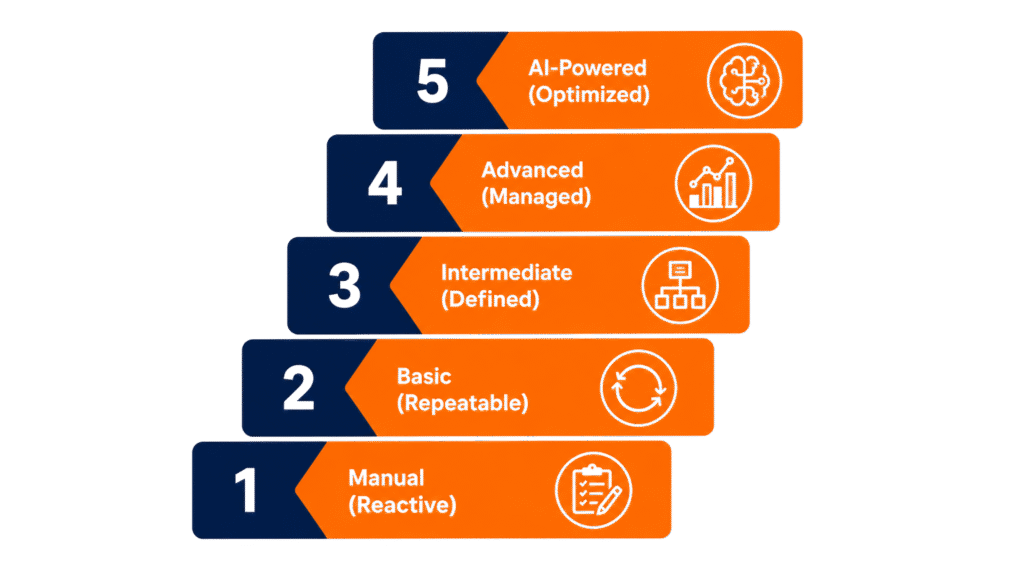
Level 1: Manual (Reactive)
At Level 1, processes are unpredictable and reactive. Work lives in spreadsheets, inboxes, and people's heads. Every project is run from scratch, success depends on individual heroics, and nothing is repeatable. At this awareness stage, processes are unpredictable and reactive.
The automation readiness signal: None yet. The priority here is not automation; it is documentation. You cannot automate what you cannot describe.
Level 2: Basic (Repeatable)
At Level 2, some processes are established but inconsistent. Teams have a few templates and habits that work, but they are applied unevenly across people and projects. Some processes are established, but inconsistency is the defining trait.
The automation readiness signal: Low. You can automate small, isolated tasks (a recurring reminder, a simple form), but the inconsistency limits how far automation can reach.
Level 3: Intermediate (Defined)
Level 3 is the turning point. Processes become standardized, documented, and communicated across the organization. Here, projects are no longer run in a vacuum by individual teams but are seen as part of the bigger picture, on an organizational level, with clear guidelines anyone can follow.
The automation readiness signal: Strong. This is where workflow automation starts delivering real returns, because there are consistent, documented processes worth automating. Standardized intake, approvals, and status updates become genuinely automatable. This is the level where a platform like monday.com, properly structured, stops being a glorified spreadsheet and starts being an operating system.
Level 4: Advanced (Managed)
At Level 4, performance is measured, controlled, and managed systematically. Data, not instinct, drives decisions. To remain efficient, Level 4 organizations use automation to collect and analyze data, keeping project goals and processes in sync with organizational strategy.
The automation readiness signal: High. Automation now spans entire workflows, dashboards update themselves, risks surface automatically, and reporting that once took days happens in real time.
Level 5: AI-Powered (Optimized)
At the top of the curve, continuous improvement and innovation are embedded into how the organization operates. Once an organization reaches Level 5, it deploys almost fully automated processes, and management's main focus shifts to constant improvement. This is also the rarest level. Many organizations never reach it, and those that do become an example to others.
The automation readiness signal: Complete. This is where AI agents do more than execute; they predict delays, recommend resource shifts, and surface insights from past projects before problems occur. It is the difference between automation that runs your workflows and intelligence that improves them.
How to Assess Where Your Organization Actually Sits
Be honest, and be specific. Most organizations are not at a single level; they are at different levels for different processes. Your intake might be Level 2 while your reporting is Level 4.
A quick self-assessment: for each core process (intake, planning, approvals, tracking, reporting, retrospectives), ask three questions. Is it documented? Is it consistent across teams? Is it measured with data? The pattern of yes and no answers reveals your real maturity, and where the gaps are.
One caution worth heeding. Be careful about forcibly increasing maturity, because too much change too fast can grind everything to a halt. Maturity is climbed one level at a time, not skipped.
The Roadmap: Moving Up the Curve
The progression is sequential, and each level unlocks the next.
From Manual to Basic, the work is documentation. Capture how things are actually done. From Basic to Intermediate, the work involves standardization. Turn scattered habits into one consistent, organization-wide process. From Intermediate to Advanced, the work is automation and measurement. Now that processes are defined, automate them and instrument them with data. From Advanced to AI-Powered, the work is intelligent. Layer in AI that learns from your project history to predict and recommend, not just execute.
The mistake most organizations make is trying to jump straight to AI from a Level 2 foundation. It does not hold. AI-powered project management is not a starting point you buy; i t is a maturity you build toward.
What This Means for Your Operations in 2026
The organizations pulling ahead are not necessarily the ones with the most advanced tools. They are the ones who know exactly where they sit on the maturity curve and are deliberately climbing it, one level at a time.
Knowing your level turns vague ambition ("we should use more AI") into a concrete roadmap ("we need to standardize intake before we automate it"). That clarity is what separates automation that compounds value from automation that just adds noise.
The Takeaway
You cannot automate your way out of immaturity. You climb your way into automation readiness.
The project management maturity curve gives you the map: Manual, Basic, Intermediate, Advanced, AI-Powered. Find where you honestly sit, fix the level you are on before reaching for the next, and the path to AI-powered operations stops being hype and starts being a plan.
The tools have never been more capable. The question is whether your processes are ready for them.
Want to know where your organization sits on the maturity curve?
At Creative Bits, we help mid-market enterprises assess their project management maturity and build the roadmap from manual processes to AI-powered operations, including workflow automation and PMaaS through our (PM)² Methodology.