monday.com Services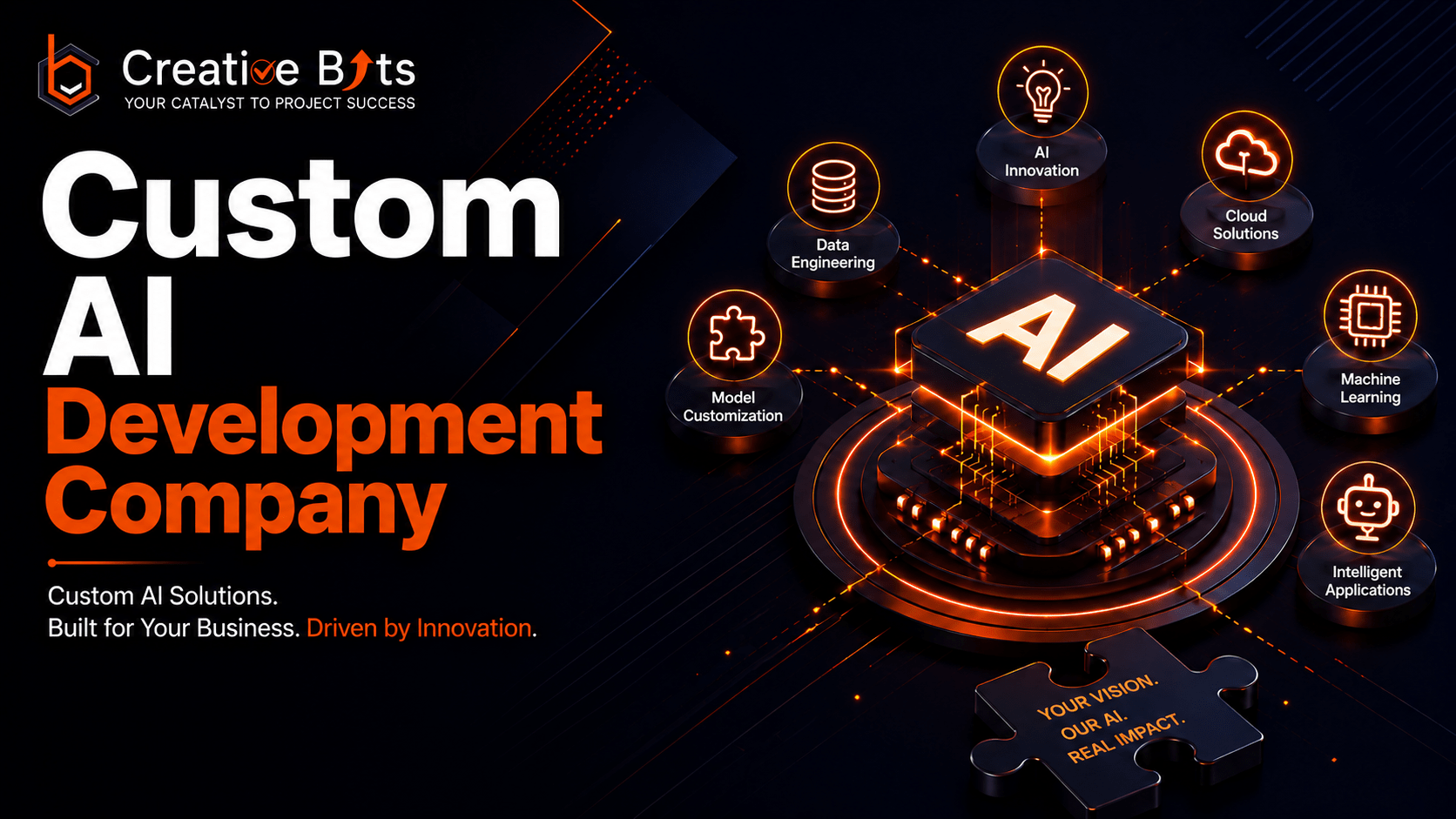
How to Choose the Right Custom AI Development Company in 2026
Every week, another vewndor claims it can "add AI" to your business. Few explain what that means once the sales call ends. If you've started researching a custom AI development company, you've probably noticed the gap this article closes: most guides list random agencies or bury you in jargon.
This piece answers those questions in plain language and shows what separates a genuine AI development partner from a team reselling someone else's API, drawing on our own experience at Creativebits, where AI development sits alongside workflow automation, monday.com implementation, and project-management-as-a-service.
What Is Custom AI Development?
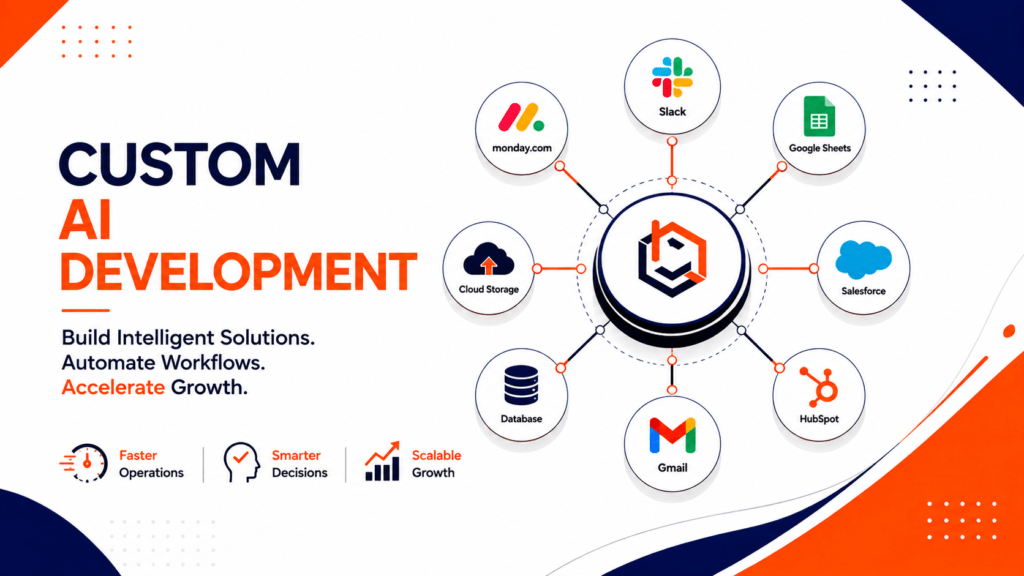
Custom AI development is the process of designing, training, and deploying an AI system built around one company's data, workflows, and goals, instead of a generic tool. A custom AI development company handles the full lifecycle: understanding the problem, preparing data, choosing or fine-tuning a model, building the software, and supporting it after launch. Custom AI development services are built for your terminology, compliance needs, and tech stack, not the average user.
This umbrella includes generative AI applications that draft content or turn unstructured inputs into structured data, AI agents that triage tickets or screen resumes, predictive models that forecast demand or score leads, retrieval-augmented generation (RAG) that lets a model answer from a company's own documents, and automation layers that push AI output into tools teams already use, like monday.com, Slack, or a CRM.
That last point is where most of our AI development work at Creativebits starts. Businesses rarely need an AI system living in isolation; they need it wired into the platforms where work already happens, which is why our AI development solutions plug into automation stacks rather than sit beside them.
Why Businesses Choose a Custom AI Development Company Over Off-the-Shelf Tools
Pre-built AI tools are quick to try and hit a ceiling fast. A generic chatbot doesn't know your return policy; a generic scoring tool doesn't know your risk factors. A custom AI development company solves three problems off-the-shelf software can't: ownership (the model and data pipeline belong to you), fit (the system is configured around your workflows), and integration (custom builds connect to your existing software instead of asking you to work around them).
This is why demand has shifted toward AI development services that bundle automation and systems integration, not just model-building.
What Is the 30% Rule for AI?
The 30% rule for AI shows up in a few related forms. In business, it suggests automating roughly 30% of a process while keeping the remaining 70% under human oversight — AI handles repetitive, lower-risk tasks, people keep the judgment calls. In education, the same rule acts as a ceiling on how much of a finished piece should come directly from AI output. In budgeting, practitioners often allocate around 30% of a project's spend to data quality (cleaning, labeling, governance), since it's usually where inexperienced vendors cut corners first.
What Are the 7 Main Types of AI?
AI gets classified two ways: by capability, and by how it processes information. Together, they make up the seven types most commonly referenced.
| Type | Category | What It Means |
|---|---|---|
| Narrow AI (ANI) | Capability | Built for one task, like spam filtering. Covers nearly every AI product in use today. |
| Artificial General Intelligence (AGI) | Capability | Learns and reasons across tasks at human level. Not yet achieved. |
| Artificial Superintelligence (ASI) | Capability | Hypothetical AI exceeding human intelligence across every domain. |
| Reactive Machines | Functionality | Responds to current input only, with no memory. Early chess engines are a classic example. |
| Limited Memory AI | Functionality | Uses recent data to inform decisions. Most modern ML systems, including generative AI, fall here. |
| Theory of Mind AI | Functionality | Understanding emotions and intent well enough to interact naturally. Still experimental. |
| Self-Aware AI | Functionality | A hypothetical future stage with AI self-understanding. Purely theoretical. |
The practical takeaway is simpler than the table looks: almost everything a custom AI development company builds today falls under narrow AI with limited memory. The rest matters for understanding where the field is headed, not for judging a vendor.
What Are 20 Questions in Artificial Intelligence?
This phrase gets searched two ways: foundational AI concepts used in interviews, and questions a buyer should ask before signing with a custom AI development company. Since this article is for buyers, here are 20 questions grouped for an actual vendor call.
Technical approach
- What data will the model be trained or grounded on?
- Will you use RAG, fine-tuning, or prompt engineering, and why?
- How will the system be tested before it touches real users?
- What happens when the model is uncertain or wrong?
- How will the solution be monitored after launch?
Ownership and risk
- Who owns the resulting model, code, and data pipeline?
- Where is our data stored, and who can access it?
- What security or compliance standards do you follow?
- What happens to our data if we end the contract?
- How do you test for bias and follow responsible AI practices?
Cost and scope
- What's included in the cost, and what counts as a change request?
- Is pricing fixed-scope, time and materials, or dedicated team?
- What are ongoing maintenance and hosting costs after launch?
- How long will discovery, build, and deployment take?
- What's the smallest version we could launch first?
Fit and support
- Have you built something similar for our size or industry?
- Who will actually be doing the work, not just selling it?
- How will this integrate with tools we already use, like monday.com?
- What does support look like three months after go-live?
- Can we talk to a current client about their experience?
A custom AI development company that can answer all 20 without hesitation is one worth taking seriously. Vague answers on ownership and cost are usually the clearest warning sign.
Who Is the Father of AI?
John McCarthy is widely credited as the father of artificial intelligence. He coined the term "artificial intelligence" and, with Marvin Minsky, Nathaniel Rochester, and Claude Shannon, organized the 1956 Dartmouth Conference — the event generally considered AI's founding moment. McCarthy also created LISP, one of the earliest programming languages built for AI research. Turing, Minsky, Newell, and Herbert Simon are also named among AI's founders, but for a single answer, McCarthy is the name historians point to first.
Core Services a Strong AI Development Company Should Offer
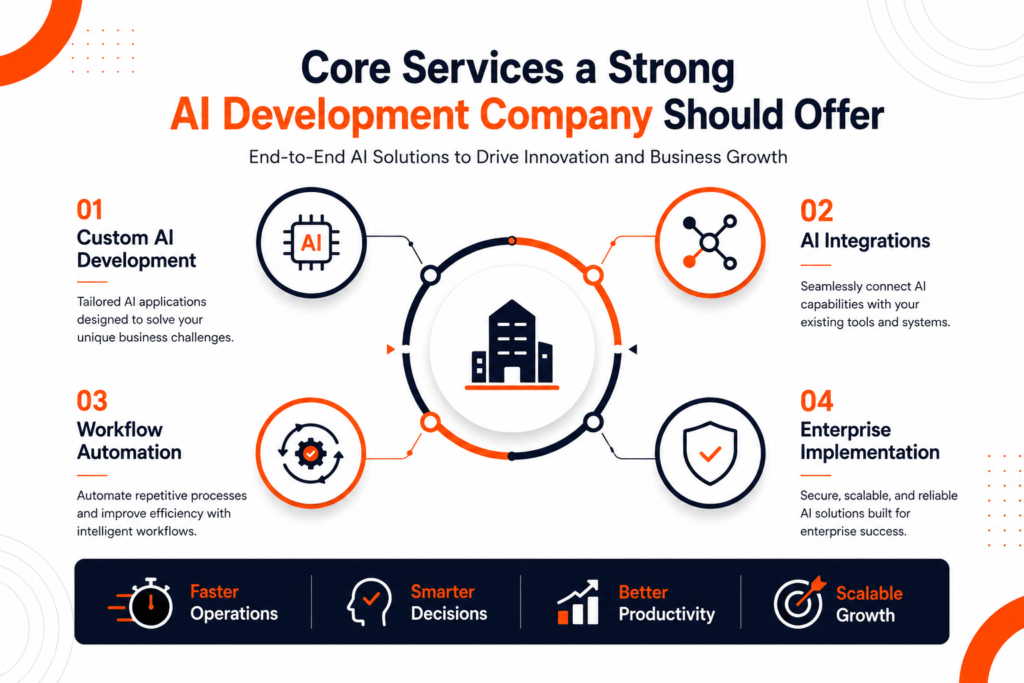
Not every AI development company offers the same depth. A genuine generative AI development company builds applications around language models that draft content, extract data from documents, or power knowledge assistants trained on your own files — not just a chatbot API with your logo on it. If you want to build and ship your own product, look for an AI product development company with a record of shipping, not prototyping. Creativebits stands apart from consulting-driven firms here: our AI development solutions team has launched proprietary AI products under our own name, including a tool that turns product specs into e-commerce descriptions and an AI resume-screening tool for recruiters.
An AI app development company that only builds standalone apps solves half the problem. The other half is getting AI output into tools people already use — the core of our workflow automation practice, which wires AI into monday.com, Make.com, Zapier, and n8n so approvals and notifications happen automatically. As an Authorized Solution Partner for monday.com, we also build AI directly into dashboards, and our PMaaS practice keeps rollouts on schedule with transparent reporting.
Custom AI Development Company in India: What Makes the Talent Pool Different
A large share of global AI work now runs through teams an AI development company India leads directly, or supports as an extension of a Western in-house team. An AI software development company in India can offer senior ML and full-stack talent at a meaningfully lower hourly rate than comparable US or European teams, without a drop in quality. Many teams have delivered enterprise software under Agile frameworks for over a decade, and strong English fluency plus overlapping hours matters when translating requirements into specs.
If you're evaluating a custom AI development company in India, apply the same 20-question framework above. Location affects cost and time zone overlap; it shouldn't lower your bar for data security or post-launch support.
What a Custom AI Development Project Typically Costs
Pricing varies by scope, but here's what a custom AI development company typically charges across common project types:
| Project Type | Typical Range | Timeline |
|---|---|---|
| Proof of concept / discovery | Lower five figures | 4–8 weeks |
| Chatbot or LLM integration | Mid five figures | 6–10 weeks |
| Custom NLP or document tool | Mid-to-upper five figures | 2–4 months |
| Full generative AI application | Six figures | 3–6 months |
| Enterprise-wide AI transformation | High six figures and up | 6–12+ months |
Two things consistently get underestimated: data preparation, which adds meaningfully to total cost, and post-launch support, often treated as an afterthought. A dedicated-team model tends to beat project pricing once an engagement runs past six months.
Common Mistakes Businesses Make When Hiring a Custom AI Development Company
- Chasing the model, not the outcome — picking a custom AI development company for name-dropping the newest LLM instead of a plan for reaching your team.
- Skipping the data audit — assuming existing data is "AI-ready" when it's incomplete or inconsistently labeled.
- Ignoring integration early — building a standalone tool first and bolting on connections later.
- Treating launch as the finish line — AI systems drift as conditions shift, so monitoring isn't optional.
Ready to Build AI That Actually Gets Used?
Choosing among custom AI development companies isn't about the flashiest demo. It's about a partner who asks the right questions before writing a line of code, builds around your existing workflows instead of asking you to change them, and sticks around after launch instead of disappearing once the invoice is paid.
Whether you need a generative AI development company for a proof of concept, an AI product development company to ship something new, or AI development services layered on workflow automation, monday.com implementation, and project management support, Creativebits would welcome the conversation. Reach out for a free consultation and we'll walk through your workflows, your data, and what a realistic first project looks like.

2. How is custom AI development different from just using ChatGPT or a similar tool?
Public tools like ChatGPT are trained on general internet data and know nothing about your business specifically. Custom AI development connects a model to your own documents, data, and workflows through techniques like RAG or fine-tuning, and wires the output into the software your team already uses instead of a separate browser tab.
3. How much does it cost to hire a custom AI development company?
A narrow proof of concept typically starts in the lower five figures, while a full generative AI application often lands in six figures, depending on scope, data readiness, and integration complexity. Ongoing hosting, monitoring, and iteration should be budgeted separately, since they rarely appear in the initial quote.
4. Should I hire an in-house AI team or outsource to an AI development company?
For most small and mid-sized businesses, outsourcing to an established AI development company is faster and less risky than building an in-house team from scratch, since senior AI talent is expensive and slow to hire. A hybrid model, where you keep a product owner internally and outsource the engineering, is common once the system moves past its first release.
5. What makes an AI development company in India a good option?
An AI development company India offers senior machine learning and full-stack talent at meaningfully lower hourly rates than the US or Western Europe, backed by over a decade of enterprise delivery experience under Agile frameworks. Time zone overlap and English fluency make day-to-day collaboration easier than many buyers expect.
6. Who owns the AI model once it's built?
This depends entirely on your contract, which is exactly why it belongs on your vendor question list. Reputable custom AI development companies grant full ownership of the resulting model, code, and data pipeline to the client, since the alternative locks you into a vendor relationship indefinitely.
7. How long does a typical AI development project take?
A proof of concept usually takes 4 to 8 weeks, a production-ready application 3 to 6 months, and an enterprise-wide AI rollout can run past a year. Timelines stretch fastest when data isn't clean or accessible, which is why a data audit early in the process matters so much.
8. Is my business too small to benefit from custom AI development?
No. Small and mid-sized businesses are often better candidates than large enterprises, since a single well-integrated AI workflow, like automated lead scoring or document processing, can produce a visible return within weeks. The key is starting with one narrow, well-defined use case rather than an open-ended transformation project.