monday.com Services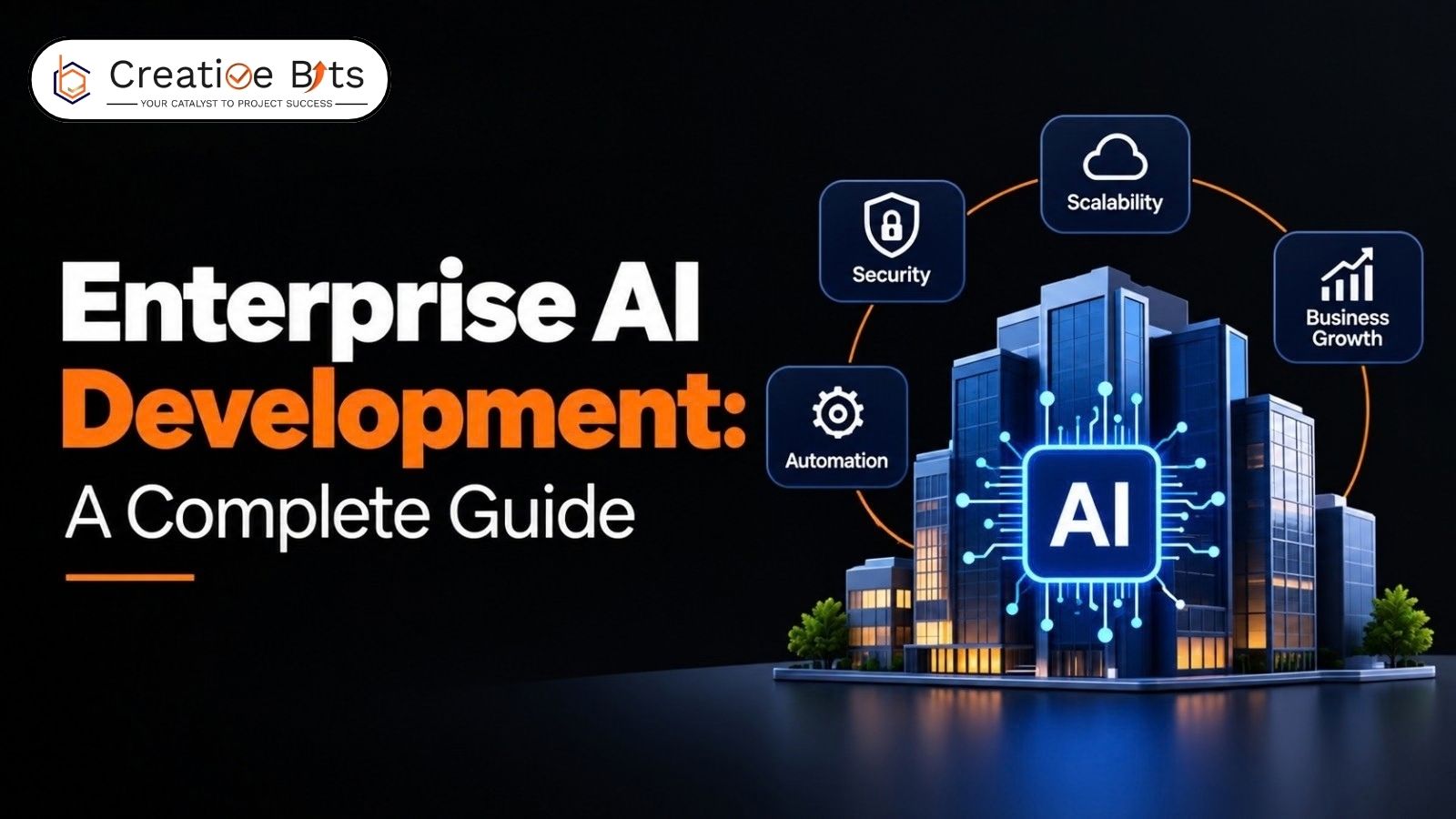
What Is Enterprise AI Development, and Why Is Getting It Right So Hard?
More than three-quarters of large organizations now report deploying AI in at least one business function, a sharp increase from just a couple of years ago. Yet most would admit that turning a promising pilot into something that runs reliably across the business is a genuinely different challenge. This guide on Enterprise AI Development: A Complete Guide breaks down what that process involves, from strategy through deployment, without the usual hand-waving.
AI Development Services for Enterprise Growth
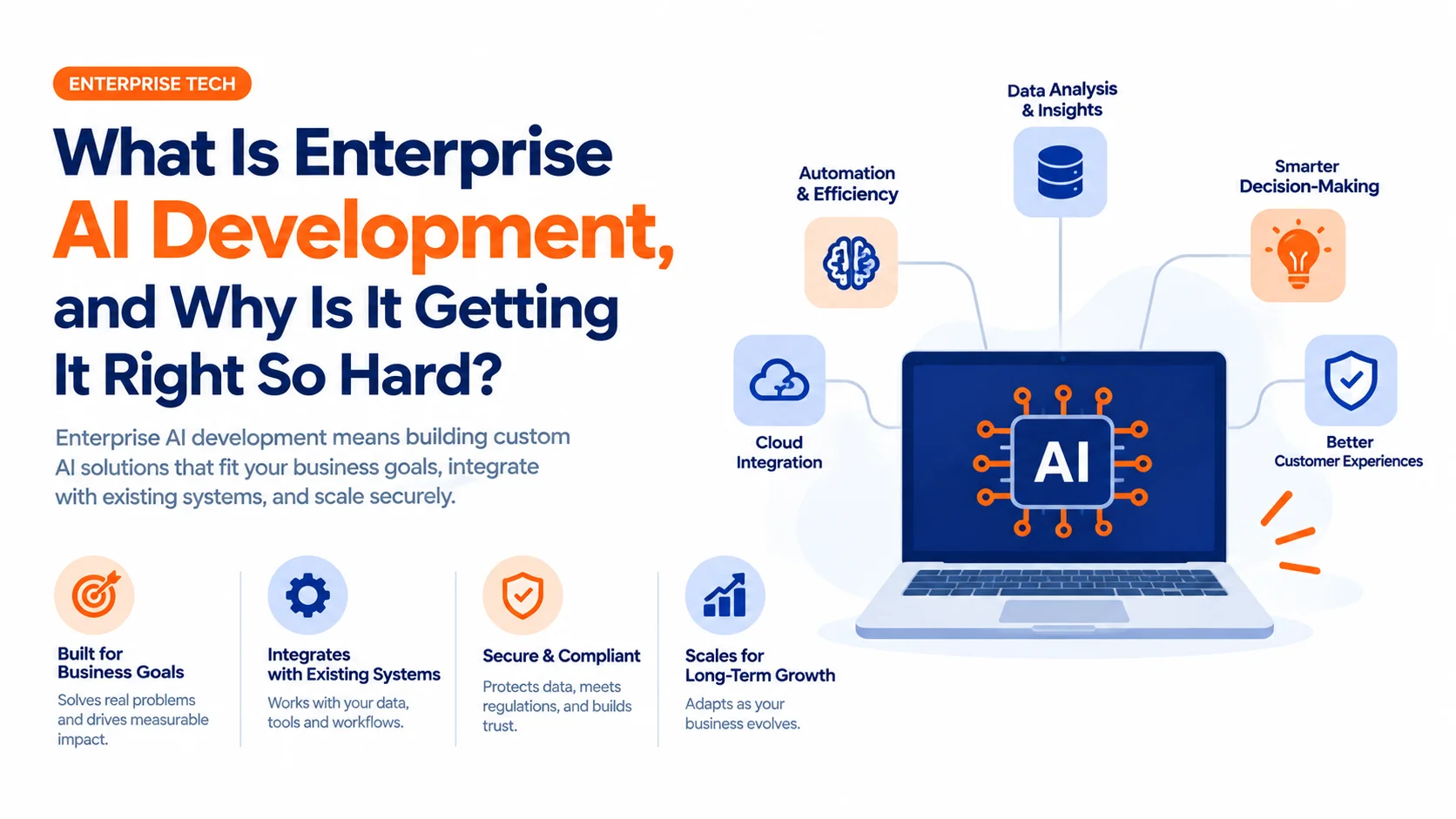
At scale, AI development services typically fall into five categories: custom AI software development, AI product development, AI integration into existing systems, proof-of-concept and MVP work, and strategic consulting around governance and readiness. Most enterprises need a blend, not just one; a pure model-building engagement rarely succeeds without the surrounding integration and governance work.
What Is Enterprise AI Development and How Does It Benefit My Organization?
Enterprise AI development is the structured process of planning, building, integrating, and maintaining AI systems for a large organization's data, workflows, and regulatory environment, distinct from a smaller pilot or a generic off-the-shelf tool. The benefits are concrete: predictive maintenance that cuts unplanned downtime, churn-prediction models that outperform traditional analytics, and content classification that processes work far faster than manual review, all backed by real deployments across automotive, retail, and media.
AI Development Platform vs. Point Solutions
An AI development platform provides a unified environment for building, training, and deploying models, unlike a single-purpose tool that covers only one part of the lifecycle. The difference matters at enterprise scale: a platform typically bundles MLOps automation, infrastructure flexibility across cloud and on-premises environments, data management, and built-in security controls, rather than requiring a team to stitch these together across a dozen disconnected tools.
How Can I Choose the Right AI Development Partner for My Enterprise?
Vendor selection usually comes down to four things: relevant domain expertise, a track record of production deployments, clarity on data governance and compliance, and a phased engagement- discovery, prototyping, full build, deployment, monitoring- rather than one opaque deliverable. Enterprises typically engage partners through fixed-scope projects, dedicated teams, or co-development alongside in-house engineers.
Building a Sound AI Implementation Strategy
A credible AI implementation strategy starts with defining strategic objectives and prioritizing use cases by impact versus feasibility, not whatever's trending. From there, it means honestly assessing data readiness, choosing between pre-trained, open-source, or fully custom models based on cost and control needs, and planning infrastructure—cloud, on-premises, or hybrid—before a single model is trained. Skipping the data-readiness step is one of the most common reasons enterprise AI projects stall after an otherwise promising pilot.
What Are the Key Steps and Best Practices for Implementing AI at Scale?
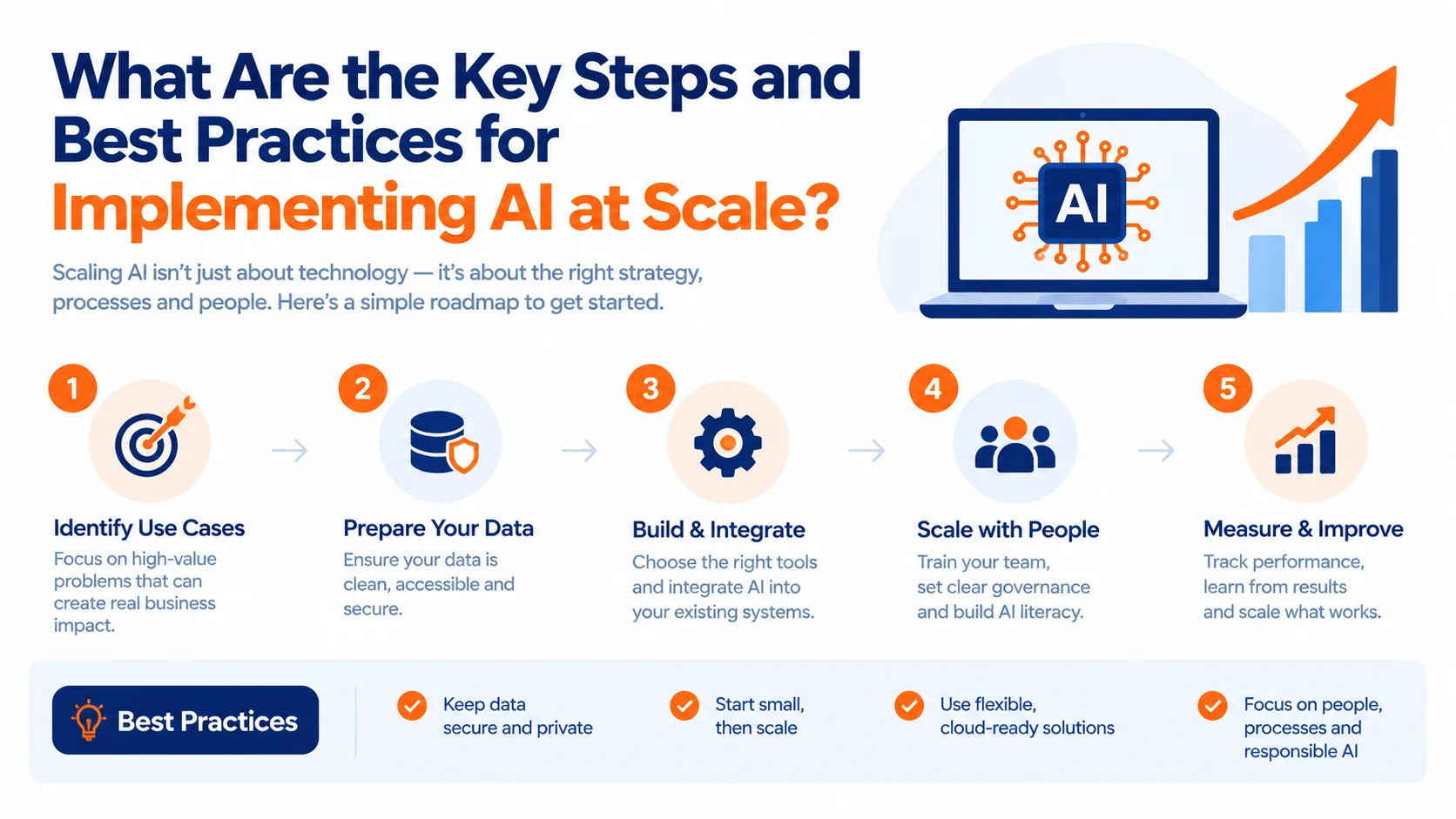
The transition from the pilot phase to the production phase typically occurs in a series of five phases, including: assessing infrastructure and data readiness, aligning all functions on KPIs, conducting the pilot program in a controlled environment, integrating the system with other CRM and ERP systems, and scaling gradually. Good practices that must be integrated into the system include: automating the governance process rather than treating it as an afterthought, employing a modular architecture for component-based updates, and monitoring model performance rather than assuming its consistency.
Which AI Technologies and Tools Are Most Suitable for Enterprise Applications?
It all depends on the application. Copilot, content generation, and knowledge base development make use of generative AI and large language models. NLP handles chatbots, document review, and sentiment analysis. Traditional machine learning and deep learning support predictive analytics and classification, while computer vision covers defect detection and image analysis. Underpinning all of these, scalable AI architecture, elastic compute, hybrid cloud support, and modular integration points determine whether a pilot solution can actually handle enterprise-scale data volumes without falling over.
AI Model Deployment Enterprise Considerations
AI model deployment enterprise-wide introduces challenges a small pilot never faces: performance under genuinely high-volume conditions, interoperability with legacy systems and multi-cloud environments, and real-time inference needs in latency-sensitive applications like fraud detection. Deployment isn't a one-time event either; models need ongoing monitoring, retraining schedules, and rollback capability when performance drifts, which is why machine learning for business success depends as much on operational discipline after launch as on the initial build.
How Do I Measure ROI and Ensure Compliance in Enterprise AI Projects?
AI project ROI calculations should tie directly to defined business outcomes, such as reduced processing time, lower cost per prediction, improved retention, or measurable revenue uplift, rather than vague efficiency claims. On the governance side, a proper AI governance framework should include role-based access control, audit logging, and clear policies for how models are retrained and monitored over time. AI compliance and ethics considerations, including GDPR, HIPAA, or industry-specific rules depending on the sector, need to be built into the architecture from the start; retrofitting compliance after deployment is consistently more expensive and riskier.
The Bigger Picture
Enterprise AI succeeds when treated as a strategic capability rather than a one-off project, grounded in a clear business goal, backed by genuine stakeholder alignment, and scaled through disciplined, phased execution rather than a single big-bang launch. The organizations getting real value from enterprise AI solutions today are rarely the ones with the flashiest pilot; they're the ones that treated data readiness, governance, and AI integration services as seriously as the model itself.
2. What's the difference between an AI development platform and a single AI tool?
A platform covers the full lifecycle- training, deployment, and monitoring- while a point solution typically covers just one part.
3. How do I choose the right AI development partner?
Look for relevant domain expertise, evidence of production deployments, clear data governance answers, and a phased engagement structure.
4. What does a solid AI implementation strategy involve?
Prioritized use cases, honest data-readiness assessment, the right model approach, and infrastructure planning before training begins.
5. What are the key steps to implementing AI at enterprise scale?
Readiness assessment, team alignment, a controlled pilot, system integration, and a gradual, monitored scale-up.
6. Which AI technologies suit enterprise applications best?
It depends on the use case: generative AI and LLMs for content, NLP for chatbots and documents, computer vision for defect detection, and ML for predictive analytics.
7. What does scalable AI architecture actually require?
Elastic compute, hybrid or multi-cloud support, and modular integration points that let the system grow without a full rebuild.
8. How should I calculate ROI on an enterprise AI project?
Tie it to a defined outcome, reduced processing time, lower cost per prediction, or measurable revenue uplift, rather than general claims.
9. What belongs in an AI governance framework?
Role-based access control, audit logging, clear retraining policies, and defined accountability for model behavior.