monday.com Services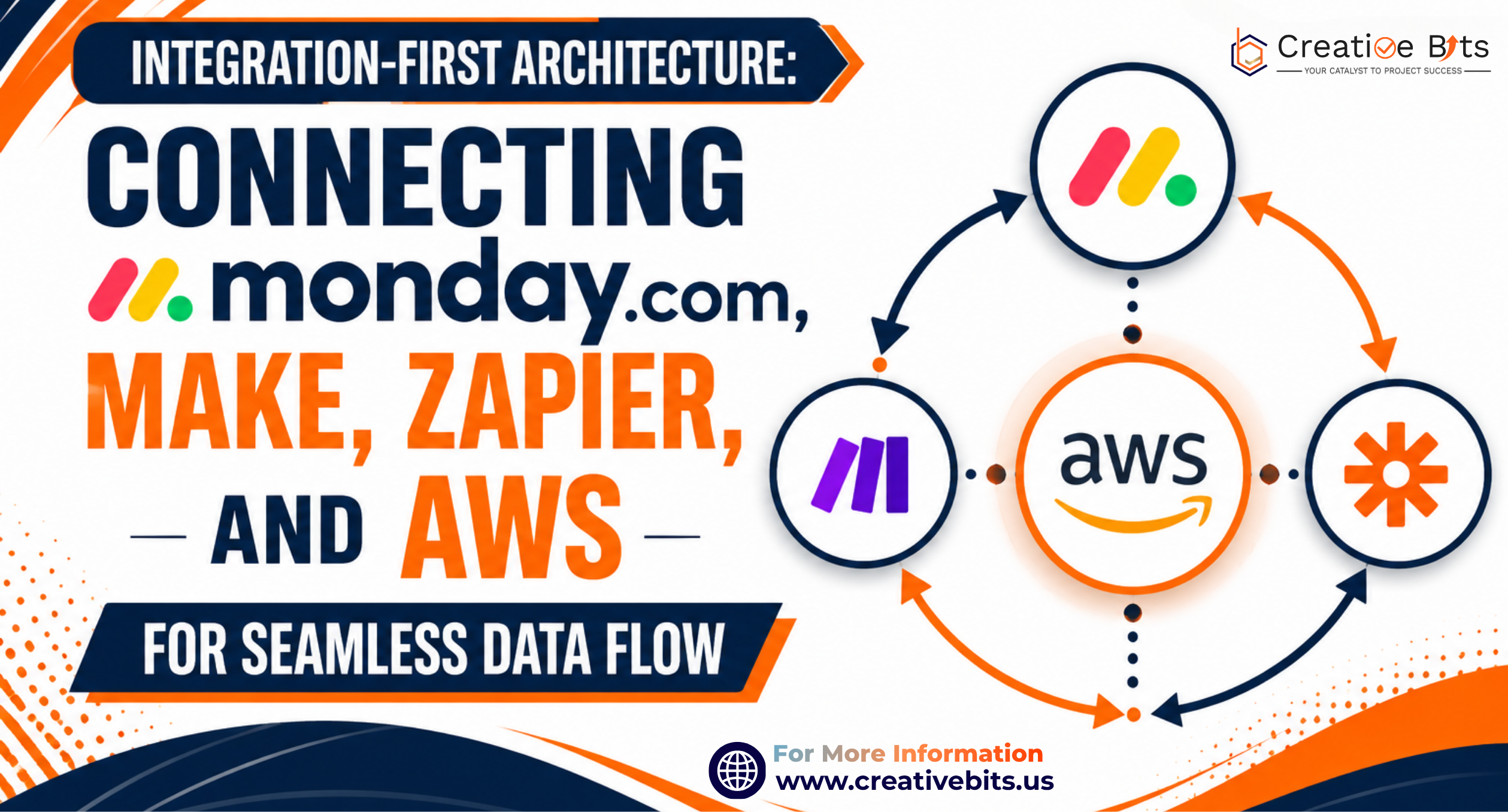
Integration-First Architecture is the discipline of designing how your systems talk to each other before you pick which tools do the talking. Most teams do it backwards. They wire monday.com to Zapier, bolt on a Make scenario, drop in an AWS Lambda, and end up with a tangle of point-to-point connections that nobody fully understands and that breaks the moment one API changes. An integration-first approach flips that: you model the data flow, the events, and the failure cases first, then choose the right tool for each hop.
Done well, this turns integration from fragile glue into a durable layer you can trust. Done poorly, it becomes the single biggest source of silent data loss in an organization. The difference is seldom the tools themselves. It is the architecture around them.
Know What Each Tool Is Actually For
The 4 platforms in this stack are not interchangeable. Integration-First Architecture starts with putting each one where it is strongest.
monday.com is usually the system of record for work. It exposes a GraphQL API and can push real-time events through webhooks whenever an item, status, or column changes, so you rarely need to poll it.
Zapier is the fastest way to connect the long tail of SaaS apps. Its enormous app catalog and simple Catch Hook triggers make it ideal for last-mile actions and quick automations that do not justify custom code.
Make gives you a visual canvas for more complex, branching scenarios, with deep modules for platforms like monday.com. When a workflow has conditions, loops, and data transformations, Make is often cleaner and more cost-effective at volume than chaining many single-step Zaps.
AWS is the durable backbone. Services like EventBridge, Lambda, and SQS give you routing, custom logic, buffering, and retries that no-code tools cannot match. This is where you put anything that must not be lost.
The mistake is using one tool for everything. The skill is routing each job to the platform built for it.
API Orchestration: One Hub, Not a Web of Wires
The reason integrations rot is topology. If every app talks directly to every other app, you get N-times-N connections and no single place to see what is happening. The integration-first alternative is orchestration: a central layer that receives events, decides what should happen, and routes work outward.
On AWS, this is the natural role of Amazon EventBridge, which routes events to targets based on rules and filters, with Lambda holding the business logic in between. AWS describes this shift from tangled webhooks toward event-driven orchestration as the way to simplify systems and let new consumers subscribe without touching the original producer. A monday.com status change becomes an event on the bus. EventBridge decides whether that event should trigger a Lambda, drop a message on a queue, or fan out to several consumers at once. Make and Zapier, then handle the SaaS-specific last mile.
The payoff is decoupling. Producers do not know or care who consumes their events, so you can add a new destination without rewiring the source. That is the difference between an integration layer that grows gracefully and one that has to be rebuilt every quarter.
Webhook Strategies That Do Not Break
Webhooks are where most integrations quietly fail, because teams treat them as fire-and-forget. They are not. A few strategies separate reliable pipelines from flaky ones.
First, handle verification correctly. monday.com sends a challenge token when you register a webhook and expects your endpoint to echo it back, so your listener has to answer that handshake before it will receive real events.
Second, acknowledge fast, then process asynchronously. Return a 200 immediately and do the real work in the background. This matters because senders retry aggressively when they do not get a quick success. Monday.com, for example, retries a failed delivery every minute for roughly thirty minutes, and that schedule cannot be configured, so a slow endpoint turns one event into a storm of duplicates.
Third, design for duplicates from day one. Because retries are inevitable, every consumer must be idempotent: dedupe on the event ID so processing the same message twice produces the same result. This is non-negotiable, especially since Zapier's Catch Hook always returns a success response regardless of what happens downstream, meaning the sender has no idea whether your logic actually ran.
Fourth, secure the endpoint. Standard monday.com webhooks created with a personal token do not carry an HMAC signature, so you cannot cryptographically prove a request came from monday. Put an API gateway or a verification layer in front, treat the URL as a secret, and add authentication headers before the payload reaches your core logic.
Fifth, buffer with a queue. Never let a downstream outage drop an event. Push incoming events onto Amazon SQS so bursts and brief failures are absorbed rather than lost. This is important because EventBridge's own retries are time-bounded, and AWS specifically recommends a queue in between so events persist beyond that retry window and consumers can work at their own pace. Pair the queue with a dead-letter queue, so anything that still fails is captured for inspection rather than vanishing.
5 Rules for an Integration Layer That Lasts
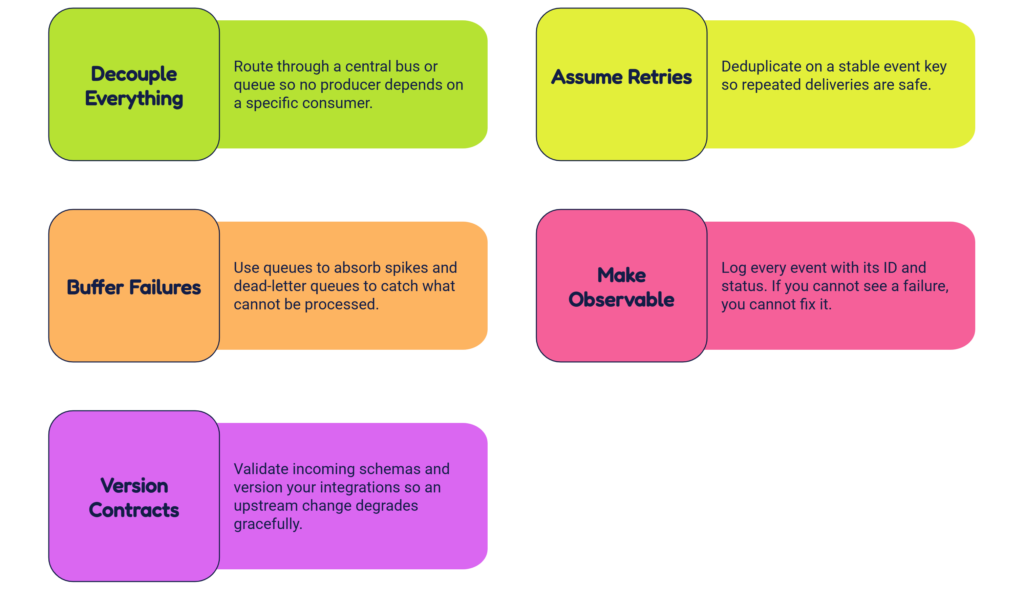
Whatever tools you use, the same principles keep the layer healthy:
- Decouple everything. Route through a central bus or queue so no producer depends on a specific consumer.
- Assume retries and enforce idempotency. Deduplicate on a stable event key so repeated deliveries are safe.
- Buffer and capture failures. Use queues to absorb spikes and dead-letter queues to catch what cannot be processed, as AWS outlines in its guidance on event-driven design with Lambda.
- Make it observable. Log every event with its ID and status. If you cannot see a failure, you cannot fix it.
- Version your contracts. Payloads change. Validate incoming schemas and version your integrations so an upstream change degrades gracefully instead of breaking silently.
A Reference Pattern
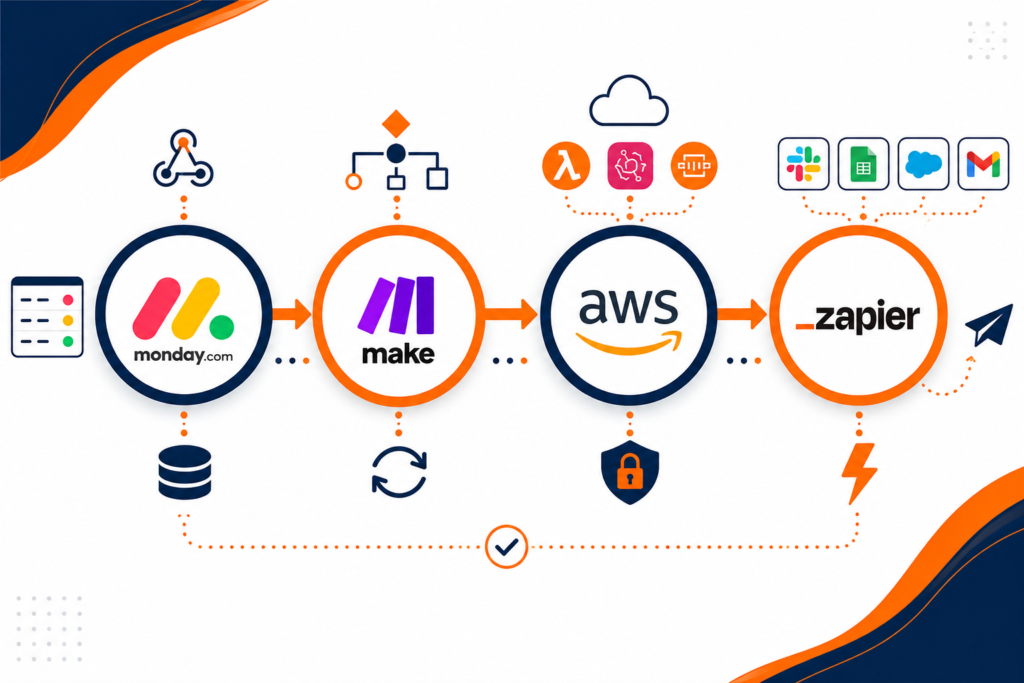
A resilient flow across all four tools usually looks like this. monday.com emits a webhook on a board event. An API gateway receives it, verifies the handshake, and hands off to a Lambda that acknowledges immediately and publishes a clean event to EventBridge. EventBridge routes that event, buffering durable work through SQS with a dead-letter queue for safety. From there, AWS handles anything mission-critical, while Make runs the branching SaaS scenarios and Zapier fires the simple last-mile actions into the wider app ecosystem. No app talks directly to another. Everything flows through a layer you can observe, retry, and extend.
Where Creative Bits Comes In
Designing this correctly is an engineering discipline, not a weekend of connecting apps. As an applied AI consultancy and monday.com partner, Creative Bits builds integration-first layers that orchestrate monday.com, Make, Zapier, and AWS into one reliable data flow, complete with idempotent handlers, queue-based buffering, dead-letter capture, and end-to-end observability. You can find more practical build guides on the Creative Bits blog.
Integration-First Architecture is what separates automation that scales from automation that silently loses data. Model the flow first, give each tool the job it is best at, orchestrate through a central layer, and treat webhooks as the fragile contracts they are. Get that foundation right, and your stack becomes something rare: a set of integrations that just keep working.
Ready to build an integration layer that does not break? Talk to the Creative Bits team about designing resilient, event-driven data flow across your monday.com, Make, Zapier, and AWS stack.