monday.com Services
What Are Generative AI Integration Services and How Do They Work?
Most businesses aren't struggling to access generative AI anymore. ChatGPT, Copilot, and a dozen other tools are one signup away. What's actually hard is getting that AI to work inside the systems a business already runs on, without creating a mess of disconnected pilots nobody uses past week two. That's the real job of generative AI integration services: connecting AI models to your CRM, your data, and your daily workflows so the output shows up where work actually happens. This guide covers what generative AI integration services actually involve, the tools and platforms behind them, and how to pick a partner who can actually deliver.
What Is Generative AI Integration?
Generative AI integration is the process of connecting a generative AI model, like an LLM or image generator, to a business's existing data, applications, and workflows so it can act on real information instead of generic prompts. It's the difference between opening Chat GPT in a browser tab and having AI-generated summaries appear automatically inside your support ticketing system. Most businesses reach this point through generative AI integration services rather than building the connections themselves.
Done properly, generative AI integration touches several layers: the data layer (cleaning and connecting the information the model needs), the model layer (selecting or fine-tuning the right model), the middleware layer (APIs and connectors linking everything together), and the application layer (where users actually see and use the output). Skip any one of these, and you end up with an AI demo that never becomes a working system, which is exactly the gap generative AI integration services are meant to close.
What Is AI Integration Service?
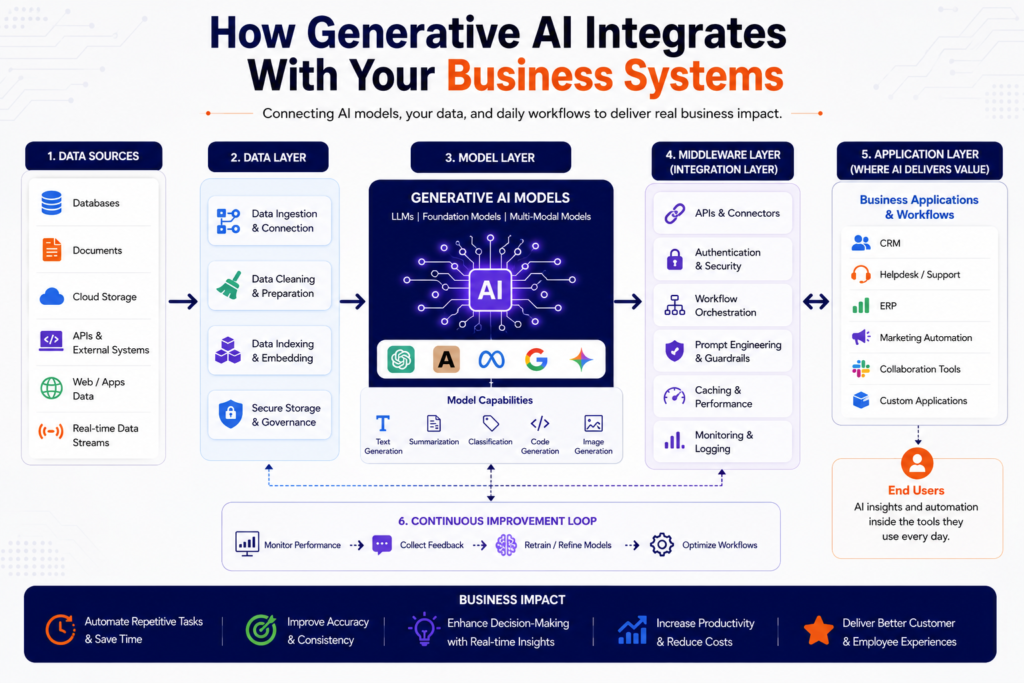
An AI integration service is the professional engagement a business hires to handle that connection work end to end, rather than building it internally. While "generative AI integration" describes the technical process, an AI integration service is the delivery model: a vendor or team that assesses your systems, selects the right approach, builds the connections, and supports the result afterward. In practice, most buyers searching for this simply want a reliable generative AI service they can hand the problem to.
Most AI integration service engagements include a few consistent components: a systems and data audit, model or platform selection, custom connector or API development, workflow embedding, and ongoing monitoring once the integration is live. Businesses hire generative AI integration services out because the combination of AI expertise and systems knowledge required is rare to have fully in-house, especially for a first project.
Core Generative AI Integration Services You Can Hire For
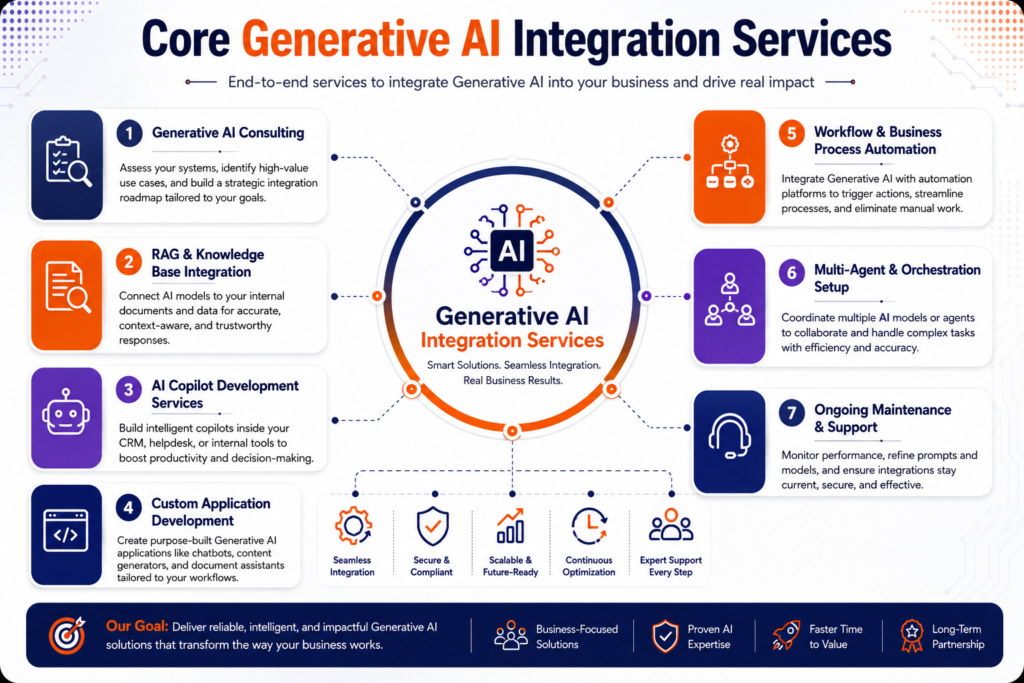
Not every provider offers the same scope, and this is often where "generative AI integration services" gets used loosely by vendors who really only offer one piece of it. Here's what tends to fall under genuine generative AI integration services, as opposed to a single chatbot build:
| Service | What It Covers |
|---|---|
| Generative AI consulting | Auditing current systems, identifying high-value use cases, and building an integration roadmap before any code is written |
| RAG and knowledge base integration | Connecting a model to internal documents so answers are grounded in your actual data, not general training data |
| AI copilot development services | Building assistant-style tools embedded into a specific app, like a sales copilot inside a CRM or a support copilot inside a helpdesk |
| Custom application development | Purpose-built generative AI apps, such as internal chatbots or document generators, tailored to one workflow |
| Workflow and business process automation | Wiring generative AI into automation platforms so it triggers and acts on real events, not just answers prompts on request |
| Multi-agent and orchestration setup | Coordinating multiple models or agents so each handles the task it's best suited for |
| Ongoing maintenance and support | Monitoring performance, retraining or re-prompting as data changes, and fixing integrations when connected systems update |
A genuine generative AI development company will usually offer several of these together as part of one connected engagement, since a copilot without workflow integration, or a RAG system without ongoing support, tends to stall out within a few months. That's what separates real generative AI integration services from a single AI development services line item on an invoice.
How Generative AI Integration Actually Works
The exact steps vary by provider, but most generative AI integration services follow a similar path, whether you're hiring a specialist generative AI service or an internal team:
Assess the need. Identify which business problem the integration is meant to solve, and what a good outcome actually looks like.
Audit the data. Generative AI integration is only as strong as the data feeding it; messy, scattered, or incomplete data is the most common reason projects stall.
Select the model or platform. Choose a pre-trained model, a combination of models, or a specific AI integration tool suited to the task and budget.
Connect the data. Bring in relevant data through APIs, databases, or real-time feeds, often using retrieval-augmented generation so the model can reference current information.
Fine-tune where needed. Adjust the model on domain-specific data for tasks that need consistent tone, terminology, or accuracy.
Test before launch. Validate outputs against real scenarios, not just clean demo data, before anything touches live customers.
Embed into workflows. Build the connectors and interfaces so the AI's output appears inside the tools people already use daily.
- Deploy, monitor, and support. Track performance after launch and keep the integration current as connected systems and business needs change.
This eight-step path is what separates real generative AI integration services from a quick chatbot install.
What Are the Top 5 Generative AI Platforms?
For businesses evaluating generative AI integration services, it helps to know the model ecosystems most generative AI integration services are actually built around:
| Platform | Known For | Common Integration Use |
|---|---|---|
| OpenAI (ChatGPT/GPT models) | The most widely adopted general-purpose LLM family | Chatbots, content generation, copilots, RAG systems |
| Google Gemini | Strong multimodal reasoning and fast growth across Google Workspace | Document analysis, search, enterprise assistants |
| Anthropic Claude | Strong performance on reasoning, coding, and long-context tasks | Coding copilots, research assistants, agentic workflows |
| Microsoft Copilot | Deep native integration across Word, Excel, Outlook, and Teams | Office productivity, reporting, meeting summaries |
| Meta Llama | Leading open-source model family, self-hostable | Custom fine-tuning, private or on-premise deployments |
There's no single "best" platform here. The right generative AI platform depends on whether you need tight productivity-suite integration (Copilot), open-source flexibility (Llama), or strong reasoning for complex tasks (Claude or Gemini), and a good generative AI integration services provider will help you match the platform to the use case instead of defaulting to whichever model they know best.
Who Are the Big 4 AI Agents?
In most enterprise conversations, the "Big 4 AI agents" refers to the agent and assistant ecosystems built by Open AI, Google, Microsoft, and Anthropic, since these four companies currently power the majority of production AI agents deployed inside businesses. Each has its own agent framework: Open AI's agent tools and GPT-based assistants, Google's Gemini-powered agents across Workspace, Microsoft's Copilot agents built into its 365 suite, and Anth ropic's Claude-based agents, often used for coding and research tasks.
It's worth noting the term gets used differently elsewhere. In professional services, the same phrase sometimes refers to the large consulting firms that have each launched their own AI agent platforms for clients. When you see "Big 4 AI agents" referenced, check the context to know which meaning applies, since it changes which generative AI integration services are actually relevant to the conversation.
AI Integration Tools That Make This Possible
Behind every working integration sits a stack of AI integration tools handling the parts a business rarely sees, and this technical layer is usually the least visible part of generative AI integration services even though it's what keeps everything running. On the technical side, this typically includes API gateways for connecting models to applications, vector databases for RAG-based retrieval, orchestration frameworks for coordinating multiple models or agents, and monitoring tools for tracking cost and performance.
On the workflow side, no-code and low-code platforms like Make, Zapier, and n8n have become an essential AI integration tool for businesses that need generative AI wired into daily operations without a lengthy custom build. These tools let AI output trigger real actions, updating a project board, sending a notification, or creating a record, rather than sitting in a chat window waiting to be copied elsewhere. Choosing the right AI integration tool often matters as much as choosing the right model.
Common Mistakes Businesses Make in the AI Integration Game
Plenty of companies get outplayed in the AI integration game not because the technology fails, but because the setup around their generative AI integration services does.
Treating a chatbot as the finish line. A standalone AI tool that isn't wired into existing systems rarely gets adopted past the first few weeks.
Skipping the data audit. Feeding a model incomplete or poorly labeled data guarantees inconsistent, low-trust output.
Choosing the model before the use case. Picking a platform because it's popular, rather than because it fits the specific task, wastes budget.
Ignoring ongoing support. Generative AI integration services don't end at launch; models and connected systems both change over time.
No human-in-the-loop for high-stakes decisions. Fully automating anything customer-facing or financial without review invites costly mistakes.
- Hiring for AI development services alone. Development without an integration plan just produces another tool sitting outside the workflow it was meant to improve.
How to Choose a Generative AI Development Company or Consulting Partner
Whether you're hiring generative AI developers directly or bringing in a full generative AI development company for complete generative AI integration services, the same evaluation criteria apply:
Proven integration work, not just model demos. Ask to see systems they've actually connected as part of real generative AI integration services, CRMs, ERPs, ticketing tools, not just a chatbot on a landing page.
Clear generative AI consulting process. A credible partner leads with generative AI consulting, auditing your systems and data before recommending a platform, rather than pushing one model regardless of fit.
Ownership terms spelled out upfront. You should own the resulting model, code, and data pipeline once the engagement ends.
A support plan beyond launch day. AI development services that stop at deployment leave you managing drift and breakage alone.
Experience with your actual tech stack. A team that already knows your CRM, ERP, or project management platform will integrate faster and with fewer surprises.
- Generative AI developers who can talk business, not just models. The best generative AI developers translate technical tradeoffs into terms your team can actually decide on.
Why Creative bits Is Built for Real-World Generative AI Integration Services
Most generative AI integration services stop at the model. Creative bits starts with the systems your team already depends on and builds AI into them, not next to them, which is the difference between AI development services that ship a demo and generative AI integration services that ship a working system.
Our AI development solutions team has shipped proprietary AI products under our own name, not just client demos, including a generative AI service that turns raw product specs into e-commerce descriptions and an AI-driven resume screening tool for recruiters. That experience shapes how we approach every generative AI integration: we think about what happens after the model responds, not just whether it responds correctly.
Because AI output is only useful once it reaches the right place, our workflow automation practice connects generative AI to the tools businesses already run on, using Make.com, Zapier, and n8n to route AI-generated data into real workflows. As an Authorized Solution Partner for monday.com, we build these integrations directly into boards and dashboards, so AI-generated summaries, scores, or drafts show up where teams already work instead of a separate tool nobody opens. This is also where an AI copilot development services engagement tends to land best: a copilot embedded inside monday.com or a connected CRM, not a standalone chat window. And because a messy AI rollout is often a project management failure as much as a technical one, our PmaaS practice keeps integration projects on schedule with a defined methodology and transparent reporting.
Ready to Move Past the AI Pilot Stage?
The gap between a generative AI demo and a system your team actually relies on is almost always integration work, not model quality. That's the whole premise behind generative AI integration services. Whether you need generative AI consulting to figure out where to start, an AI copilot built into an existing tool, or full generative AI integration services connecting AI to your CRM, monday.com boards, or internal workflows, Creative bits can help.
Reach out for a free consultation and we'll walk through your current systems, your data, and what realistic generative AI integration services should look like for your business.