monday.com Services
Hybrid workforce coordination has quietly become the defining operational challenge of the modern enterprise. Your designer logs off in Nairobi just as your developer logs on in New York. A decision made in London at 4 PM doesn't reach Manila until the next morning. And somewhere in those gaps, momentum stalls, work waits, questions pile up, and the "always-on" team you imagined becomes a relay race where everyone is waiting for the baton.
The teams that solve this aren't the ones with the most overlapping hours. They're the ones who've stopped depending on overlap altogether. With 65% of companies now offering hybrid arrangements, coordinating distributed work is no longer a niche concern; it's the norm. And the answer isn't more meetings. It's better to use asynchronous workflows.
Here's how to build hybrid workforce coordination that turns time zones from a liability into a 24-hour advantage.
Why Synchronous-First Coordination Breaks Across Time Zones
The instinct, when a team spreads across the globe, is to schedule more calls to "stay aligned." It backfires. Every added meeting forces someone to work outside their hours, multiplies video fatigue, and slows the very work it was meant to speed up.
The data has settled this debate. Teams that reduce unnecessary meetings and invest in clear written communication report fewer interruptions and higher deep-work output. Synchronous coordination assumes everyone is awake at once. Across time zones, that assumption is simply false, and building your workflow on it guarantees bottlenecks.
There's also a hidden tax most teams never measure: information scatter. Workers juggle an average of 18 apps daily, creating significant context-switching overhead. When a distributed team's knowledge is spread across chats, inboxes, and someone's memory, the handoff from one time zone to the next leaks information every single day.
Asynchronous-first coordination fixes this at the root. It treats documentation, not conversation, as the source of truth, so work can move forward even if no one else is online.
The Three Pillars of Asynchronous Hybrid Coordination
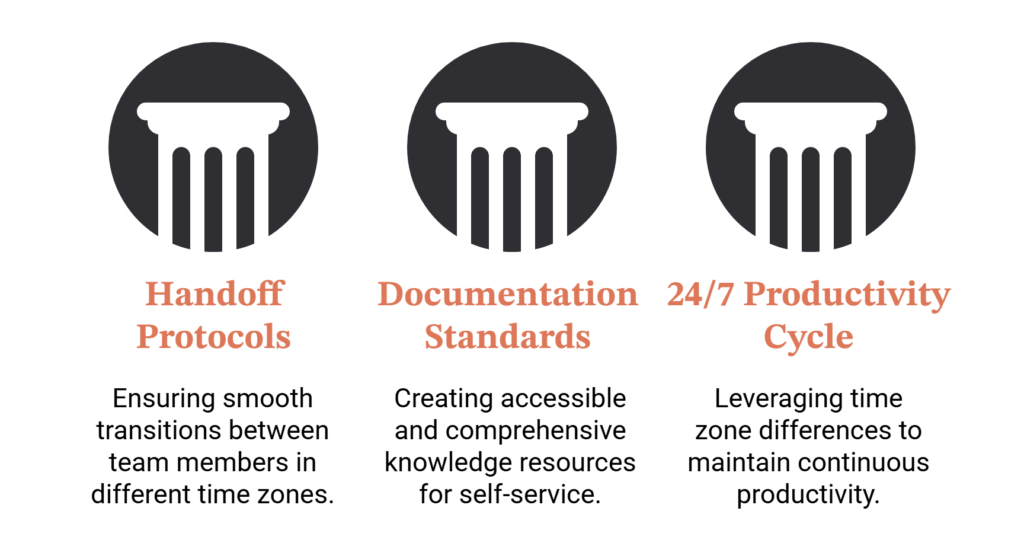
1. Handoff Protocols: Passing the Baton Cleanly
The single highest-leverage practice in distributed work is the structured handoff. When a team member ends their day, the next region should be able to pick up exactly where they left off, without a meeting, without a delay, without guessing.
A strong handoff protocol answers four questions in writing: what was completed, what's in progress, what's blocked, and what the next person needs to do. Captured in a shared workspace rather than a fading chat message, this turns the end of one workday into the clean start of another somewhere else. It's the difference between a relay team that drops the baton and one that never breaks stride.
This matters because ambiguity is the real enemy of distributed work. As one analysis of global teams put it, the most common headaches include figuring out who is actually in charge of a task and losing important information across too many apps. Clear handoffs eliminate both.
2. Documentation Standards: Making Knowledge Self-Serve
Asynchronous work lives or dies on documentation. If the answer to "why did we decide this?" lives only in someone's head, your team is blocked every time that person is asleep.
The high-performing distributed teams treat written clarity as a core discipline, not an afterthought. Written decisions, shared documentation, and explicit communication guidelines are what high-performing teams have that struggling ones don't. The standard to aim for is simple: any team member, in any time zone, should be able to find what they need to keep working without waiting for a reply.
That means documenting decisions and the reasoning behind them, maintaining a single source of truth for project status, and writing updates so explicit that they require no follow-up questions. This is the same structural thinking we applied in The 4-Layer Integration Stack: systems that don't break when one component goes offline.
3. The 24/7 Productivity Cycle: Turning Time Zones Into Advantage
Here's the reframe that changes everything. Time zones aren't a coordination problem to minimize; they're a productivity engine to harness. When work is structured asynchronously, a project can move forward 24 hours a day, passed from region to region in a continuous "follow-the-sun" cycle.
A design brief written in New York is executed overnight in Manila and reviewed the next morning, three time zones turning a three-day cycle into one. But this only works when the first two pillars are solid. Without clean handoffs and strong documentation, follow-the-sun becomes follow-the-confusion. The cycle is the reward for getting the fundamentals right, not a shortcut around them.
The Human Side of Coordination
One caution worth heeding: asynchronous efficiency can't come at the cost of connection. 71% of respondents agree that building and maintaining relationships is a great challenge for virtual teams, and over-indexing on async can deepen that isolation.
The strongest distributed teams balance asynchronous execution with intentional human moments, a rotating meeting time so no single region is always working late, a short overlap window for live questions, and occasional real-time connection to maintain trust. Async handles the work. Deliberate sync handles the relationships. Both matter.
What This Means for Your Operations in 2026
Hybrid workforce coordination is no longer about forcing a distributed team to behave like a co-located one. It's about designing workflows that are genuinely better because they're distributed, more documented, more resilient, and capable of progress around the clock.
For mid-market enterprises hiring across borders, this is a competitive advantage hiding in plain sight. The same time-zone spread that feels like a logistical headache becomes, with the right protocols, a 24-hour operation your single-location competitors simply can't match.
The Takeaway
The goal of hybrid workforce coordination isn't to get everyone online at the same time. It's to make sure work never has to wait for that to happen.
Build clean handoff protocols. Document so knowledge is self-serve. Then let your time zones do what co-located teams never could: keep the work moving 24 hours a day. The distributed teams winning in 2026 aren't fighting their geography. They're turning it into their edge.
At Creative Bits, we help mid-market enterprises design asynchronous workflows, handoff systems, and documentation standards that keep distributed teams aligned across every time zone, powered by smart workflow automation.
👉 Book a strategy session with our team to optimize your distributed workflows.