monday.com Services
Is PMaaS the Powerful Project Management Upgrade Your Business Needs?
Hiring a full project management office is expensive, and going without structured oversight is worse — missed deadlines, budget overruns, and teams that don't know who owns what. Somewhere between those two extremes sits a faster, leaner answer: PMaaS.
At Creative bits, we deliver PMaaS to growing businesses that need experienced project leadership without the overhead of building an internal PMO from scratch. If you've heard the term but aren't sure exactly what it covers, how it's structured, or what tools support it, this guide breaks it down in plain language.
What does PMaaS stand for and what does it do?
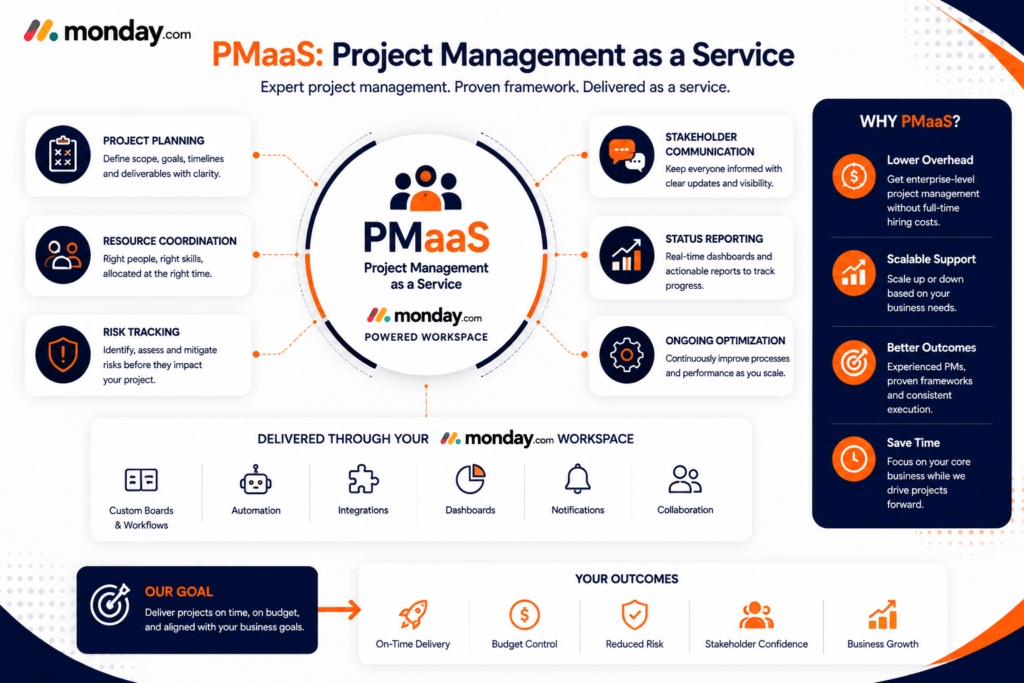
PMaaS stands for Project Management as a Service. It's a subscription or engagement-based model where an outside team of certified project managers plans, runs, and reports on your projects, instead of you hiring, training, and managing that function internally. Rather than a single freelance project manager or a traditional consulting engagement, this model is delivered as an ongoing service with defined scope, reporting cadence, and accountability built in — closer to how you'd think about outsourced IT or finance.
In practice, the service covers project planning, resource coordination, risk tracking, stakeholder communication, and status reporting, all handled by a team that already holds relevant PMaaS certification and follows a proven PMaaS framework rather than improvising a process from scratch. For a business without a mature internal PMO, that experience often separates projects that stay on track from ones that quietly drift.
At Creative bits, our engagements are built around your existing tools — often monday.com — so you get structured project management without ripping out the systems your team already knows. We pair this service with our workflow automation and monday.com implementation work, so project oversight and day-to-day execution reinforce each other instead of living in separate silos.
The appeal is flexibility. You can scale support up during a busy launch quarter and back down afterward, something that's nearly impossible with full-time internal hires. It also means you get a team that has already worked through a proper PMaaS framework across many clients, rather than one person figuring it out for the first time inside your organization.
What are the five phases of the project management life cycle?
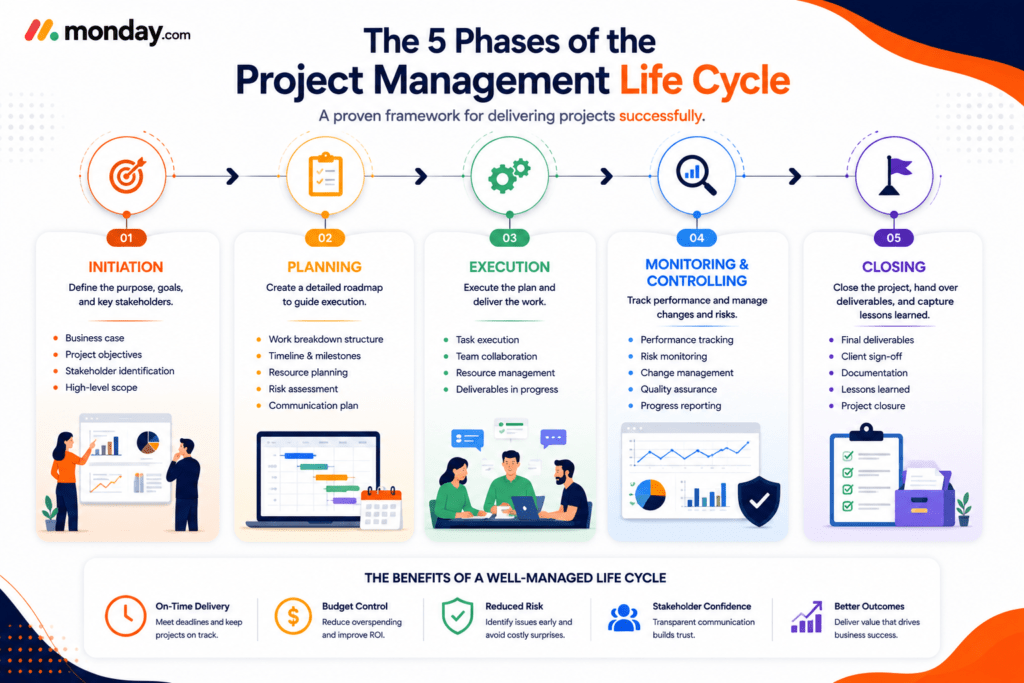
Every well-run project, whether it's managed internally or externally, moves through the same five phases. Understanding them helps you evaluate whether a provider is following a disciplined process or just managing tasks reactively.
- Initiation. This phase defines why the project exists — the business case, objectives, key stakeholders, and high-level scope. A strong provider won't skip this step just to start executing faster; a rushed initiation phase is where scope creep and misaligned expectations usually begin.
- Planning. Here the project gets broken into a detailed plan — timeline, budget, resource assignments, risk register, and communication plan. This is also where PMaaS training and certification show real value, since experienced project managers build realistic plans rather than optimistic guesses.
- Execution. This is where the actual work happens — tasks get assigned, deliverables get built, and the team coordinates day to day. A good engagement keeps this phase visible through dashboards and regular check-ins, not just a spreadsheet nobody opens.
- Monitoring and controlling. Running alongside execution, this phase tracks progress against the plan, flags risks early, and manages changes in scope, budget, or timeline before they derail the project.
- Closing. The project wraps up with final deliverables signed off, documentation completed, and lessons learned captured for future work. This phase is easy to skip informally, but it's where a mature PMaaS framework actually pays off over time, since every closed project makes the next one run smoother.
What are the top 5 project management software?
A capable delivery team is only as good as the tools behind it. While the right platform depends on your business, these five consistently stand out for how teams actually run projects day to day:
- monday.com. A highly visual, flexible work operating system that supports custom workflows, automation, dashboards, and integrations — a strong fit for teams that want structure without rigid, code-heavy setup. It's the platform Creative bits builds most of its PMaaS and automation work around.
- Asana. Popular for task and campaign management, with solid timeline views and reporting, especially for marketing and cross-functional teams.
- Jira. The standard for software development teams running agile or scrum workflows, with deep support for sprints, backlogs, and issue tracking.
- Microsoft Project. A long-standing tool for detailed scheduling, resource management, and Gantt-chart-heavy planning, often used in construction, engineering, and enterprise environments.
- Smartsheet. A spreadsheet-style platform with strong project tracking and reporting features, useful for teams that want familiar spreadsheet logic with added project management structure.
The tool matters less than how it's configured and used. A provider with real PMaaS training will get more value out of any of these platforms than an inexperienced team using the most expensive option on the market.
What does PMA stand for in project management?
PMA is sometimes used as shorthand within project management circles, though it's less standardized than terms like PMaaS or PMO. Depending on context, it most commonly refers to a Project Management Association or, within an organization, a Project Management Approach — the documented methodology a team follows for running projects consistently.
It's worth distinguishing PMA from PMaaS clearly, since the two are easy to confuse. PMA generally describes a methodology or association, while PMaaS describes a delivery model, an outsourced or subscription-based team executing project management on your behalf. A business might follow a specific PMA internally while still bringing in outside support to actually staff and run that approach, especially if it lacks the bandwidth to do so consistently.
Understanding this distinction matters when evaluating providers. One that talks about their PMA but can't show a track record of hands-on delivery, complete with relevant PMaaS certification, is offering theory without execution.
Final thoughts
PMaaS isn't about replacing your team's judgment — it's about giving your projects the structure, accountability, and experienced leadership they need to actually finish on time and on budget. Whether you're launching a single initiative or need ongoing oversight across multiple teams, working with a provider that combines a proven PMaaS framework with real platform expertise makes the difference.
At Creative bits, our offering is built around exactly that combination — certified project managers, a repeatable framework, and deep monday.com and automation expertise, so projects run smoothly from initiation through closing.
2. How is PMaaS different from hiring a freelance project manager?
A freelance project manager is typically one person; PMaaS is a structured, ongoing service backed by a team, a defined framework, reporting cadence, and built-in accountability rather than a single individual's availability.
3. What is a PMaaS framework? A PMaaS
framework is the repeatable methodology a provider uses to plan, execute, and close projects consistently — covering initiation, planning, execution, monitoring, and closing across every engagement.
4. Is PMaaS certification a real credential?
PMaaS itself isn't a single standardized credential, but reputable PMaaS providers typically staff teams with recognized project management certifications and structured PMaaS training to ensure consistent delivery quality.
5. What are the five phases of the project management life cycle?
Initiation, planning, execution, monitoring and controlling, and closing. Each phase has a distinct purpose, and skipping any one of them is a common reason projects run over budget or miss deadlines.
6. Which project management software works best with PMaaS?
It depends on your team, but monday.com, Asana, Jira, Microsoft Project, and Smartsheet are among the most widely used platforms for running PMaaS engagements effectively.
7. Can PMaaS work with the tools my team already uses?
Yes. A good PMaaS provider builds around your existing platform — such as monday.com — rather than forcing your team to adopt an entirely new system.
8. Is PMaaS only for large enterprises?
No. Small and mid-sized businesses often benefit the most from PMaaS, since it gives them access to experienced project leadership without the cost of a full internal PMO.
9. What does PMA stand for in project management?
PMA commonly refers to a Project Management Association or a Project Management Approach — a methodology, as opposed to PMaaS, which describes a service delivery model.
10. How long does a typical PMaaS engagement last?
Engagement length varies. Some businesses use PMaaS for a single project or launch, while others keep it as an ongoing service across multiple initiatives throughout the year.