monday.com Services
How Do You Choose the Best Business Process Automation Solution Company?
Every growing business eventually asks the same question: is it time to bring in a business process automation solution company, or can this stay in-house? The honest answer depends less on company size and more on how much manual, repetitive work is eating into your team's week. A good business process automation solution company doesn't just sell software; it maps how work actually flows through your organization and then builds automation around that reality.
Business Process Automation Solution Company
A genuine business process automation solution company starts with a process audit, not a product demo, since automating a broken workflow just makes the broken workflow faster. The strongest providers look at where approvals stall, where data gets re-entered across systems, and where employees spend hours on tasks a machine could handle consistently. Choosing the right business process automation solution company usually comes down to one question: do they understand your bottlenecks, or are they leading with a platform before knowing your process?
Can You Give Me an Example of Business Process Automation?
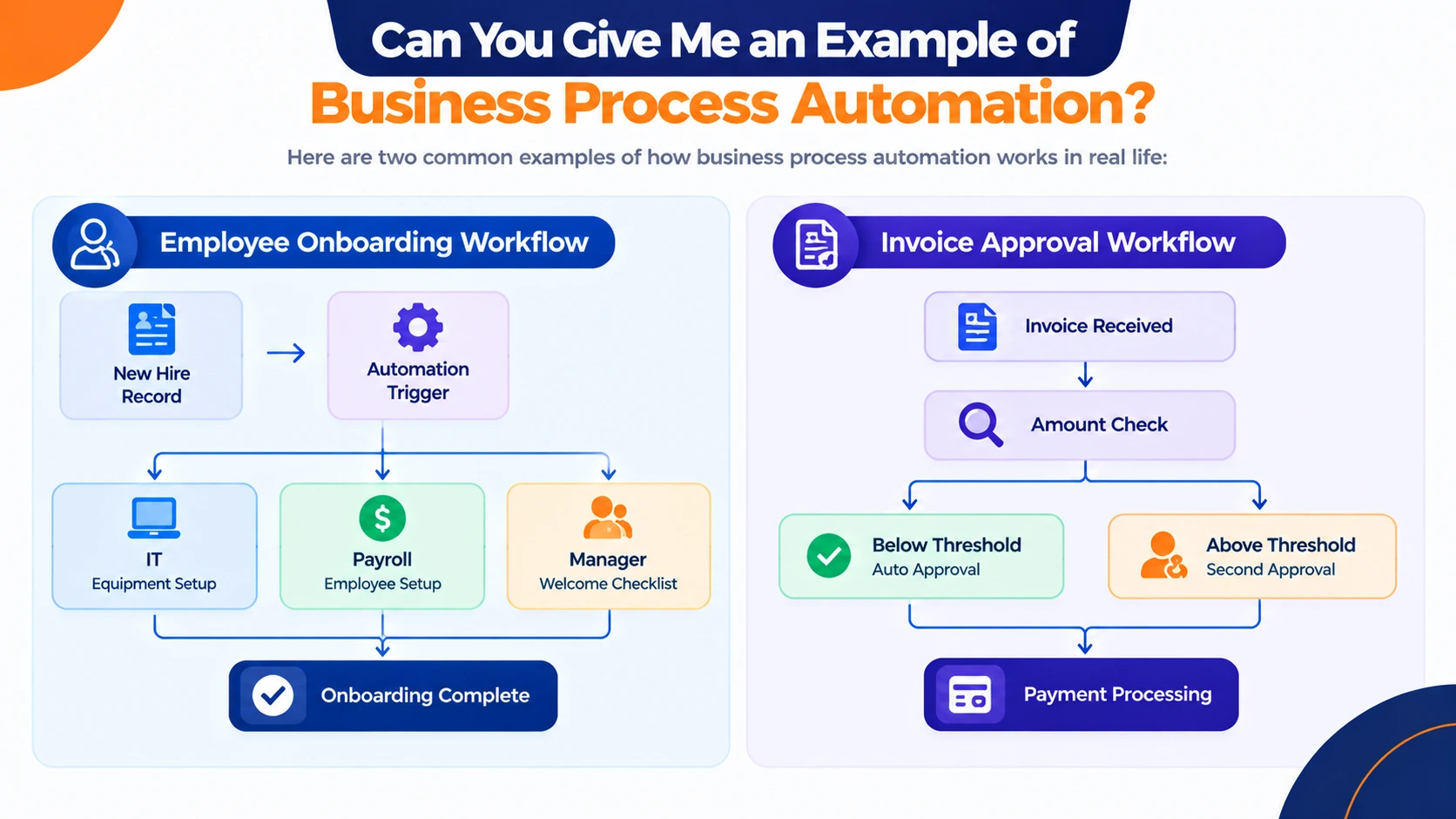
Employee onboarding is one of the clearest business process automation examples: a new-hire record triggers IT provisioning, payroll setup, and manager tasks automatically, instead of someone forwarding emails between departments. Invoice approval is another, where amounts above a set threshold route to a second approver while smaller ones clear instantly. Many teams document these flows in a business process automation PDF first, mapping each decision point on paper before a developer builds the equivalent digitally.
Building a Business Process Automation Strategy for Growing Companies
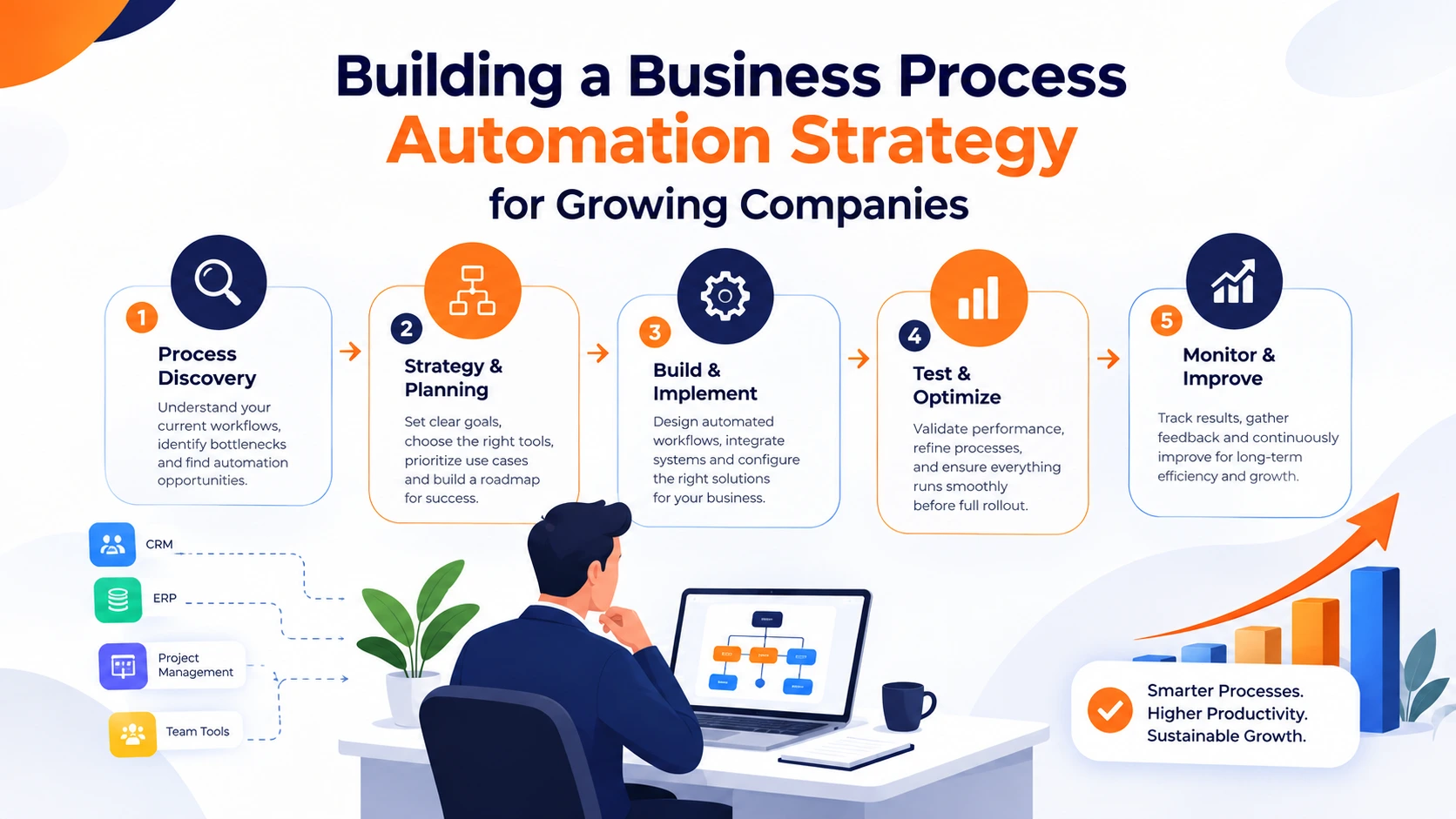
A solid business process automation strategy for growing companies template usually starts by ranking processes by volume and repetitiveness, not by which department shouts loudest. A useful business process automation strategy for growing companies example is a mid-size company automating accounts payable first, since it's high-volume, rules-based, and easy to measure. Teams that want to see this laid out step by step often look for a business process automation strategy for growing companies PDF that walks through prioritization, tool selection, and change management in order, rather than jumping straight to software.
Business Process Automation Tools Worth Knowing
The right business process automation tools depend on what you're automating: workflow platforms handle multi-step approvals, robotic process automation handles repetitive data tasks, and AI-driven tools handle judgment-heavy decisions. For enterprises already running SAP, business process automation SAP integrations are common, since SAP holds core financial data that automation tools need to read and act on directly. Picking tools before mapping the process is a common reason automation projects stall after the pilot.
Is AI Replacing RPA?
Not exactly, though the two are converging fast. Robotic process automation still handles structured, rules-based tasks reliably. At the same time, AI adds the ability to interpret unstructured information, like an email or a scanned document, before deciding what to do with it. Most modern platforms now combine both, using RPA to execute the steps and AI to handle judgment calls that rules-based automation couldn't manage alone. The result is fewer processes that need to stay fully manual just because they involve a decision.
What Are the Top 5 RPA Tools?
Despite the ranking changing each year, some of the top RPA tools mentioned in industry analyses include UiPath, Automation Anywhere, Blue Prism, Microsoft Power Automate, and Pega. All perform the same essential function of automating structured, repetitive processes; however, they vary in their ability to integrate with other programs and the amount of effort involved in doing so. Ultimately, choosing the appropriate tool will often have less to do with branding than the ease of integration with your existing software stack.
What Are the 5 Core Business Processes?
Most organizations, regardless of industry, run on five core business processes: order-to-cash, procure-to-pay, hire-to-retire, record-to-report, and the customer service lifecycle. These show up repeatedly in automation strategies because they're high-volume, rules-heavy, and tied directly to revenue or compliance, which makes the return easy to measure. Businesses starting their automation journey typically get the fastest wins by targeting one of these five first, rather than a niche process nobody outside one team notices.
Learning More: Business Process Automation Books and Resources
For teams building internal expertise, several business process automation books cover the strategic and technical sides in depth, from process mapping frameworks to hands-on RPA implementation guides. These resources are especially useful for a business analyst trying to build a case for automation internally, since they translate abstract efficiency gains into frameworks leadership can act on. Pairing that reading with real internal process data tends to produce a stronger pitch than theory alone.
The Real Test Before Signing Any Automation Contract
Before committing to any provider, ask them to walk through a process they automated that didn't go as planned, not just their best case study. How a company handles a stalled rollout, a rule that didn't account for an edge case, or a department that resisted adoption says more about fit than a polished pitch deck ever will. Providers who can speak specifically about what they'd do differently next time are usually the ones who've actually run enough projects to know where the real risk sits.