monday.com Services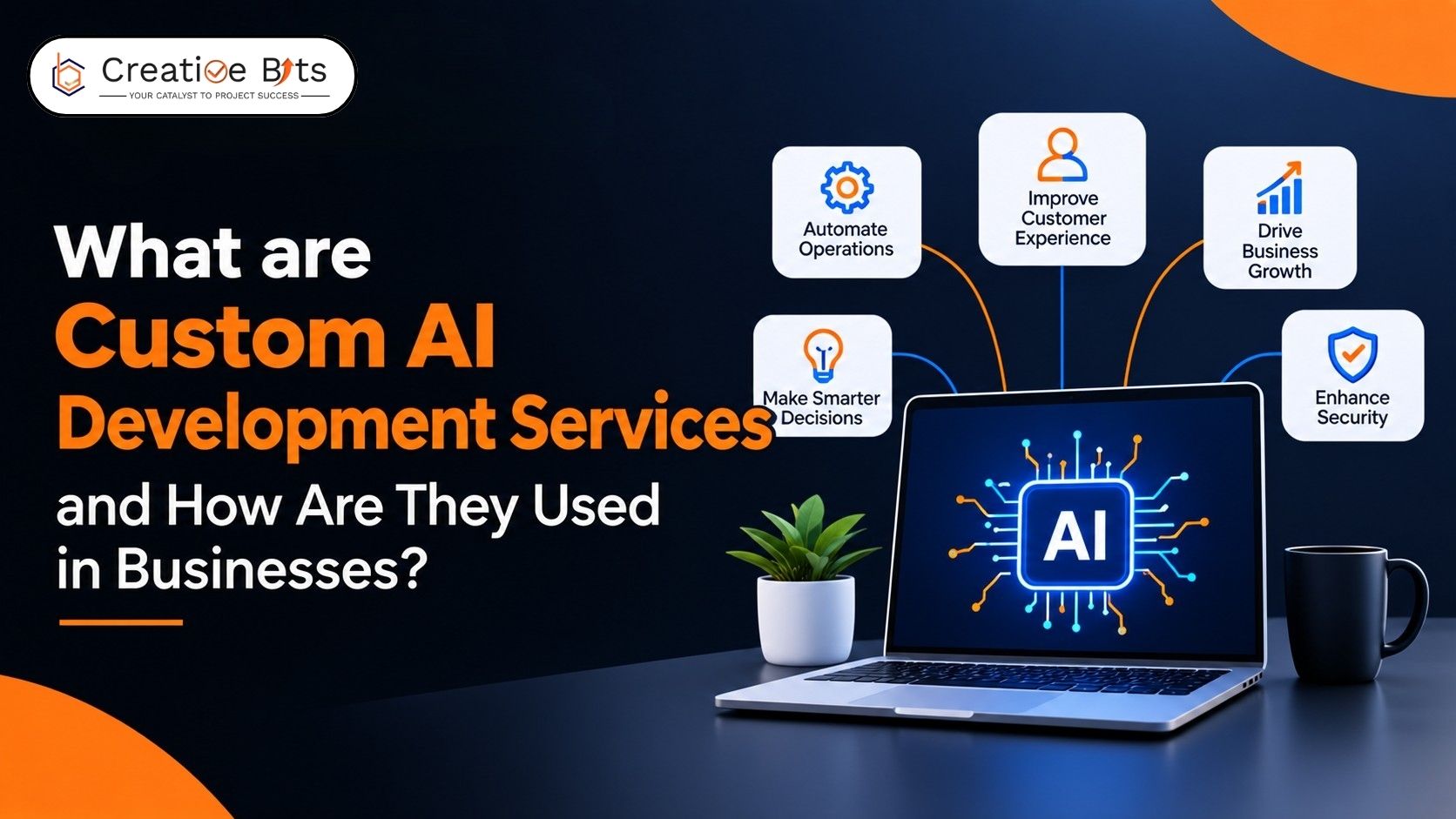
What Are Custom AI Development Services and How Do They Supercharge Businesses?
Many businesses want to use AI, but the real challenge is figuring out where it can actually make a difference. Buying another AI Tool is not always the answer. Sometimes, the bigger problem is a slow approval process, repetitive data entry, scattered information, or a team spending hours on tasks that could be automated
That's where custom AI development services can help. Instead of asking your business to adapt to a generic AI product, a custom solution is built around the way your team already works. It can connect with your existing tools, use your business data, follow your processes, and help automate tasks that would otherwise require a lot of manual effort.
Below: what custom AI development services include, how businesses use them, and the questions people search most before hiring an AI development company.
In this guide, we will look at what custom AI development services include, how businesses are using them, and what to consider before choosing an AI development partner
Custom AI Development Service Company
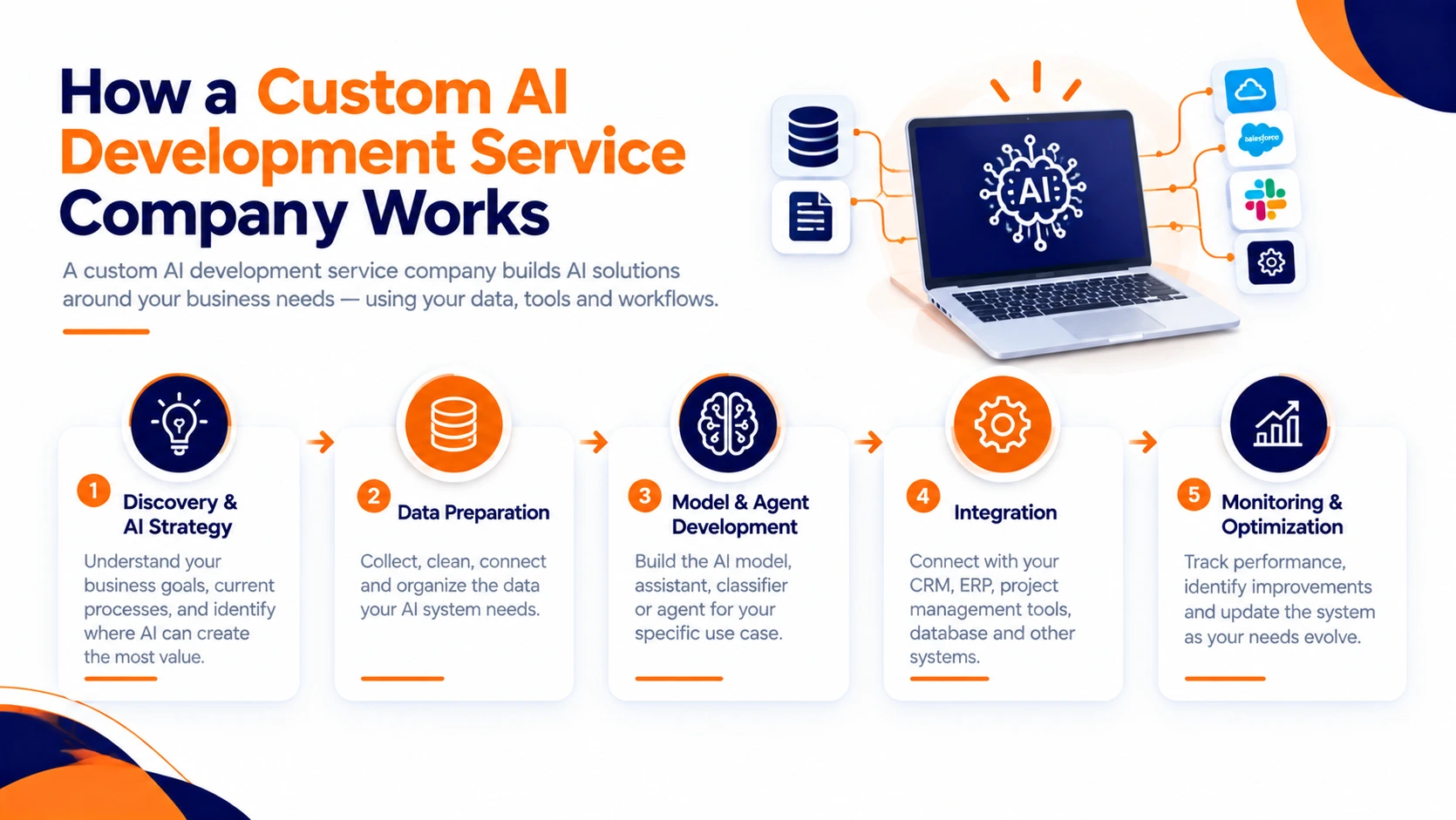
A custom AI development service company builds AI solutions around the specific needs of a business. Data preparation —Instead of giving every customer the same features like a typical subscription-based tool, a custom solution is designed around your data, existing software, workflows, and business rules. Most custom AI development projects generally involve five key stages:
Discovery and AI strategy —understanding your current processes, identifying where AI can make the biggest difference, and deciding how success will be measured.
Data preparation — collecting, cleaning, connecting, and organizing the data the AI system will need.
Model and agent development — developing the AI model, assistant, scoring system, classifier, or agent needed for the specific task.
Integration — connecting the AI solution with the CRM, ERP, project management platform, database, or other tools your team already uses.
Monitoring and optimization — keeping an eye on performance and updating the system as your data and business requirements change.
Conversational AI development is often part of the same process. For example, a company might build an internal AI assistant that answers employees' questions using approved company documents, or a customer support chatbot that can check an order status and hand the conversation over to a human when necessary
How Are Custom AI Development Services Used in Businesses?
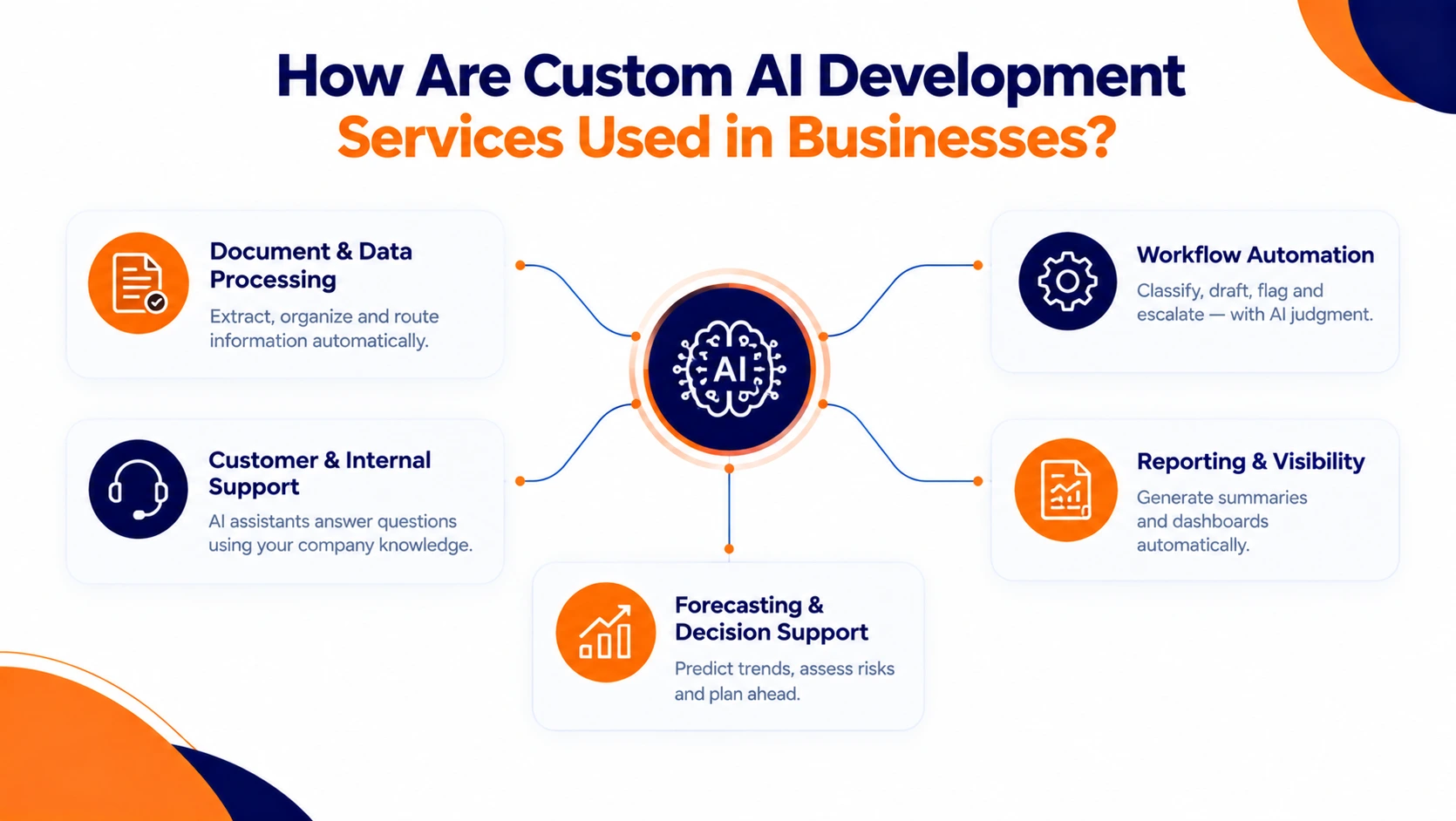
The best projects start with a bottleneck, not a buzzword. Here is where custom AI development services usually land first.
Document and data processing. Invoices, resumes, contracts, and support tickets get read, extracted, scored, and routed automatically, so nobody retypes fields between systems.
Workflow automation with judgment. Standard automation follows fixed rules. AI-assisted workflows handle the grey areas: classifying a request, drafting the reply, flagging the exception, and escalating only what needs a person.
Customer and internal support. Conversational AI development services power assistants that pull from your own knowledge base, so answers reflect your policies rather than a generic internet consensus.
Forecasting and decision support. Demand planning, churn prediction, and risk scoring, trained on your own history rather than a generic benchmark.
Reporting and visibility. Status summaries, portfolio roll-ups, and dashboard narratives generated automatically instead of assembled by hand every Monday.
We look at AI from a practical business perspective. The goal isn’t to add AI just because it’s a available. We first look at where a team is losing time or dealing with repetitive work, and then consider whether AI automation can improve that process
What Are the Top 3 Most Used AI?
Three assistants dominate. Sensor Tower's 2026 data puts ChatGPT at roughly 1.1 billion monthly users, Google Gemini at about 662 million, and Anthropic's Claude at around 245 million. Similarweb's web-traffic view is similar: ChatGPT near 54% of chatbot visits, Gemini around 28%, Claude about 9%.
ChatGPT (OpenAI): ChatGPT is the most-used AI overall in the world, leads the market globally, and is used by students for study. It captures significantly more web traffic and mobile active users than any competitor.
Gemini: It ranks as the second-largest consumer AI tool globally on both web and mobile platforms and is multimodal, used to write and summarize content, analyze images, and generate code.
Microsoft Copilot: Microsoft Copilot is heavily used in workplaces for productivity and office automation and helps you write and search code and handle daily tasks. It is built into the web, Windows, and popular work apps.
The trend matters more than the ranking. ChatGPT's share fell below 50% for the first time in 2026, and the market has split into tools people pick for different jobs. That fragmentation is one reason custom AI development services are growing faster than any single platform.
For businesses, the takeaway is simple: those three are interfaces, not solutions. They can draft an email, but they can't approve your purchase order or update your CRM. Custom AI development services turn a capable model into a system that does your work, inside your stack, with your guardrails.
What AI Is Better Than ChatGPT?
The useful version of this question is "better at what?" It is also the first thing custom AI development services have to settle.
Claude is widely preferred for long-document analysis, coding, and enterprise deployments where reasoning quality and data governance matter. Gemini has the edge on multimodal tasks and anything inside Google Workspace. Grok leans toward real-time information and aggressive developer pricing. ChatGPT remains the strongest all-rounder.
There is no single winner, which is why model choice should be a design decision, not a default. A capable AI development company benchmarks two or three candidates against your actual data, weighs accuracy against cost per task, and builds the integration so a model can be swapped later without a rebuild. That flexibility is a quiet advantage of custom AI development services.
Which AI Does Elon Musk Use?
Elon Musk uses Grok, built by his own company, xAI. Grok powers the standalone Grok app, the assistant inside X, and the Grok Build coding agent, and it has been rolled into Tesla vehicles as an in-car assistant.
Grok is best for tracking real-time social media intelligence, pulling breaking news from live X (formerly Twitter) data, and executing automated knowledge-work tasks using persistent AI agents.
The signal for business leaders is the release cadence, not the branding. Frontier models change monthly, so custom AI development services should be architected to treat a model upgrade as a configuration change rather than a re The Grok 4.x line arrived in rapid succession through 2026, with Grok 4.5 entering private beta inside SpaceX and Tesla, and Grok 4.6 launching at roughly half the price of comparable frontier models. Grok is also tied to Tesla's Optimus robot programme.
Which Is the Smartest AI Right Now?
Whoever shipped most recently. Frontier models from OpenAI, Google, Anthropic, and xAI sit within a few points of each other on most public benchmarks, and the leaderboard reshuffles every few weeks.
Which is why "smartest" is the wrong question for a business. Smartest is a benchmark score. Most useful is the measure custom AI development services optimise for: does the system have your data, does it fit your workflow, is it accurate on your edge cases, and can a human review output before anything irreversible happens?
A model that scores slightly lower but is wired correctly into your process beats a benchmark champion sitting in a browser tab. Closing that gap between raw capability and business outcome is the entire job of custom AI development services.
Turning AI Interest Into Working Systems
AI stops being a talking point the moment it removes a real task from a real calendar. That shift comes from mapping the process, preparing the data, building for your systems, and supporting the result after launch.It builds practical AI tools, workflow automation, and monday.com solutions for teams that want fewer manual steps and faster decisions. If a process eats hours every week, start there.
Ready to see what custom AI development services could do for your operations?
ChatGPT is a general assistant with no access to your systems. A custom solution is connected to your CRM, project boards, and databases, follows your business rules, and produces outputs your team can act on directly. Typically: an AI strategy and roadmap, cleaned and connected data, a trained model or agent, integration into your existing tools, testing and documentation, and ongoing monitoring and retraining after launch. They cover AI assistants and chatbots built on your own knowledge base — internal helpdesks, customer support bots, lead qualification assistants — connected to live systems so they can look things up and take action, not just chat. Anything repetitive, document-heavy, or judgment-light: invoice and resume processing, ticket triage, status reporting, data entry between systems, forecasting, and first-line customer support. ChatGPT, Google Gemini, and Anthropic's Claude lead by both monthly users and web traffic, with ChatGPT's share now below half of the assistant market as Gemini and Claude grow quickly. It depends on the task. Claude is often favoured for long-document reasoning, coding, and enterprise use; Gemini for multimodal work and Google Workspace integration; Grok for real-time data and low developer pricing Grok was developed by his company, xAI. It runs in the Grok app, inside X, in Grok Build, and in Tesla vehicles as an in-car assistant. No model holds the title for long — the leading systems trade places on benchmarks every few weeks. For business use, fit, grounding in your data, and reliability matter far more than a benchmark ranking. 2. How are custom AI development services different from using ChatGPT?
3. What does a custom AI development service company actually deliver?
4. What are conversational AI development services?
5. Which business processes benefit most from custom AI?
6. What are the top 3 most used AI tools in 2026?
7. Which AI is better than ChatGPT?
8. Which AI does Elon Musk use?
9. Which is the smartest AI right now?