monday.com Services
Which Agentic AI Workflow Examples Actually Work in Production?
Give an agent several tools, and it will skip calls or run them in the wrong order.
That finding comes from a 2025 engineering paper on taking agentic workflows to production, and the fix was blunt: one agent, one tool. It's the kind of detail missing from almost every article promising agentic AI workflow examples: plenty show you what's possible; very few show you what breaks.
So here's both. Real agentic AI workflow examples, one walked through end to end, the patterns that hold up, and the engineering practices that keep them running.
Practical Agentic AI Workflow Examples and the Best Free Tools to Build Them
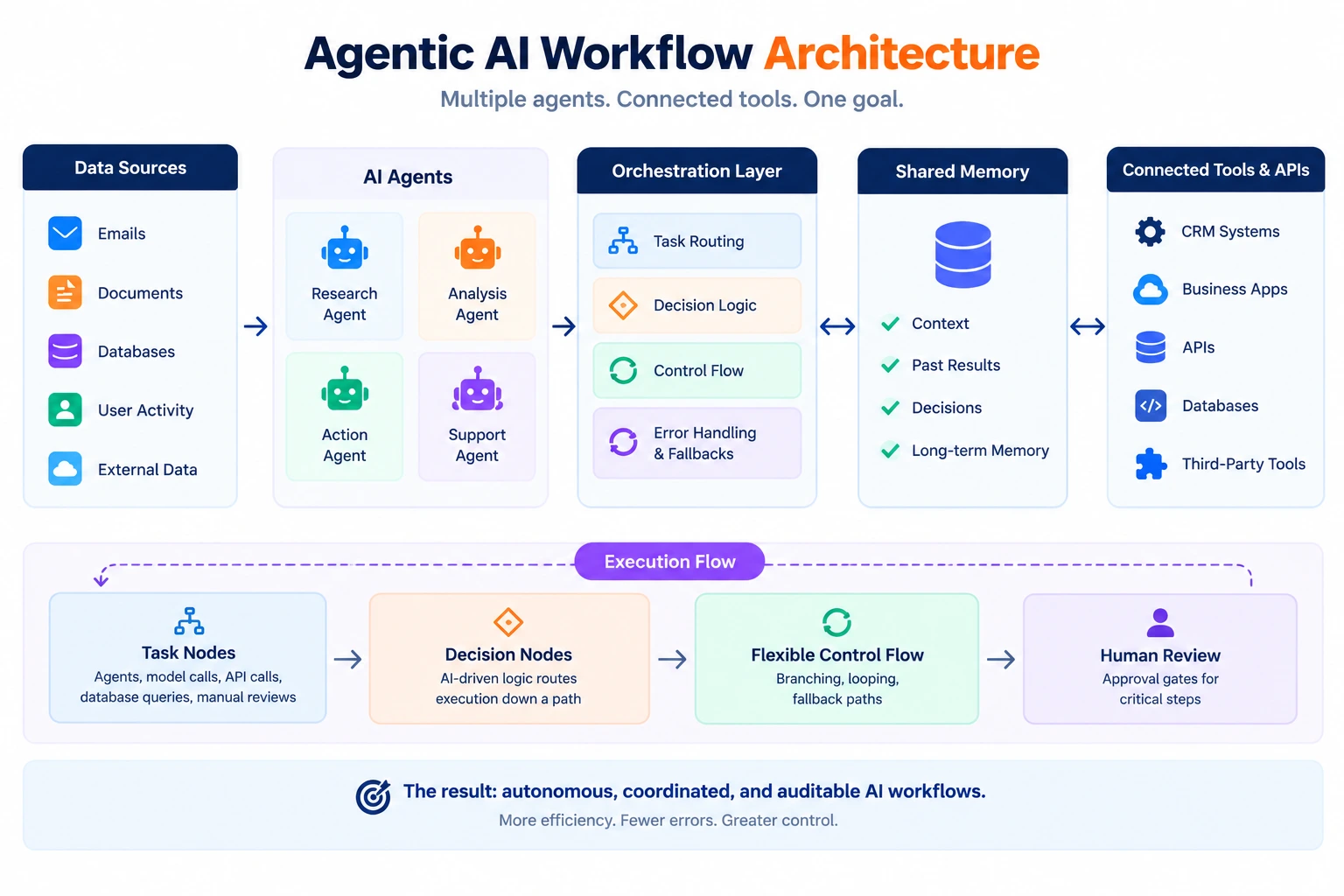
Start with the architecture, because every working agentic AI workflow shares the same three parts.
Reasoning. The model plans, breaking a task into steps, and reflects, evaluating outcomes and adjusting.
Tools. Internet search, vector search, code interpreters, APIs. These extend the model past its training data, and they're normally paired with explicit permissions.
Memory. Short-term holds immediate context like conversation history. Long-term persists across sessions, which is what lets an agentic AI workflow personalise and improve.
Worth noting a distinction that trips people up: the agentic architecture is the overall system design; the agentic workflow is the sequence of steps the agent takes through it. If you're sketching an agentic AI workflow diagram, the architecture is the boxes and the workflow is the arrows.
Proven agentic AI workflow examples by function:
- Agentic RAG: the agent splits a query into subqueries, evaluates what comes back, and reformulates when the answer is unsatisfactory
- Research assistants that browse, synthesise, and adapt their plan mid-task
- Coding assistants that execute code, refine based on results, and pause for approval
- Lead enrichment, researching names and emails into full records, then drafting personalised outreach
- Support triage, searching a knowledge base, summarising similar cases, recommending a resolution for human approval
On free tools: open-source frameworks are genuinely free to self-host, with model tokens and infrastructure your only cost. Automation platforms with AI steps, the category Creative Bits builds on, mostly have usable free tiers. Either is enough to build your own agentic AI workflow examples this week.
Can You Provide an Example of an Agentic AI Workflow?
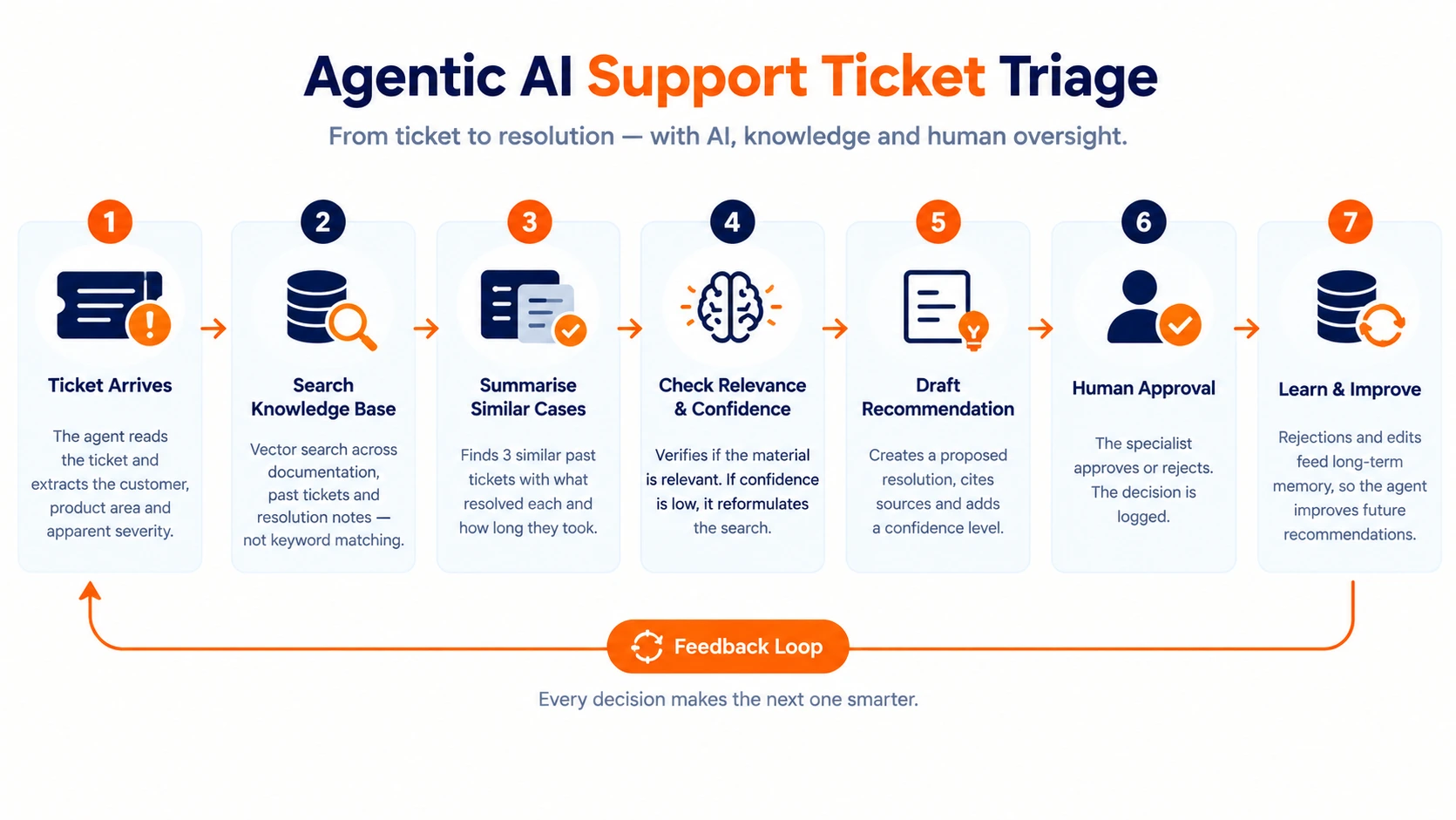
Take support ticket triage, one of the most common agentic AI workflow examples in production, step by step.
A ticket arrives. The workflow reads it and extracts the customer, product area, and apparent severity.
It searches the knowledge base. Vector search across documentation, past tickets, and resolution notes, not keyword matching, so it finds conceptually similar cases rather than ones sharing words.
It summarises precedent. Three similar past tickets: what resolved each, how long they took.
It reflects. Is the retrieved material actually relevant? If confidence is low, it reformulates the search rather than answering from thin evidence. This self-critique step is what makes it agentic rather than a lookup.
It drafts a recommendation, proposed resolution, cited sources, and confidence level.
A human approves or rejects. The specialist decides. The workflow logs the decision.
It learns. Rejections and edits feed long-term memory, so the agentic AI workflow improves its future recommendations.
Notice the shape. High-frequency, low-risk steps- reading, searching, summarising, drafting- run automatically. The one consequential step, replying to a customer, stays human. That split is common to essentially all agentic AI workflow examples that survive contact with production.
What Is the Best Agentic Workflow?
Three agentic AI workflow patterns exist, and they suit different problems.
Planning. The agent decomposes a complex task into subtasks. Best when the path to the goal is genuinely unclear, and the trade-off is real: published guidance notes that planning makes results less predictable.
Tool use. The agent interacts with external systems rather than only retrieving information. This is the workhorse pattern and where most business value sits.
Reflection. The agent critiques its own output, uses feedback like error messages to refine, and stores the insight.
The honest answer to "which is best": tool use plus reflection, with planning avoided unless you need it. Predictability matters more than cleverness in a business process, and planning is where predictability goes. The best agentic AI workflow examples use a fixed sequence with AI reasoning inside individual steps, not an agent inventing its own route each run.
Published engineering guidance goes further: prefer direct function calls for anything deterministic. Committing a file, posting to an API, writing a timestamp- run those as plain code in the orchestrator. It's cheaper, faster and easier to test than asking a model to decide. Reserve tool calls for steps that genuinely need language reasoning.
What Are Some Good Examples of Agentic AI?
Here are agentic AI workflow examples actually running, drawn from documented deployments across sectors:
- Retail, voice support across hundreds of stores, answering pricing and stock questions from point-of-sale and procedure documents
- Construction, multi-agent extraction from tender PDFs into an operations platform, with reported tender processing up to around 90% faster
- Hospitality, booking emails handled, inventory checked, alternative dates negotiated, itinerary creation handed to humans
- Real estate, tenant queries across web, WhatsApp and email with escalation to human teams
- Banking, omnichannel case triage with agent-assist and audit trails
- Procurement, RFQ automation and supplier matching, with regulatory document handling
- Utilities, grid data ingestion, outage prediction, alert routing
- Healthcare staffing, matching staff to facility requests, managing scheduling and compliance
One caution about reading agentic AI workflow examples like these: most published results are qualitative, faster cycles, better visibility, less manual work. Where figures appear, they're often engineered targets rather than verified outcomes. Treat them as proof the pattern works, not as a forecast of your numbers.
The common thread is more useful than any single figure: every one of them automates a high-volume task where a person previously read something and decided what happened next.
What Are Some of the Best Agentic AI Projects?
If you want to build rather than buy, these agentic AI workflow examples teach the most:
- Agentic RAG over your own documents. Query decomposition, retrieval, self-evaluation. Teaches the whole loop with low stakes.
- Document extraction with validation. Invoices or forms into structured fields, with a reflection step checking its own output.
- Support draft generation with human approval before anything is sent.
- Lead research and enrichment, the most immediately useful first build for most businesses.
Then apply the practices that published engineering work found actually matter:
- One agent, one tool. Agents with several tools skip calls or misorder them.
- Single-responsibility agents. Separate planning from execution.
- Externalise prompts. Store them outside code so they can be versioned, reviewed, and rolled back without redeploying.
- Decouple backend from interface. Expose the workflow as an API; keep the integration layer thin.
- Keep it flat. Readable, function-driven designs beat deep abstraction.
And know where agentic AI workflow examples fail before you meet it: ambiguous tool selection, skipped calls as prompts grow, malformed output mixed with prose, fabricated status messages for actions that never happened, and different models stating the same fact differently. Evaluate each agent separately, check structural validity, and test consistency across repeated runs.
Build One, Then Break It
Pick one high-volume decision. Build the narrowest agentic AI workflow that handles it, fixed sequence, AI reasoning inside steps, human approval on anything irreversible. Then try to break it deliberately before it meets real work.
Creative Bits maps the process before the tooling, which is the same order these engineering practices recommend: process mapping, build, real-world testing.