monday.com Services
Which Agentic AI Workflow Tools Actually Deliver in Production?
Two tools advertise $50 a month. One means 50,000 credits; the other 2,000 tasks. Neither tells you what a month of real work costs.
That's the first thing about agentic AI workflow tools: headline prices are close to meaningless because the billing unit differs between vendors. Credits, tasks, activities, executions, seats- the same figure means something different in each, and model usage is often billed on top.
So here's a buyer's guide to agentic AI workflow tools: what's genuinely free, which categories exist, how integration works, and what to verify before trusting any with real data.
Best Agentic AI Workflow Tools: Free and Open-Source Options
Two kinds of free, and they behave completely differently.
Genuinely free: open-source frameworks. Six or seven of these agentic AI workflow tools are in active production use, nearly all MIT- or Apache 2.0-licensed and free to self-host. Your only costs are model tokens and infrastructure.
- LangGraph: stateful, branching workflows with human-in-the-loop approvals. Python and TypeScript.
- CrewAI, role-based multi-agent setups such as research crews. Python only.
- LlamaIndex agents, retrieval-first agents reasoning over your indexed data.
- Semantic Kernel, the pick for .NET and Azure estates.
- Pydantic AI, Python teams prioritising type safety.
- AutoGen / AG2, research-style conversations and code execution, though the original repo is in maintenance mode, so new work may belong on a fork.
A licensing caution: published sources disagree on some of these licences, and rebrands change them. Check each project directly before building anything commercially significant.
Free tiers on commercial platforms. Roughly two-thirds offer one, but published testing found allowances frequently too small to evaluate properly, small credit quotas, a run limit on one agent, balances expiring after seven days, or a 14-day trial instead of a plan. Self-hosting remains the only route to a free tier with no ceiling.
What Are the Top Agentic AI Workflow Tools for Businesses?
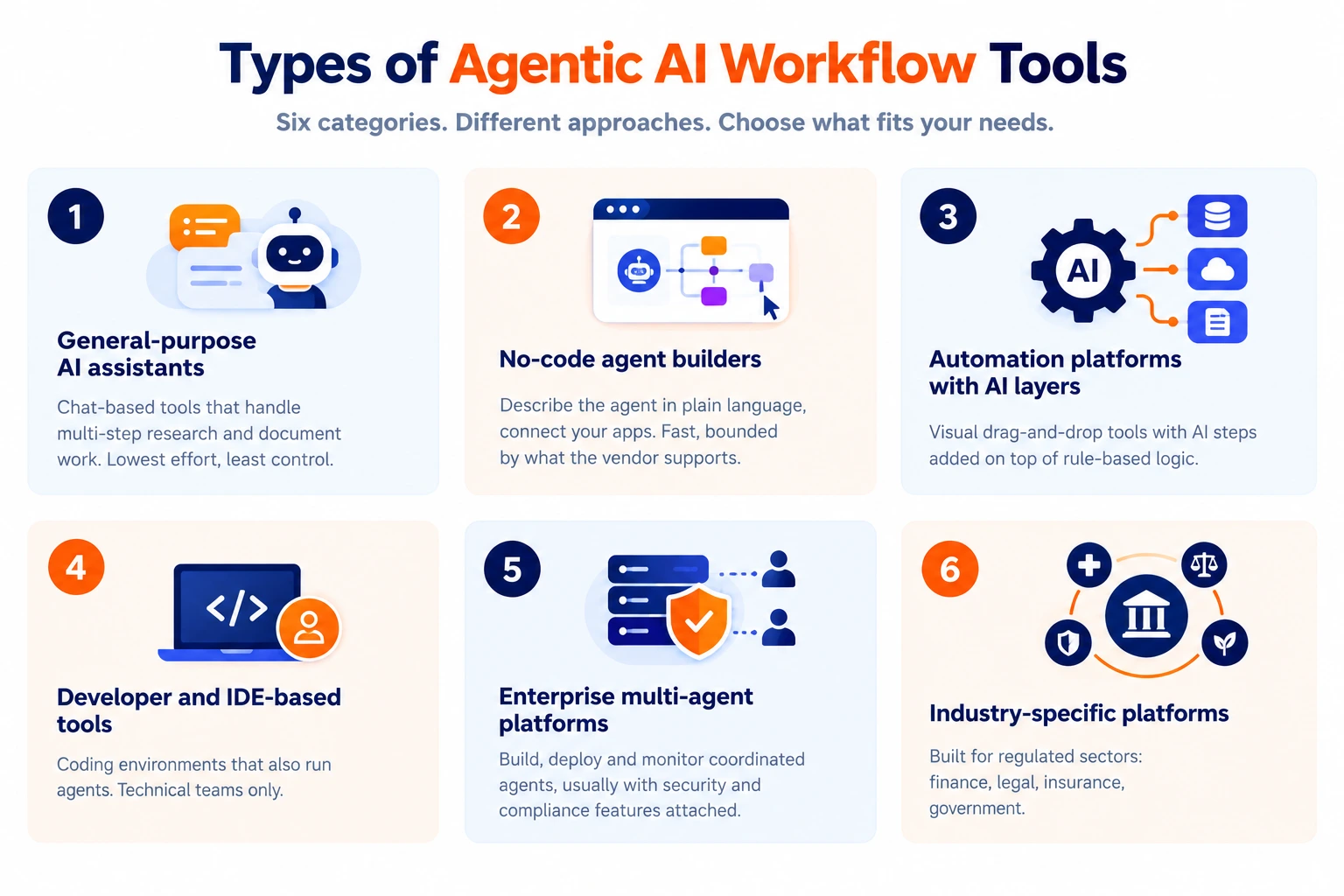
Rankings shift monthly, and every published list of agentic AI workflow tools is written by a vendor appearing in it. Categories are more durable. Six exist:
General-purpose assistants with agentic features. Chat-based, handling multi-step research and document work. Lowest effort, least control.
No-code agent builders. Describe the agent in plain language, connect your apps. Fast, bounded by what the vendor supports.
Automation platforms with AI layers. Visual drag-and-drop tools with AI steps added on top of rule-based logic. For most businesses, this is where agentic AI workflow tools should start; rules stay deterministic, and AI handles only interpretation.
Developer and IDE-based tools. Coding environments that also run agents. Technical teams only.
Enterprise multi-agent platforms. Build, deploy, and monitor coordinated agents, usually with security and compliance features attached.
Industry-specific platforms for regulated sectors: finance, legal, insurance, government.
Pick the category before the product. Most apparent choice dissolves once you know which of those six you are shopping in.
How Do Agentic AI Tools Integrate With My Existing Software Stack?
Four mechanisms, and which ones your agentic AI workflow tools support, determine how much custom work you will do.
Standardised connectors. Pre-built integrations into your CRM, helpdesk, document store, and messaging. Breadth varies enormously.
MCP support. The Model Context Protocol lets agentic AI workflow tools use shared tool collections rather than bespoke wiring per integration. Support is uneven and worth confirming explicitly.
Model access. Some include LLM access; others require your own API key, which changes cost structure and which models you can swap to later.
Observability. OpenTelemetry tracing, span coverage, failure logging, native in some frameworks, bolt-on in others. Agentic AI workflow tools without tracing are unobservable when something breaks.
The practical test: port one real workflow using at least two tools onto your top two candidates. Measure model calls, tool-call success rate, retries, latency, cost, and checkpoint support. Then deliberately break it, force timeouts, feed malformed responses, reject an approval, and watch how it degrades.
Which Agentic AI Workflow Platforms Offer the Best ROI?
Return on agentic AI workflow tools comes from matching tier to job, not from picking the cheapest or most capable.
Where ROI is strongest. Automation platforms with AI layers, on one high-volume interpretation task. Low setup cost, predictable billing, auditable rules around the AI. For most businesses, this beats a custom build on cost per outcome.
Where ROI gets destroyed. Over-tooling, buying an enterprise multi-agent platform for a workflow that needed one AI step inside an existing automation. Also per-credit pricing on high-frequency workflows, where the billing unit quietly multiplies.
The billing trap. Model usage billed on top of base fees, orchestration fees on credit consumption, and governance features, audit logs, SSO, role-based access, reserved for enterprise plans. The tier you need for compliance often sits two tiers above the tier you need for capability.
How to compare. Take one workflow, estimate monthly runs, multiply by each tool's real billing unit, add model costs, then add the tier premium for the governance features you need. Published pricing comparisons are nearly useless without that exercise, because they compare headline rates across incompatible units.
What Features Should I Look For in an Agentic AI Workflow Solution?
Nine features separate usable agentic AI workflow tools from demo-ware:
- Natural-language agent creation for non-technical builders
- Integration breadth, including standardised connectors
- Flexible model access, bring-your-own-key or included
- A visual canvas showing how steps actually connect
- Template libraries to shorten the first build
- Scheduled and event-triggered runs, plus access from team messaging
- Human approval gates, the ability to pause before anything is sent
- Performance and failure monitoring
- Clear usage limits or credit visibility so spending stays predictable
Two matter most. Human approval is what makes agentic AI workflow tools safe on anything consequential. And time to first working agent, published testing measured signup to a correct result, predicts adoption better than any feature count.
Also check error quality. When agentic AI workflow tools break, are the messages useful enough to fix things quickly? Invisible in a feature matrix, obvious within an hour of real use.
How Secure Are Agentic AI Workflow Tools for Handling Sensitive Data?
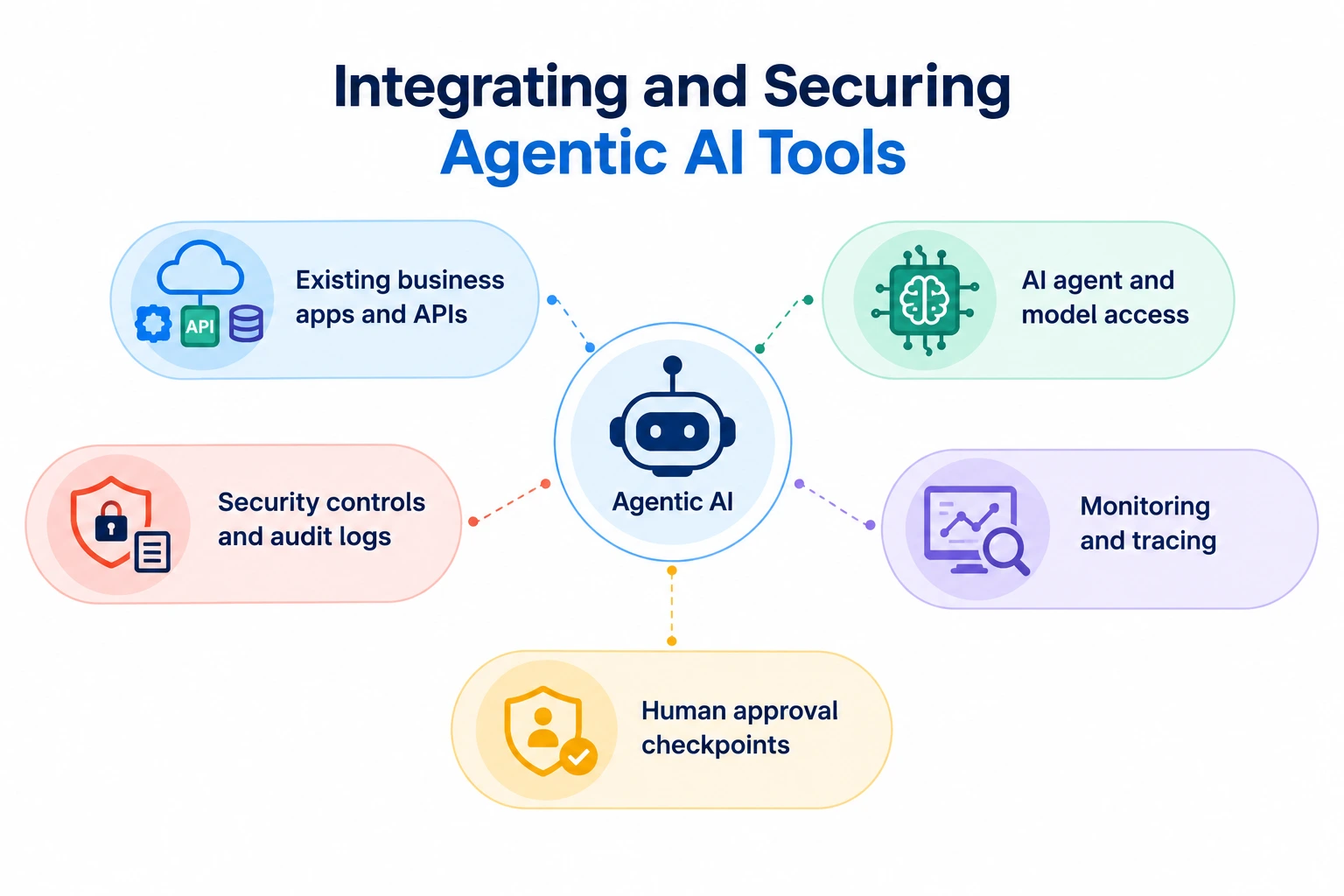
Agentic AI workflow tools are as secure as what you verify, which means asking specific questions rather than reading a trust page.
Sandbox code execution. Some frameworks state plainly that their local Python executors are not a security boundary. Any code-executing agent needs a sandbox before it touches files, credentials, or customer data.
Govern agent memory. Where agents edit their own memory, decide who may write or delete it, and how bad memory gets audited, a genuinely new failure mode.
Check deployment options. Cloud, hybrid, and self-hosted paths differ across agentic AI workflow tools. Self-hosting is the only answer when data cannot leave your infrastructure.
Confirm governance tier. Audit logs, SSO, and role-based access are frequently enterprise-only. Price the plan that includes them, not the one that doesn't.
Re-check licences after rebrands. One framework's current repository sits under a different licence from its predecessor. Verify before and after adopting.
Watch maintenance status. A popular repository in maintenance mode becomes a liability. Stars are not a signal; release cadence and issue velocity are.
Pilot Two, Break Both
Shortlist agentic AI workflow tools by category. Price by real billing unit at real volume. Then pilot one actual workflow on two candidates and try to break them.
Creative Bits builds on Zapier, Make, n8n, and monday.com, which means the recommendation on agentic AI workflow tools comes from mapping your process first, not from a platform we need you to buy.