monday.com Services
How Do Agentic AI Workflows Actually Decide and Act?
There is no universally agreed definition of agentic AI. That's worth knowing before you read anything else on the subject.
MIT Sloan says so plainly, and it explains why vendor pages describing agentic AI workflows contradict each other so freely. The term covers semi- and fully autonomous systems that perceive, reason, and act, and the gap between that definition and a well-prompted chatbot is where most confusion lives.
So here's the mechanics: what agentic AI workflows are, how the loop actually runs, where ChatGPT sits, and a worked example.
What Are Agentic AI Workflows? Examples, Architecture, Tools, and How They Work
Start with the distinction that matters most, because it's the one almost every article skips.
An AI agent is a single autonomous unit built around a language model. It reasons internally and decides which actions to take, which means its decision-making is largely hidden from anyone watching from outside.
An agentic workflow is an orchestrated process coordinating multiple agents, services, APIs, and human steps. The control flow is defined externally, even though the system can still choose paths at runtime.
That difference decides everything downstream. Agentic AI workflows are traceable, auditable, and debuggable precisely because the orchestration sits outside the model. A single agent is faster to prototype and far harder to govern.
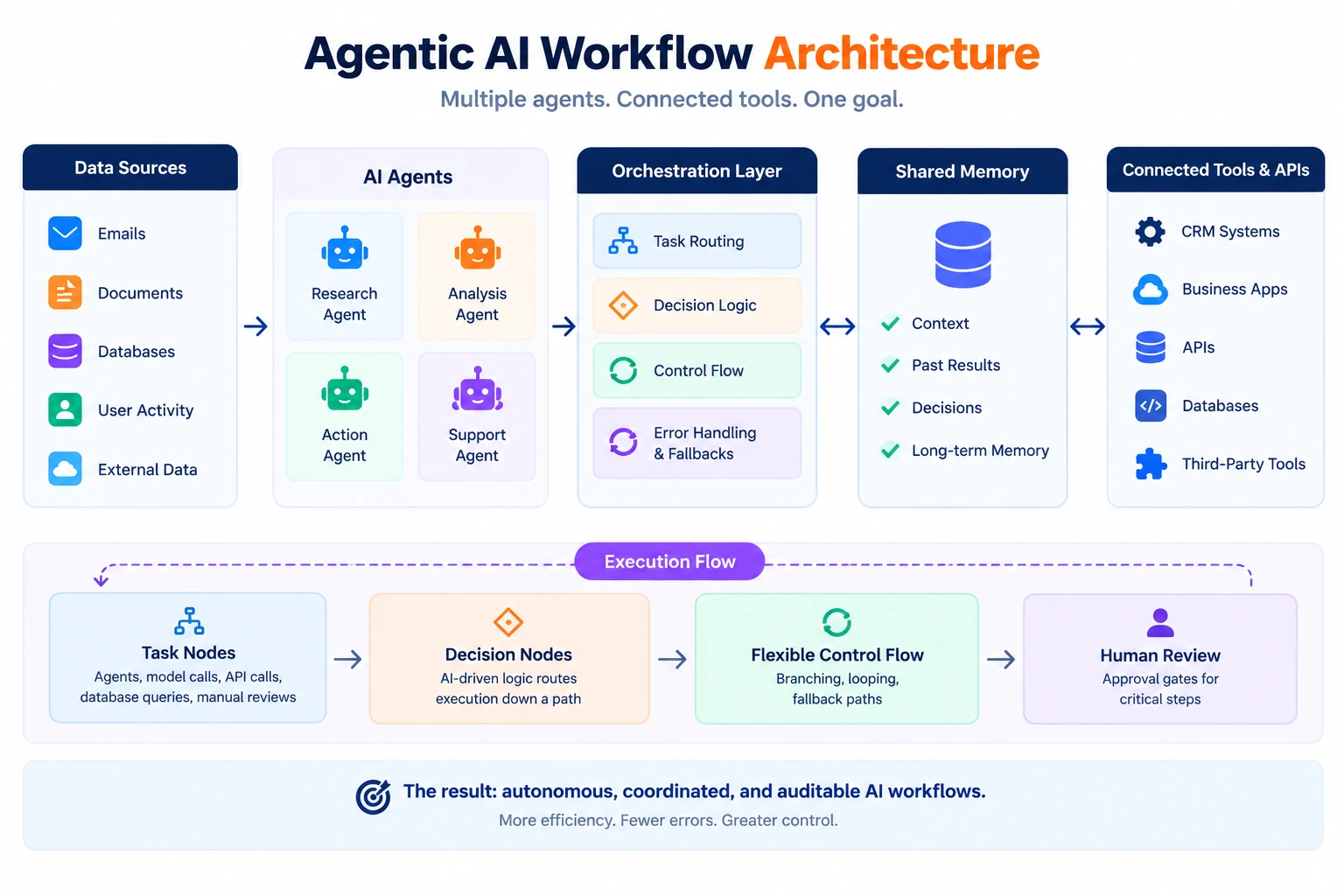
The architecture of agentic AI workflows has four parts:
- Task nodes, agents, model calls, API calls, database queries, manual reviews
- Decision nodes where AI-driven logic routes execution down one path or another
- Shared working memory carried across steps
- Flexible control flow with branching, looping and fallback paths
Agentic AI workflows break complex work into smaller steps, map the dependencies between them, and assign each to a specialised agent. Examples span customer support triage with handoff to humans, invoice processing and transaction matching in finance, inventory and maintenance prediction in supply chain, résumé screening and interview scheduling in HR, and code suggestion and test automation in software teams.
Orchestration tooling handles the sequencing. The practical recommendation from published guidance: prototype as a single agent, then move to agentic AI workflows for production, where governance actually matters.
How Do Agentic AI Workflows Work?
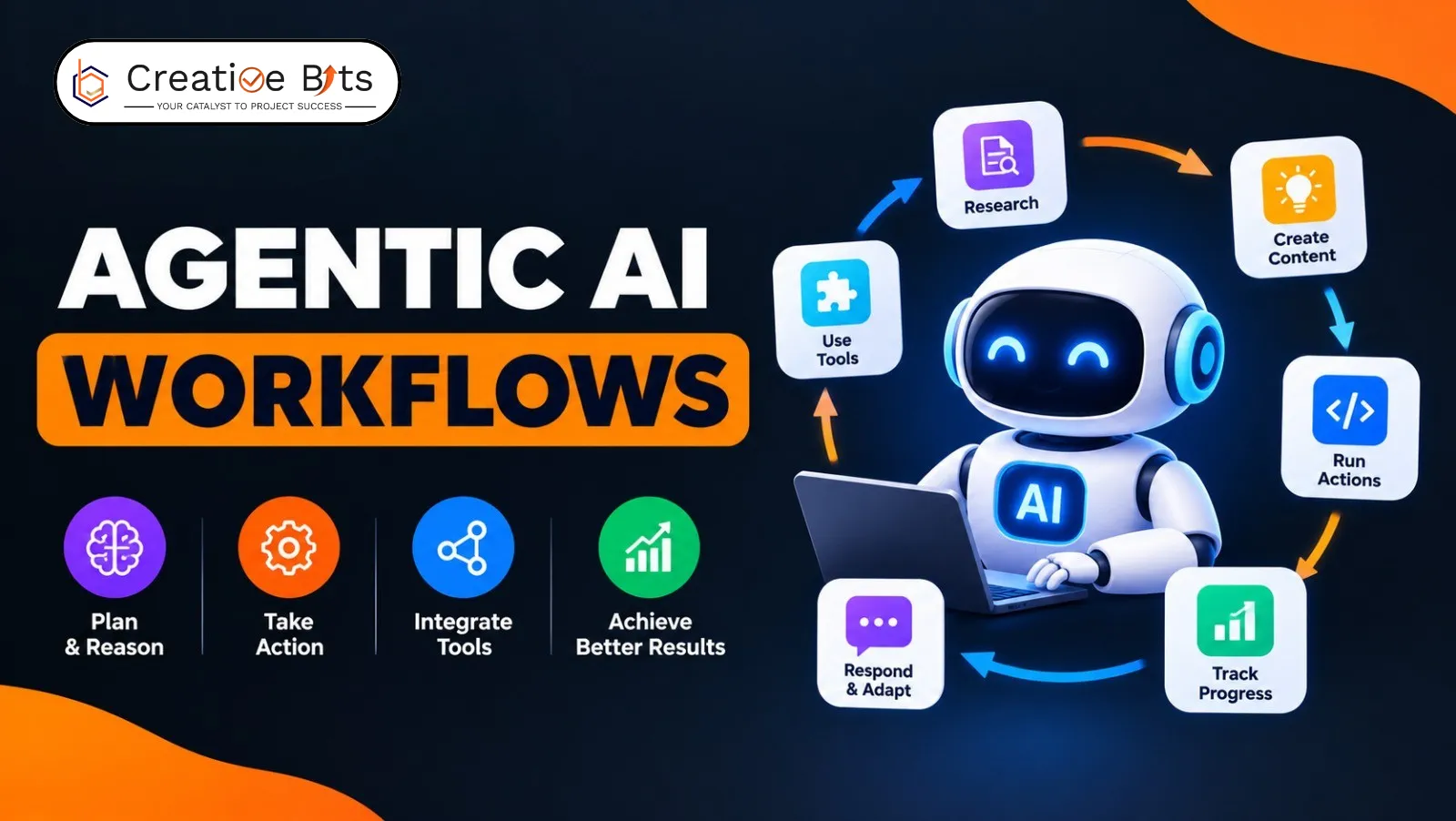
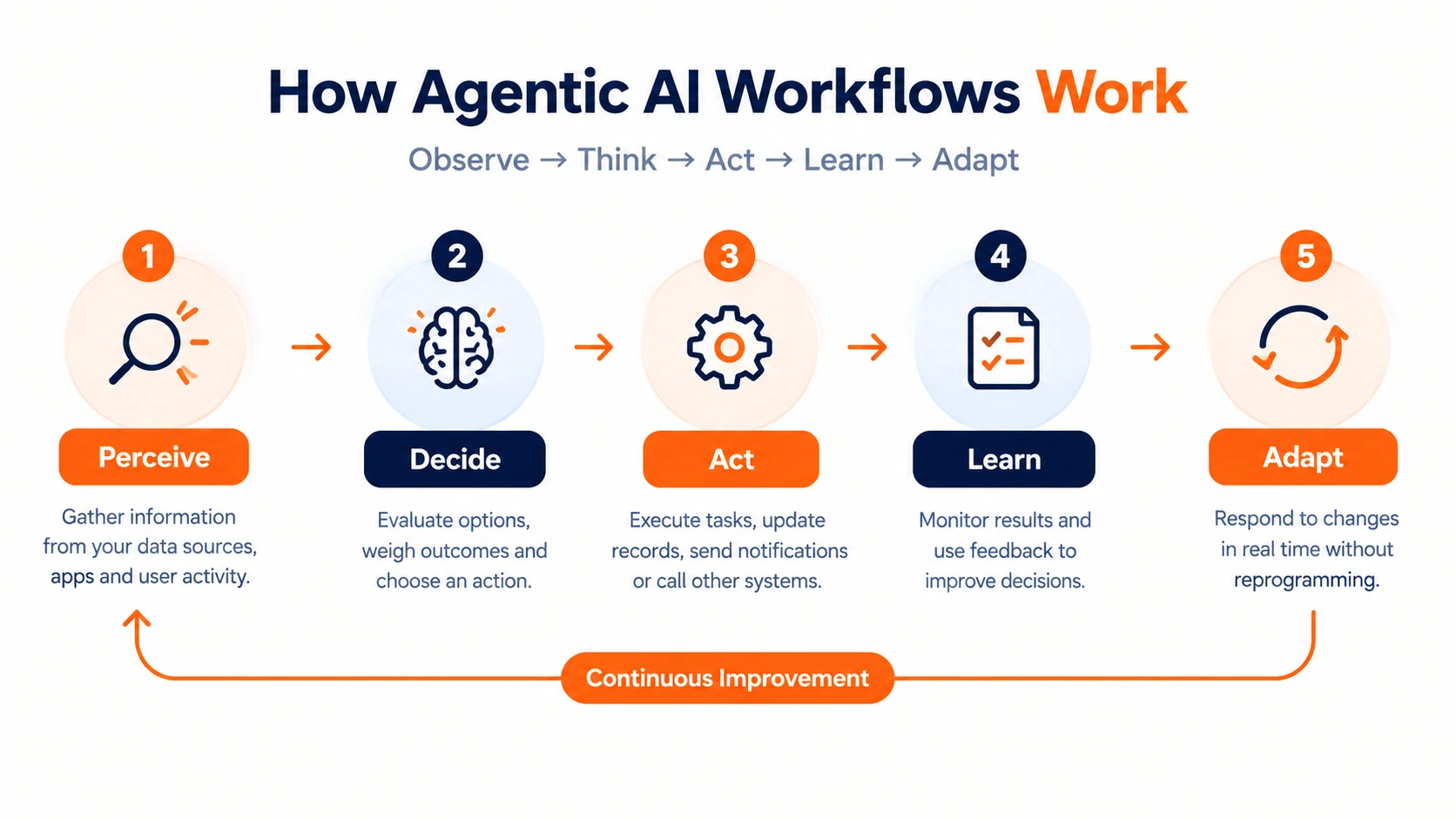
Five stages, repeating. Published descriptions of agentic AI workflows converge on the same loop.
- Perceive. The system gathers information from email, databases, documents, and user activity to identify what needs attention.
- Decide. It evaluates options, weighs past outcomes, and chooses an action. Internally, this often follows a Thought → Action → Observation cycle, where the model reasons, acts, observes the result, and reasons again.
- Act. It executes, sending notifications, updating records, generating content, and calling another system.
- Learn from feedback. Results get monitored and feed future decisions.
- Adapt. Conditions change, and the system responds without reprogramming.
Summarised, agentic AI workflows observe, think, and act. What makes them workflows rather than agents is that steps three and four pass through defined checkpoints you control.
Six components make this reliable: connected data sources, a model capable of using both available information and past results, connections into existing software, tracked outcomes, access limits with audit trails, and a coordination layer if multiple agents collaborate.
Is ChatGPT an Agentic AI?
Partly, and the honest answer depends entirely on configuration.
A chatbot answering questions is not running agentic AI workflows. It responds to a prompt and stops. Generative AI creates text, images, and video from human language. That's a different capability from acting in the world.
The same underlying model becomes agentic when you give it three things: tools it can call, memory across steps, and permission to act without approval at each step. At that point, it can execute multi-step plans, use external tools, and interact with digital environments.
So agentic AI vs generative AI isn't a comparison of two technologies. Generative AI is the engine. Agentic AI workflows are what you build around it, orchestration, tools, memory, guardrails. One MIT researcher draws a further line: AI agents are individual systems, while agentic AI describes multiple agents orchestrating a task together.
The practical test for anything marketed as agentic: what does it decide on its own, and which tools can it actually call? If the answer is "none" and "none," it's a chatbot with better marketing. Ask the same two questions of any vendor demo and most of the category sorts itself out quickly.
How Do Agentic Workflows Work Inside an Enterprise Workflow Platform?
Enterprise platforms implement agentic AI workflows through five capabilities, and they're worth knowing whichever platform you run.
Decision-making. Agents evaluate data, weigh possible actions, and select an approach rather than following fixed rules.
Task decomposition. Complex work splits into subtasks with dependencies mapped, which sets execution order.
Integration with existing systems. Agents reach the software, databases, and infrastructure holding the information they need. Nothing gets replaced.
Human interactivity. People guide agentic AI workflows through prompts, commands or manual adjustments mid-run.
Completion and follow-up. Agents assess outcomes, track performance, and refine subsequent work.
The governance layer matters as much as the capability. Published enterprise guidance is consistent: track data usage, manage access permissions, keep complete audit trails, apply metadata to key data points for transparency, keep humans in high-stakes decisions, and require that agents can explain their actions.
That last point is not optional. Agentic AI workflows making consequential decisions you cannot explain are a liability regardless of accuracy.
What Is Agentic AI and How It Works With an Example?
Take invoice processing, one of the most common real deployments.
A supplier invoice arrives by email. The workflow perceives it, extracts the supplier, amount, line items, and dates. It decides by matching against the purchase order and receiving record, checking the supplier's payment history, and flagging anything unusual. It acts by coding the entry to the right account and project, then staging a payment for approval. A human approves. The workflow learns from corrections and improves its coding accuracy.
Notice what stayed human: the payment. High-frequency, low-impact steps run automatically; the irreversible one routes to a person. That single design rule prevents most of what goes wrong in agentic AI workflows.
Now the honest caveats, because they're the part vendor pages omit.
Agents struggle with exceptions people handle easily, and their decision-making remains poorly understood. Faulty information can produce harmful decisions, a wrongly rejected loan, for instance, so explainability and consistency are requirements, not features. As agents gain access to more systems, permission controls become critical. And someone has to own accountability when an agent errs.
Most striking: in one documented study, roughly 80% of the work was data engineering, stakeholder alignment, governance and workflow integration, not prompt engineering or fine-tuning. Agentic AI workflows are an integration project wearing an AI costume.
One more measurement caution. Time saved doesn't automatically become labour-cost savings, and proving value needs shared, robust metrics agreed before launch. Monitoring should be treated as a permanent operating expense with governance oversight, not a launch task.
Build the Boring Part First
Pick one high-volume process. Map it, including every exception. Capture baseline numbers. Then build agentic AI workflows around it, orchestrated rather than monolithic, with approval gates on anything irreversible.
The 80% finding is the real lesson: data, integration, and governance decide whether this works. Creative Bits starts with process mapping before tooling, which is the same order.