monday.com Services
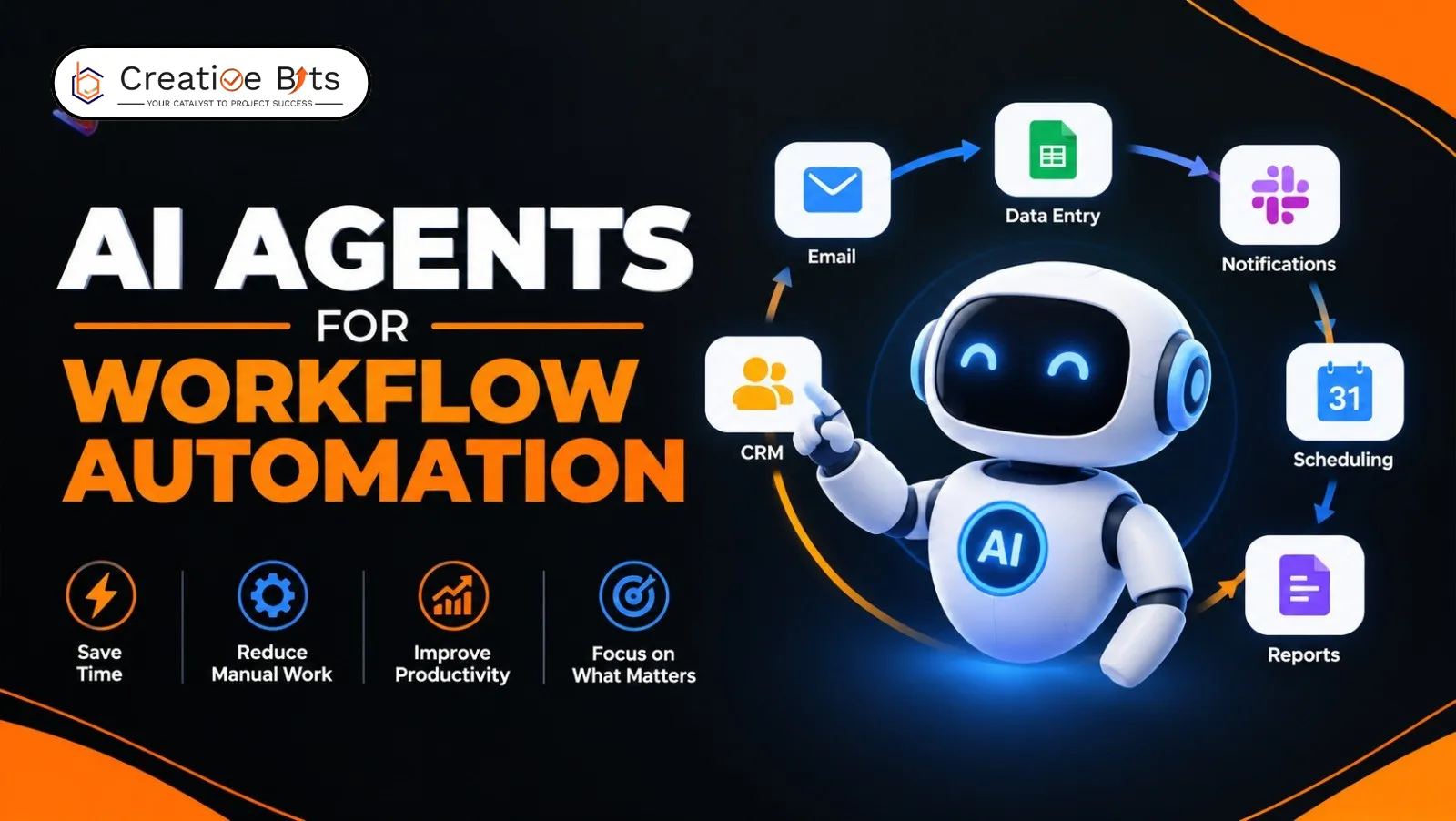
What Does AI Agent Workflow Automation Actually Change in Your Business?
Gartner expects more than 40% of agentic AI projects to be cancelled by the end of 2027.
Hold that number in mind. AI agent workflow automation works; the measured gains are real, but the failure rate is high enough that scoping the first project matters more than tool choice. One widely cited MIT study found around 95% of generative AI pilots produced no measurable P&L impact.
So here's the practical version of AI agent workflow automation: how to build agents, what they automate, what they cost, and how to keep data safe.
How to Build AI Agents for Business Workflow Automation Using ChatGPT, Copilot, and LangChain
One distinction first. Agentic AI is the capability of models that reason, plan, and use tools. An agentic workflow is a business process built around it. Published definitions are loose, so be precise internally: you're buying the second.
Any agent in AI agent workflow automation needs six components:
A model. ChatGPT, Copilot, or any foundation model via API. Parameters like temperature affect output consistency.
Tools. Datasets, web search, APIs that extend the model past its training data and let it act.
Prompt design. Chain-of-thought, few-shot, and self-reflection. Prompt quality drives AI agent workflow automation performance more than teams expect.
Feedback. Human-in-the-loop review, or other agents checking the work.
Orchestration. LangChain and LangGraph handle multi-step sequencing and scale. Copilot suits Microsoft-centric estates; a framework suits teams with engineers.
Integrations. Into existing systems. Consolidating data centrally is usually step one.
The build sequence: assess which processes have real potential, match agent type to process, build a structured knowledge base for retrieval, pilot narrowly, design the human-machine split deliberately, then monitor. Compose several specialised agents handing off through defined interfaces rather than one end-to-end agent; more reliable, far easier to test.
What Specific Business Processes Can AI Agents Automate to Improve Efficiency?
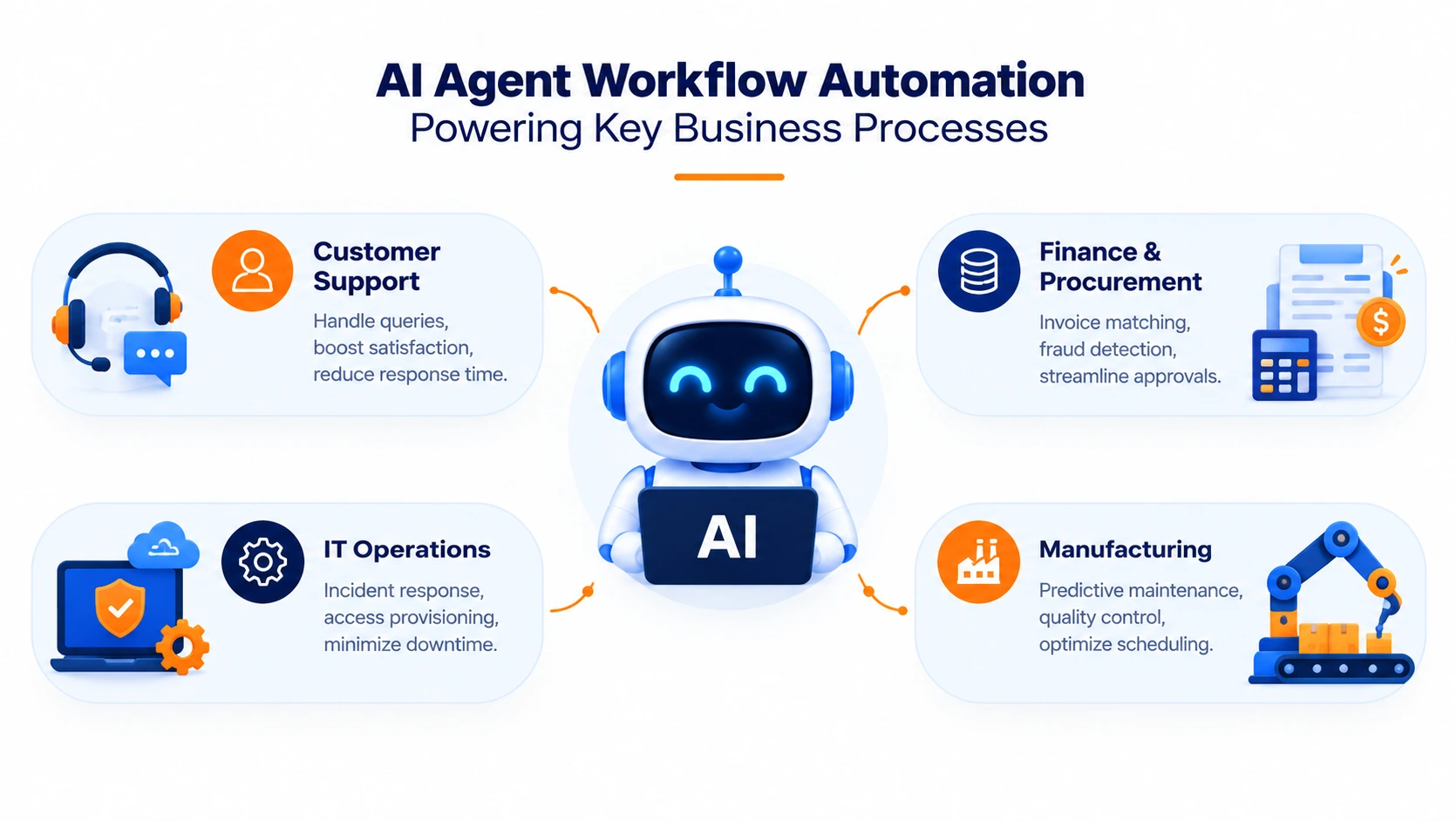
Published taxonomies describe seven agent types, and matching type to process is the core skill.
Rule-based for stable, compliance-driven, high-volume work. Conversational for customer service, self-service, and sales qualification. Predictive for inventory planning, maintenance and churn. Collaborative for summarising data to support human decisions. Adaptive for learning from outcomes. RPA-with-AI for cross-system work and exception handling. Cognitive for unstructured documents, images and audio.
Mapped to domains, AI agent workflow automation lands first in:
- Finance and procurement: invoice matching, fraud detection, regulatory reporting
- Customer operations: tier-one support, churn prevention
- IT operations: incident response, access provisioning
- Manufacturing: predictive maintenance, quality control, scheduling
Published results from AI agent workflow automation are substantial: roughly 15% average productivity gain in a customer-support field experiment across 5,179 agents, coding tasks 55.8% faster in controlled conditions, 1.9 to 4 hours saved per worker weekly in Copilot-style deployments, and 40–60% of tickets resolved autonomously against 20–30% for traditional chatbots.
One caveat: knowledge workers completed 12.2% more tasks and worked 25.1% faster on suitable work, but scored 19 points worse on correctness outside the model's competence boundary. Scope matters.
How Do AI Agents Integrate With Existing Enterprise Software and Tools?
Integration is where the budget goes; published analysis identifies it, not the model, as the biggest cost variable in AI agent workflow automation. Four things make it work.
Consolidate the data first. Agents reasoning over fragmented sources produce fragmented answers.
Connect through APIs, not replacements. The agent reads from and writes to your CRM, ERP, helpdesk and document systems. Nothing gets ripped out.
Set autonomy by risk. High-frequency, low-impact tasks run fully automated; high-impact decisions produce a recommendation a human approves. This one rule prevents most of what goes wrong.
Fit the existing process. AI agent workflow automation that forces people to change how they work gets abandoned regardless of accuracy.
To avoid disruption: pilot inside one workflow with clear boundaries, keep the old path running in parallel, and switch over only once the override rate is low enough to trust.
What Are the Cost and ROI Benefits of Using AI Agents for Workflow Automation?
The published numbers are encouraging and need to be read carefully.
Costs. A focused single-workflow agent runs roughly $10,000–$50,000 to build and integrate; complex multi-agent systems reach $200,000+. Infrastructure sits around $500–$3,000 monthly at moderate volumes, and ongoing optimisation is 15–25% of build cost annually.
Returns. Organisations project average ROI around 171% from AI agent workflow automation, with financial services highest at 4.2x. Published payback: customer service 2–4 months, operations 3–6 months, sales agents 6–12 months since pipeline impact is harder to isolate. Independent analyses put payback commonly at 6–14 months.
The caveat. That 171% reflects deployments that succeeded. Against it: over 40% of agentic projects forecast for cancellation, around 30% of proofs of concept abandoned, and one CEO study finding only 25% of AI initiatives met expected ROI. Many vendor savings figures are annualised or gross of implementation cost, not net.
Realistic expectation for AI agent workflow automation: measurable improvement within 90 days and solid ROI by month six, for a narrow, well-chosen use case. Capture baseline numbers first, or the return is unprovable.
How Secure and Compliant Are AI-Driven Automation Solutions for Sensitive Data?
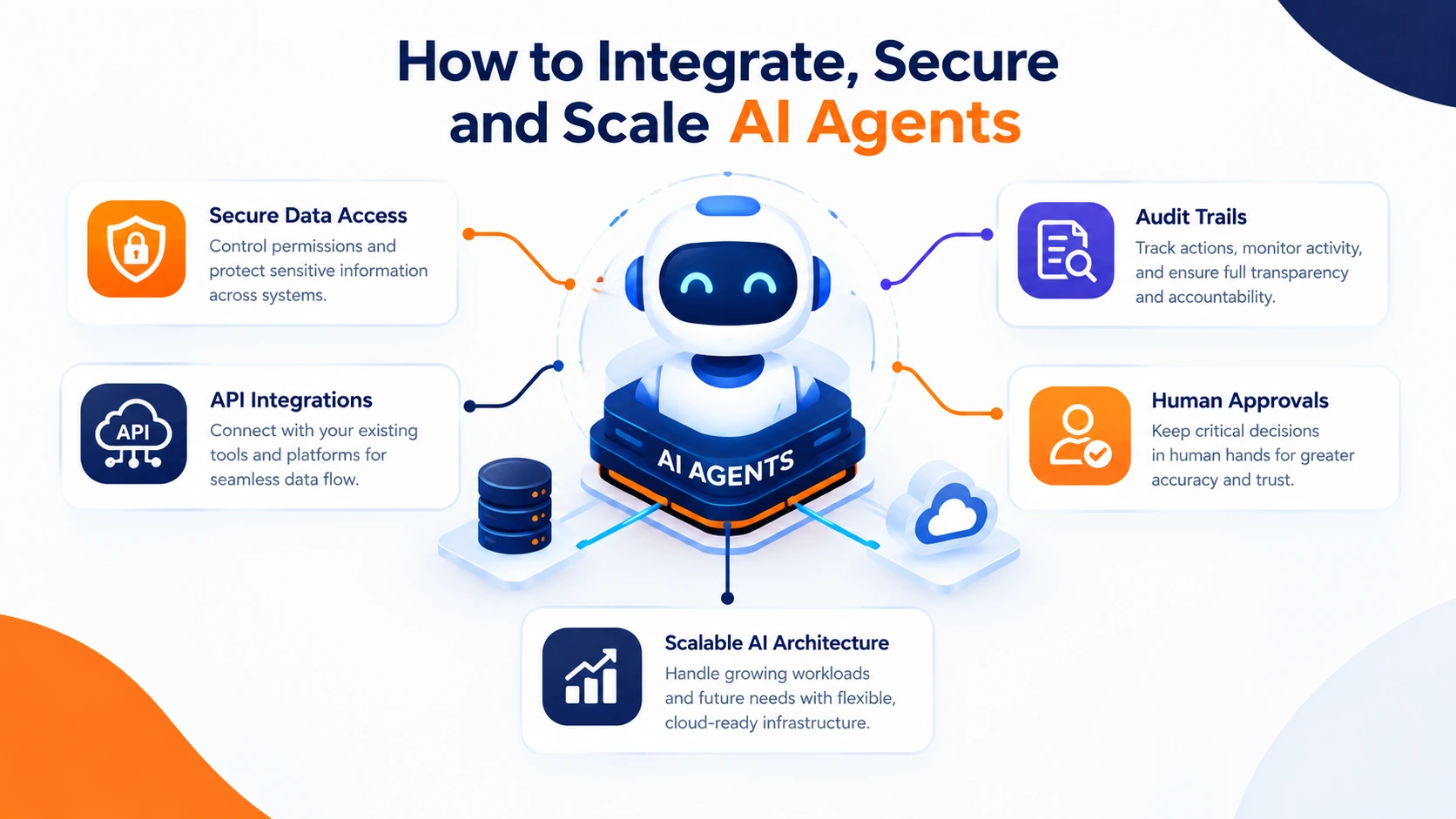
As secure as you build them, a design requirement in AI agent workflow automation, not a feature to tick off.
Access controls scoped so an agent reaches only the data its task needs. Broad credentials are the most serious common mistake in AI agent workflow automation.
Audit trails on every action. When an agent touches a customer record or moves money, you need to know what it did and why.
Regulatory alignment established before development, not at the pre-launch review. Sector obligations shape architecture.
Regular security testing, ongoing rather than a one-time sign-off.
Knowledge-source governance. An agent is only as trustworthy as what it can read.
Human approval gates on anything irreversible, money moving, messages leaving, records being deleted.
Published analysis names inadequate risk controls as a direct cause of cancellation. Governance doesn't slow AI agent workflow automation down; it lets it reach production.
What Level of Customization and Scalability Do AI Agents Offer for Complex Workflows?
AI agent workflow automation is strong on both counts, with one structural condition.
Customisation comes from composition. Rather than one configurable agent, build several specialised ones handing work to each other through defined interfaces, which is what makes complex AI agent workflow automation testable. Each gets its own tools, knowledge scope and autonomy level.
Scalability needs three things planned at once: transaction growth, expanding knowledge bases, rising compute. Multi-agent collaboration lets agents share what they learn, which is how AI agent workflow automation grows without each new workflow costing as much as the first.
The condition: modular architecture from the start. Monolithic agents become unmaintainable exactly when they become valuable.
One market warning. Published estimates suggest only a small fraction of vendors marketing "agentic AI" offer genuinely agentic systems; many are rebranded chatbots or RPA. Ask what the agent decides alone, and which tools it can call.
Start Narrow, Measure Honestly
Pick one high-volume process where someone reads something and decides what happens next. Capture the baseline. Build one agent, gate the consequential decisions, measure for 90 days. That is all AI agent workflow automation asks of you to begin.
Creative Bits maps the process before recommending tooling, and in AI agent workflow automation, that order is the difference between the 171% and the 40%: process mapping, build, real-world testing, in that sequence.