monday.com Services
When Do AI and ML Development Services Beat Ready-Made Tools?
Your competitors can buy the same subscription you can.
That's the entire argument for custom work, compressed. Ready-made AI platforms are faster, cheaper upfront, and often the right answer, but they give you capability, not advantage. AI and ML development services earn their premium only when your data, workflow, or compliance position is unusual enough that generic tools can't reach the outcome.
So here's an honest comparison of AI and ML development services against the alternative: what each path costs, how long each takes, the five types of AI worth knowing, and how to decide.
What Are Custom AI Solutions, and How Do They Compare with Ready-Made AI Tools?
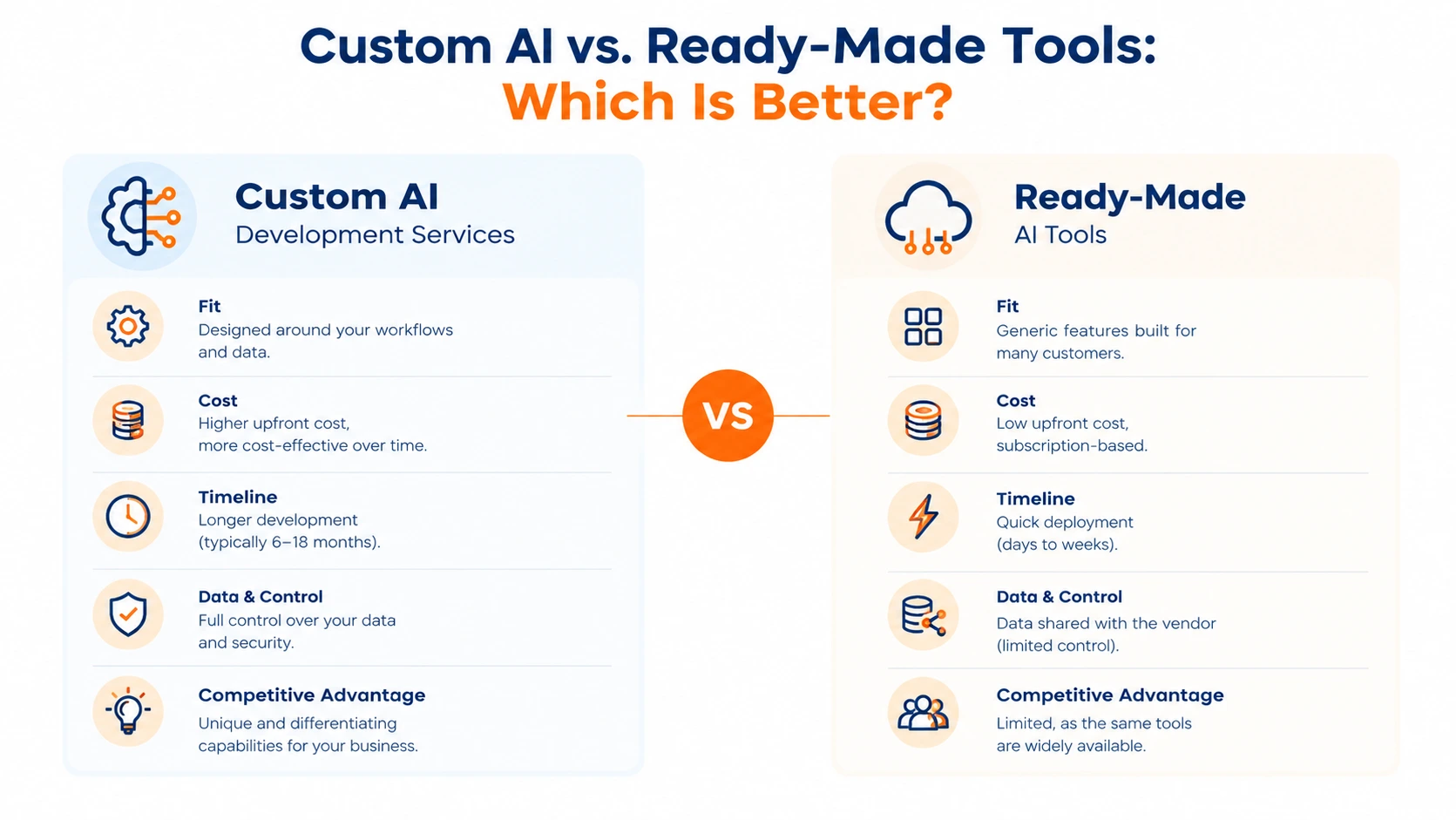
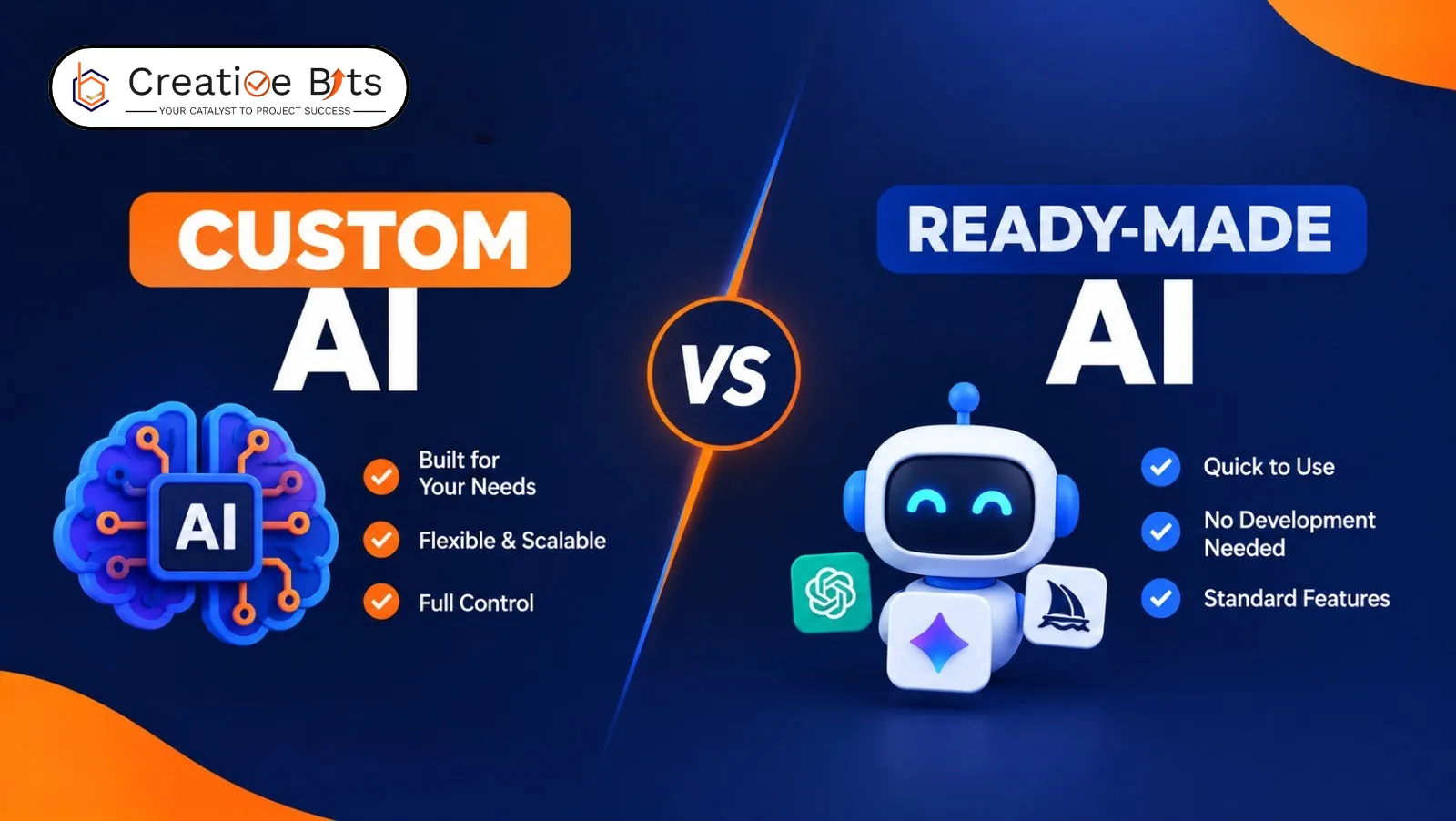
AI and ML development services are built around your specific data, workflows, and business logic. A ready-made platform is built for broad use across many customers. Published comparisons agree closely on how the two differ:
| Factor | Custom build | Ready-made platform |
| Fit | Designed around your processes and data | Generic, built for many customers |
| Upfront cost | Higher | Low, usually subscription-based |
| Ongoing cost | Tends to decline over time | Recurring AI software licensing costs, indefinitely |
| Timeline | Roughly 6–18 months depending on complexity | Days to weeks |
| Integration | Built for existing and legacy systems from the outset | Vendor APIs; may need middleware |
| Scalability | Controllable, if architected for it | Bounded by vendor pricing and limits |
| Data control | Full | Shared with the vendor |
| Explainability | Designed in from the start | Hard to retrofit onto a black box |
| Competitive edge | Differentiating | Limited, anyone can buy it |
The AI tool vs custom solution decision resolves cleanly once you know which column you're in, and AI and ML development services belong firmly in the left one.
Choose ready-made when the use case is standard, basic automation, a general-purpose chatbot, common analytics, when budget is tight, when you need results now, when internal technical capacity is thin, or when you're testing whether AI helps at all before committing.
Choose custom when your workflows are genuinely unique, your data is proprietary enough to be an advantage, you face strict regulatory obligations (healthcare, financial services, insurance, government), you're integrating with legacy infrastructure, generic tools can't hit your performance requirements, or AI is central to your business model rather than supporting it.
Or go hybrid, which is what most organisations should do. Ready-made tools for general productivity, AI and ML development services for the two or three processes that genuinely differentiate you. Several published guides recommend starting off-the-shelf and commissioning AI and ML development services as needs mature.
One costing note worth taking seriously: assess total cost of ownership over three to five years, not the subscription price. A low monthly fee multiplied by sixty months, plus vendor dependence, often tells a different story.
Where Should Your AI Actually Run: SaaS or On-Premise?
The AI SaaS vs on-premises question usually gets decided by compliance rather than preference, and it's worth settling early because it shapes architecture.
SaaS means lower operational burden, vendor-managed security, and faster deployment than AI and ML development services can match. The trade-off is shared infrastructure, which creates genuine data security and compliance challenges in regulated sectors, and your data governance becomes a function of someone else's policy.
On-premises or private cloud gives full control over data residency, retention, and lineage. AI and ML development services built this way can meet bespoke requirements: VPC isolation, air-gapped deployment, controls your auditor will actually accept. You take on more responsibility for security in exchange.
The practical filter: if your data cannot legally leave a jurisdiction, or your sector's regulator expects you to demonstrate exactly where records sit, the decision is already made. Otherwise,e SaaS is usually the sensible default, and data security in AI solutions is a matter of verifying the vendor's posture rather than owning the infrastructure.
What Are the 5 Different Types of AI?
Worth noting that published versions of this list differ;r, some frameworks count four stages, others five or seven. The most common five-part framing combines capability stages with functional types:
- Reactive machines. No memory, no learning. They respond to current input only, the earliest and most limited category.
- Limited memory. Uses recent historical data to inform decisions. This is where essentially all working AI sits today, including every model behind current AI and ML development services.
- Theory of mind. Systems that would model human beliefs and intentions. Research stage, not commercially available.
- Narrow AI (ANI). Excellent at one defined task. Every production system delivered by AI and ML development services sits here.
- General and super intelligence (AGI/ASI). Human-level or beyond across arbitrary domains. Hypothetical.
The commercially useful takeaway: everything you can buy or build today is limited-memory narrow AI. Any vendor implying otherwise is selling a story.
What Is the Difference Between All the AI Tools?
Tools differ mainly in what they do to your input, which is a more useful lens than brand names.
Predictive tools take structured historical data and output a number or probability: demand forecasts, churn scores, risk ratings. The classic brief for AI and ML development services.
Generative tools take a prompt and produce text, code, images, or audio. Non-deterministic, so the same input can yield different output.
Extractive tools take unstructured documents and return structured fields—the highest-reliability category, and usually the best first project.
Classification tools sort inputs into categories: ticket triage, sentiment, spam, intent.
Agentic tools chain several of the above plus system calls to complete multi-step work autonomously.
Vision tools interpret images and video, defect detection, safety compliance, document scanning.
Ask which of those six any proposal is. A lot of apparent choice between AI and ML development services dissolves once you see two vendors solving different problems.
What Are the Different Types of AI Solutions?
By deployment shape rather than technology, business AI resolves into five patterns.
Embedded features inside software you already pay for. Free, instant, consistently underused, and no AI and ML development services required.
Workflow AI, an AI step inside an existing automation. Classify, extract, then let deterministic rules carry on.
Assistants and copilots that respond to requests inside the tools people use daily.
Agentic systems that execute multi-step work, with approval gates on anything irreversible.
Custom models and platforms, where AI and ML development services build something that doesn't exist off the shelf.
Enterprise AI integration is where most AI and ML development services succeed or fail. Connecting to CRM, ERP, and operational systems consumes more hours than model work, and a scalable AI architecture, modular, API-first, built so components can be swapped, is what prevents the second project from costing as much as the first.
Run the ROI Before You Choose
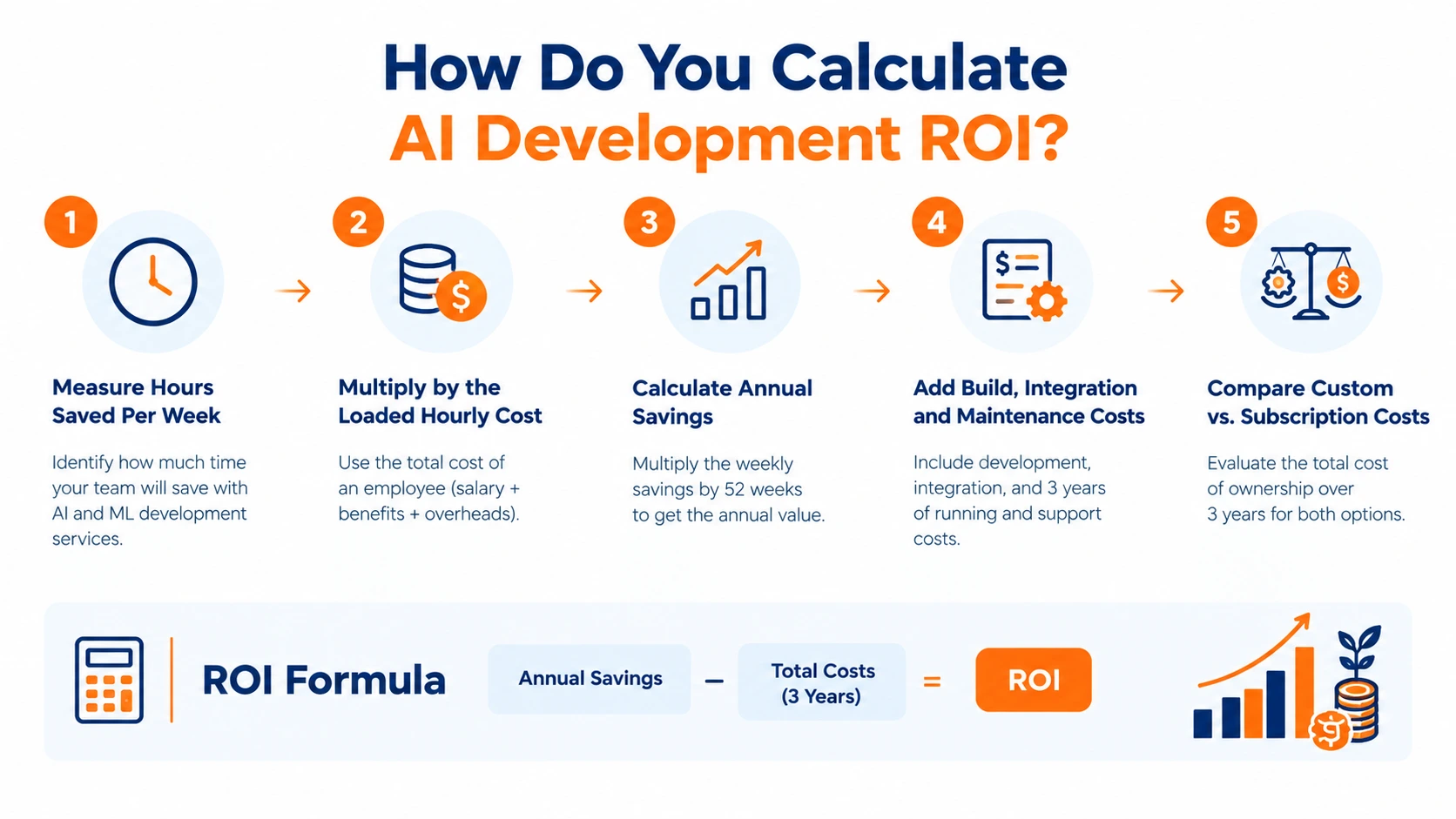
Before commissioning AI and ML development services, run the numbers. AI development ROI is a calculation, not a feeling. Hours saved per week multiplied by loaded hourly cost, annualised, set against build cost plus three years of running and maintenance. For a platform, multiply the subscription across the same window and add integration effort.
Capture baseline numbers before anything launches, because without them the return is unprovable either way. Then pick the lightest option that clears your threshold, and commission AI and ML development services only where nothing lighter will do.