monday.com Services
Which Questions Expose a Weak AI Development Partner Before You Sign?
Ask a vendor how they measure success and listen for whether the answer contains a number.
That single question filters more effectively than any ranking list, because the gap between a capable AI development partner and an expensive one is almost never technical skill. It's whether they'll put a measurable outcome, a realistic timeline, and an honest list of risks in writing before you commit.
This is a buyer's due diligence guide to picking an AI development partner: what to verify, which services exist, why transparency is the deciding factor, and which tools your team should be using.
How to Choose the Right AI Development Company: Key Factors to Consider
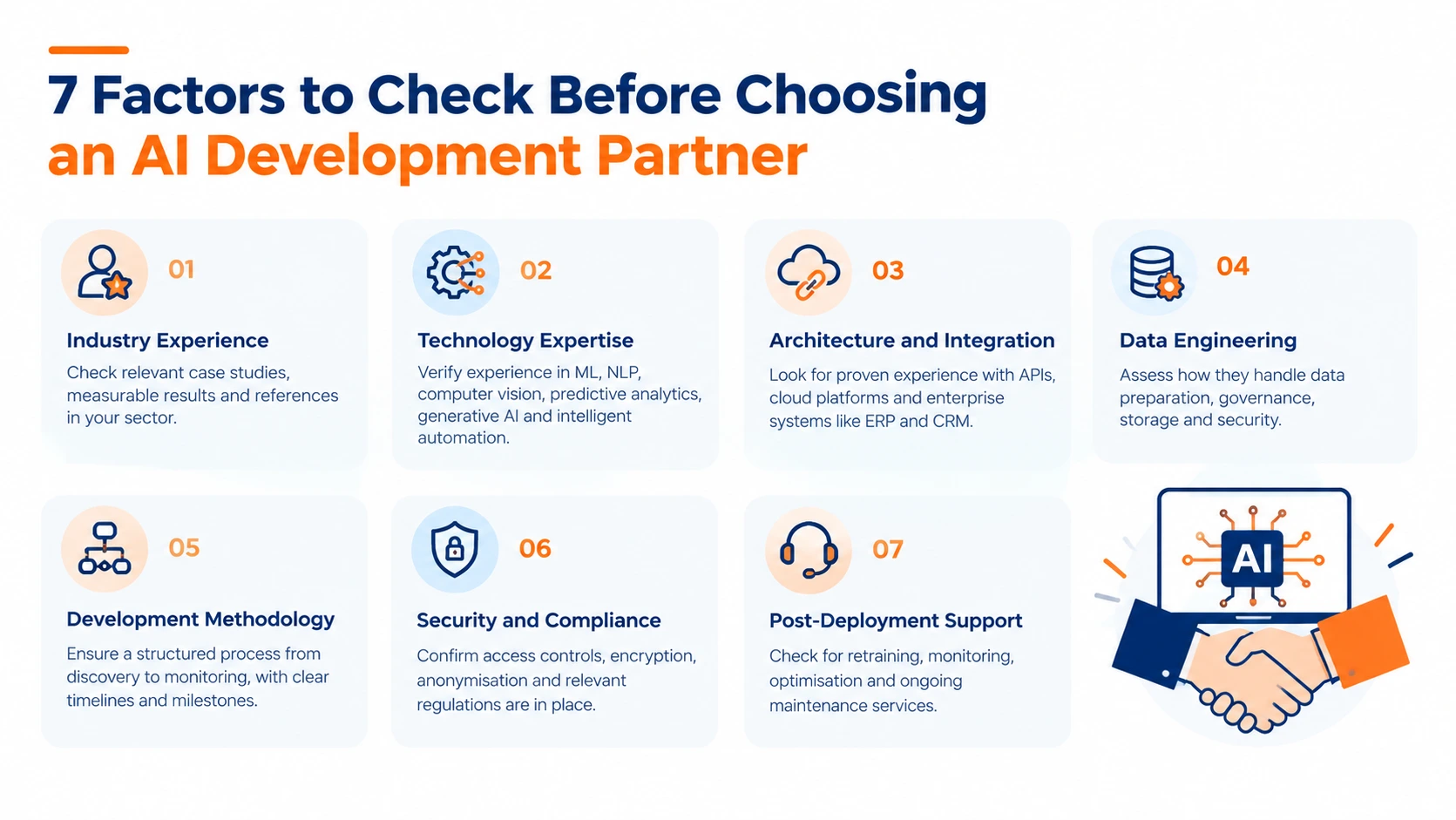
Published guidance on vetting an AI development partner converges on seven verifiable factors. Verifiable is the operative word; ask for evidence, not assurances.
Industry experience. Familiarity with your sector's regulations, data, and workflows. Request case studies in your industry with measurable outcomes attached, plus references you can actually call.
Technology breadth. Machine learning, NLP, computer vision, predictive analytics, generative AI, and intelligent automation are separate disciplines. Confirm which ones an AI development partner has shipped to production rather than prototyped.
Architecture and integration. Experience with APIs, cloud platforms, and enterprise systems like ERP and CRM. This is where most of the hours go.
Data engineering. How they handle preparation, governance, storage, and security. Ask specifically what they did on a past project, not what they believe in.
Methodology. A structured process from discovery through monitoring, with timelines and milestones your AI development partner names upfront.
Security and compliance. Access controls, encryption, anonymisation, and the regulations relevant to your project, discussed before development starts, not at the pre-launch review.
Post-deployment support. Retraining, monitoring, optimisation, and maintenance. The most commonly omitted item in a proposal.
The common mistakes are equally well documented: choosing the lowest price, weighting technical skill above sector knowledge, ignoring how the system will fit existing processes, not understanding the support model, and trusting marketing claims over documented results. Any AI development partner worth engaging will welcome the scrutiny.
What Are the Top 5 AI Services?
Grouped by what they actually do, the market resolves into five categories.
- Strategy and consulting. Tying AI effort to business objectives, identifying use cases, checking data readiness, building the ROI case. The right first purchase when the problem isn't yet defined in measurable terms.
- Data engineering and preparation. Pipelines, quality, governance. Unglamorous, and the stage that determines whether anything downstream works.
- Model and application development. Custom machine learning, generative AI, agents, and the software built on top of them- the work most people picture when they hire an AI development partner.
- Integration and deployment. Connecting models to enterprise platforms, then shipping to cloud infrastructure with monitoring in place.
- Monitoring, optimisation and support. Performance tracking, retraining, maintenance.
A useful distinction when shortlisting: providers cluster into full-stack partners covering the whole lifecycle, industry specialists with deep sector and regulatory knowledge, open-source-oriented teams that prioritise transparency and flexibility, and cloud-native platforms that remove infrastructure management. A single AI development partner spanning strategy through support reduces handoff delays compared with coordinating several vendors, which is the main practical argument for full-stack.
Why Does Transparency Matter in AI Development and Deployment?
This is the factor that separates a working system from an unusable one, and it operates at two levels.
Transparency from your partner. Honest timelines, named resource requirements, and the potential problems stated rather than discovered. AI delivery is iterative: experimentation, training, fine-tuning, so an AI development partner who promises a fixed outcome on a fixed date either doesn't understand the work or isn't being straight. Realistic expectations set early are a credibility signal, not a weakness.
Transparency in the system itself. Because model outputs are probabilistic rather than reproducible, AI needs specialised QA: continuous testing, monitoring and validation, not a one-time test pass. And when a model makes a decision that affects a customer, someone will eventually ask why.
So explainability, audit trails and human oversight are design requirements your AI development partner should raise first, not optional extras. Regulatory frameworks increasingly assume all three. An AI development partner who can't explain how a model concluded has handed you a system you cannot defend to a regulator, a customer or your own board.
Practical test: ask your prospective AI development partner to explain a specific past model's decision to a non-technical stakeholder. Vague answers here are the most reliable warning sign in the whole evaluation.
What Made AI Models Get So Good So Fast?
Worth understanding, because it explains what you're buying and what you no longer need to pay for.
Three factors drove the shift. Compute optimised for machine learning made training at scale economically possible. Pre-trained foundation models removed the need to train from scratch, the single largest cost reduction in the field, and the reason a custom build now means fine-tuning and wiring rather than starting from zero. MLOps tooling made deployment, versioning, and monitoring repeatable instead of artisanal.
The practical consequence for anyone evaluating an AI development partner: nobody should be quoting you for foundational model training on an ordinary business problem. If a proposal is priced as though it requires research-grade work for a document-classification task, ask exactly what requires it.
What hasn't gotten cheaper is everything around the model: integration, governance, data preparation, and compliance. That's where your budget now goes, and a good AI development partner will say so unprompted.
Which Specific AI Tools Should Your Team Use at Work?
Separate from any custom build, there are tools worth adopting immediately.
Meeting transcription and summarisation. The highest-return, lowest-effort adoption available. Notes and action items without anyone typing.
Document search across your own files—retrieval over your actual contracts, policies, and records rather than general web content.
Drafting assistants in the tools you already use. Email, documents, spreadsheets. Editing a draft is faster than producing one.
Workflow automation platforms with an AI step. Classification, extraction, and routing inside automations you already run.
Coding assistants for any team shipping software, the one category where adoption usually outpaces anything an AI development partner delivers.
Start here before commissioning anything custom. Most organisations have more unrealised value in tools they already pay for than in anything an AI development partner could build for them this quarter. A credible one will tell you that too.
Verify, Then Commit
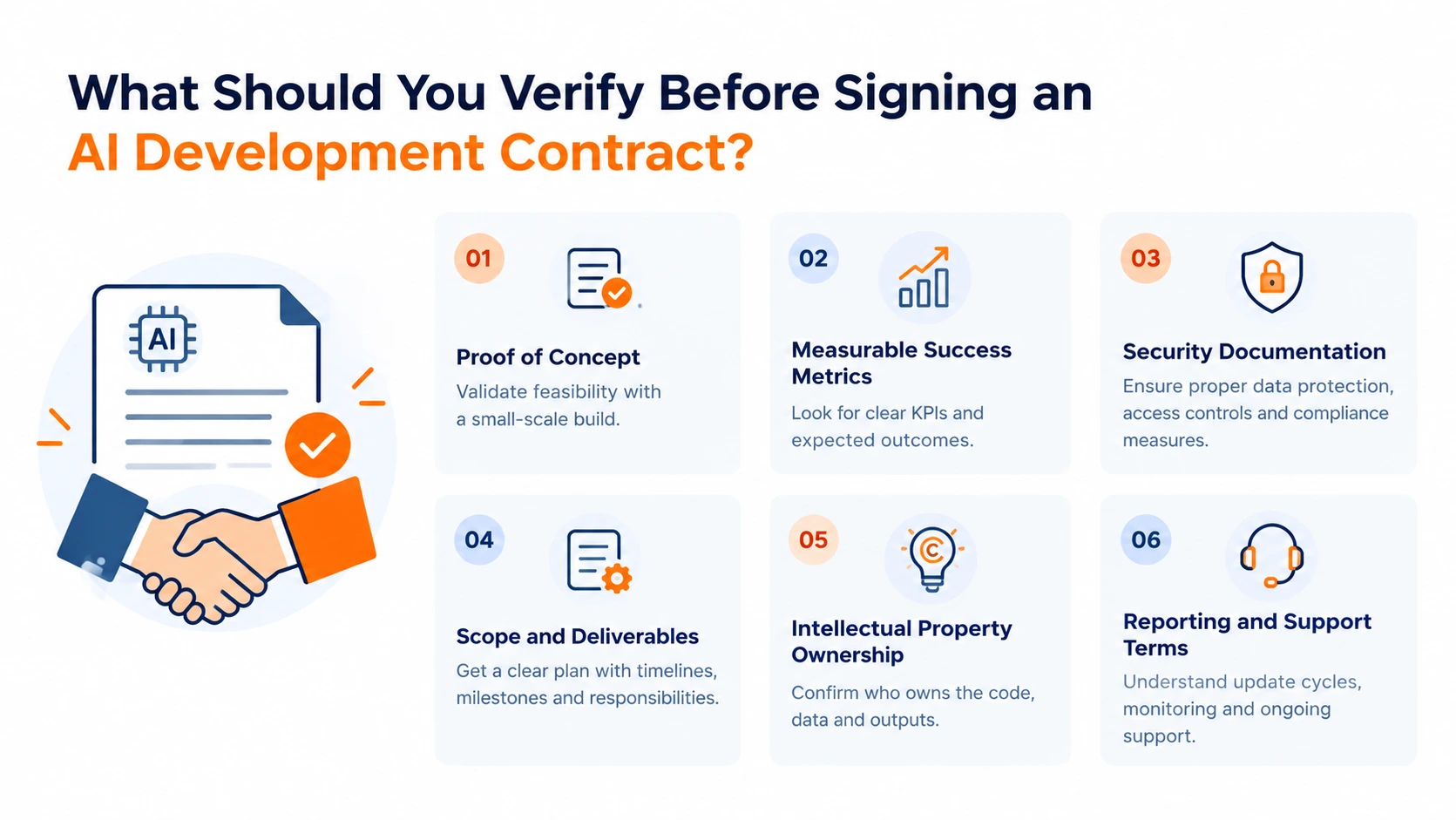
Shortlist on filters that match your real constraints, sector, budget, integration needs, compliance obligations. Then insist on three things before signing: a proof of concept to surface feasibility problems early, documented security posture, and a written agreement covering scope, deliverables, IP, reporting cadence, and exactly what support includes.
The right AI development partner will push you toward the narrowest first project that produces a measurable number. Treat that as the strongest signal you'll get.