monday.com Services
Which Custom AI Solutions Actually Fix a Broken Workflow?
Automation applied to a messy process gives you a faster mess.
That's the single most useful thing to know before commissioning anything. Custom AI solutions work when the underlying process is understood well enough to say what "better" means in numbers, and they stall, reliably, when nobody wrote the process down first.
So here's a practical guide to custom AI solutions: how to scope work that lands, the mechanism by which AI handles complexity, which skills stay human, and what you're really buying.
How Can Businesses Use Custom AI Solutions to Solve Complex Problems and Improve Workflow Efficiency?
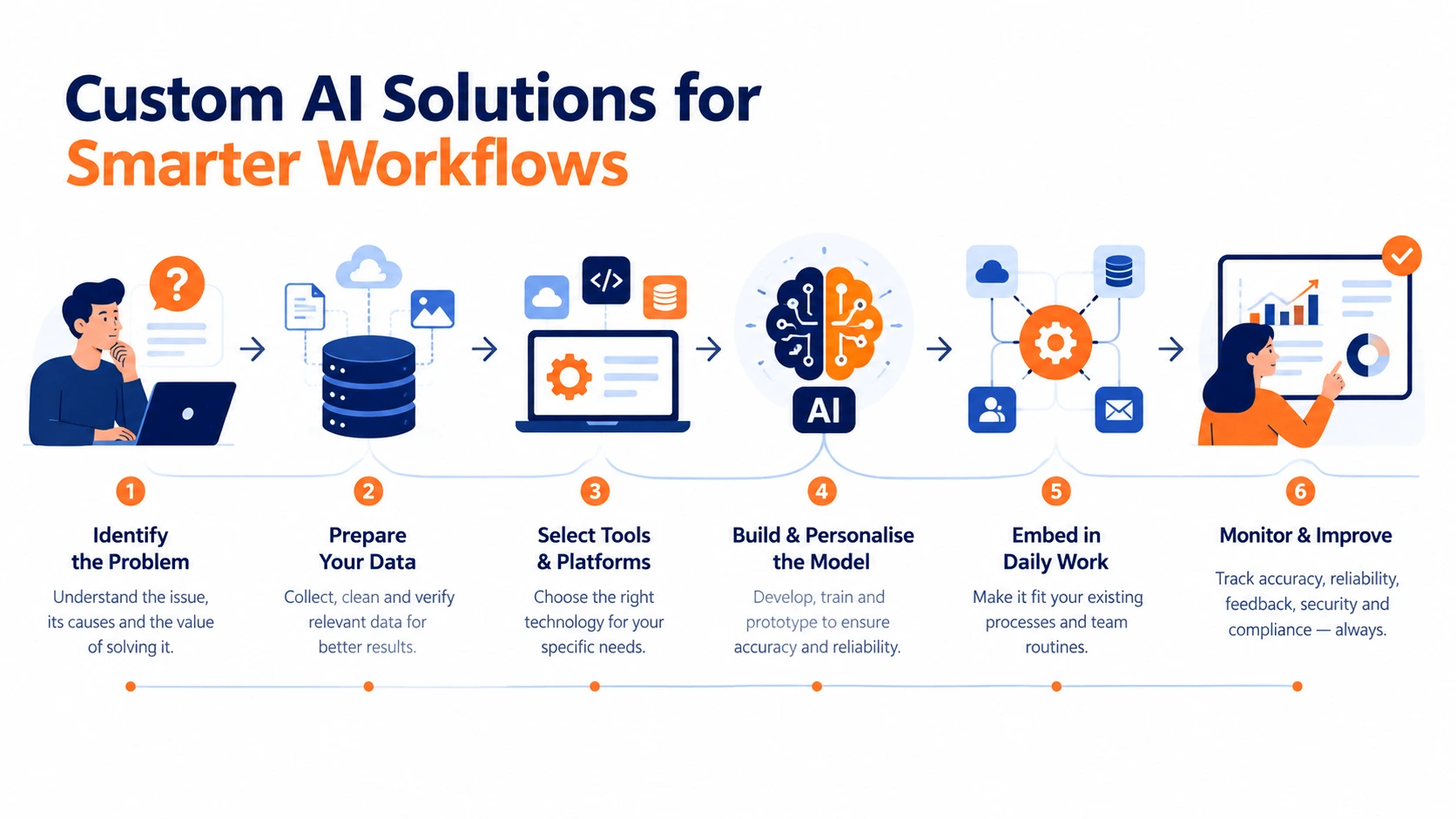
Published methods for building custom AI solutions converge on six steps. The order is what matters.
- Define the business problem. Name the problem, its causes, and the value of solving it. Then set the requirements, performance metrics, primary data sources, and the accuracy threshold that makes the decision safe.
- Organize your data. Gather, clean, and verify what's relevant. Custom AI solutions are only as good as the data behind them, and this stage consistently takes longer than anyone budgets for.
- Select tools and platforms. Fit the technology to the problem, not the other way around; most custom AI solutions now start from an existing foundation model.
- Build and personalize the model. Develop, train, then prototype across varied scenarios to surface errors before launch.
- Embed it in daily work. This is the step that separates working custom AI solutions from expensive demos. AI workflow customization means the system fits how work already gets done, rather than forcing teams to reshape their process around a tool.
- Monitor. Prediction accuracy, system reliability, user feedback, security exposure and compliance changes. Permanently, not once.
The obstacles are equally predictable: poor data quality, a shortage of skilled staff, setup and upkeep costs, and security or compliance risk. Published guidance on overcoming them is consistent: cross-functional teams, real data governance, a small pilot before any full rollout, staff training, and outside help where in-house skills don't yet exist.
Business process optimization: AI delivers most where problems are concrete: late deliveries, poor inventory management, high complaint volume, delayed invoice processing. Those are the briefs custom AI solutions handle well.
How to Use AI to Improve Workflow?
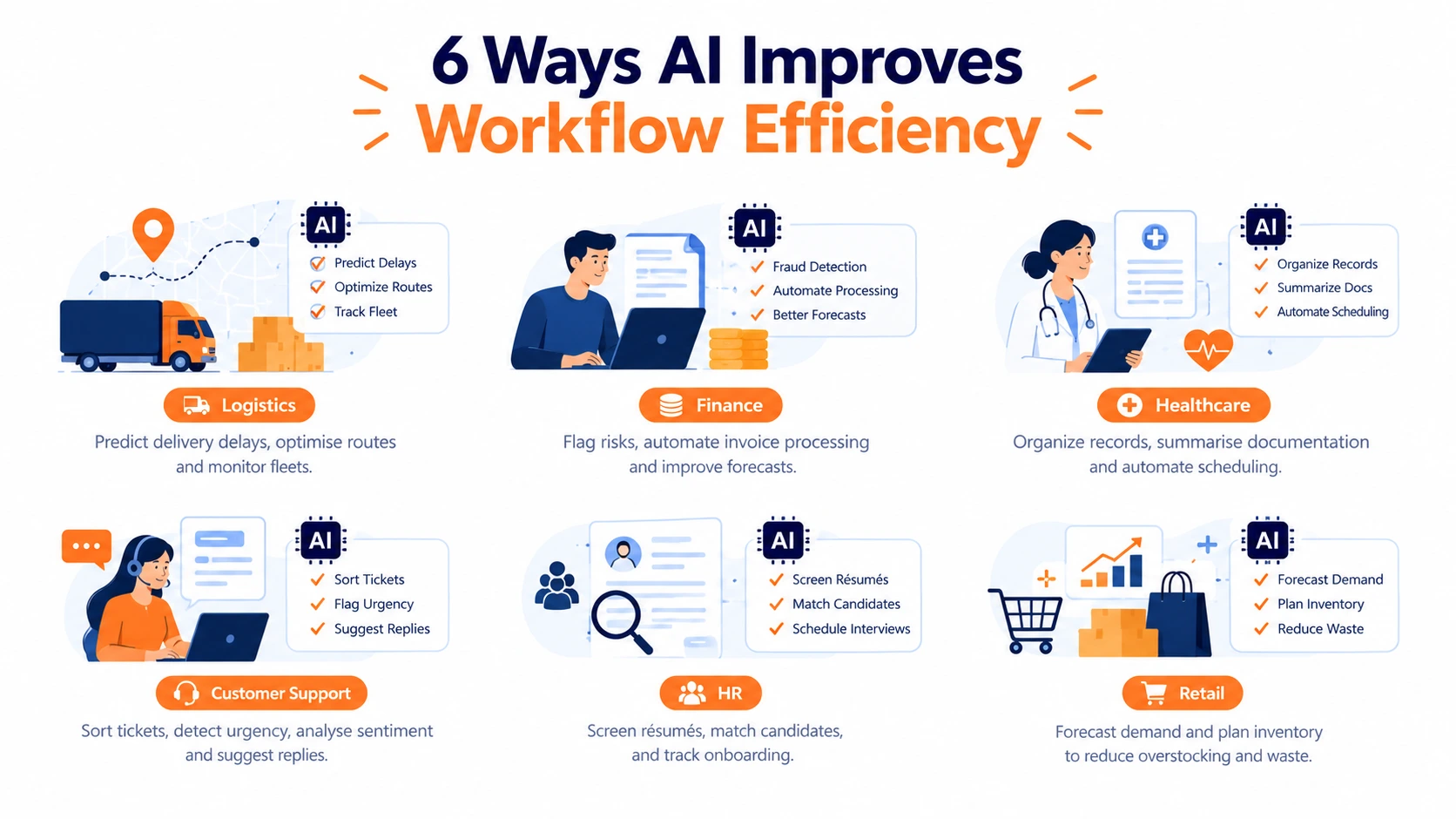
Start with the pattern that works everywhere: find the task where someone currently reads something and decides what happens next. That's the insertion point for AI workflow automation, and where custom AI solutions pay back fastest.
Published AI workflow case studies cluster into six recognisable shapes:
Logistics. Predicting delivery delays from traffic, weather and driver availability, plus route optimisation and fleet monitoring.
Finance. Invoice risk analysis, flagging unusual payment behaviour, automated processing, better forecasts. One documented approach has software check every line item against multiple databases and route only exceptions to human auditors, so people solve problems instead of hunting for them.
Healthcare. Intelligent document processing to organise records, summarise documentation, and automate scheduling.
Customer support. Ticket sorting, urgency flagging, sentiment analysis, suggested replies for agents.
- Résumé screening, candidate matching, interview scheduling, onboarding tracking.
Retail. Demand forecasting and inventory planning that reduces overstocking and waste.
The practical sequence for AI-driven workflow management: start with the busywork that is repetitive and error-prone, confirm the problem is widespread rather than one person's irritation, capture baseline numbers, then automate exactly that. AI business efficiency compounds from one well-finished workflow far faster than from five half-built ones.
How does AI Solve Complex Problems?
Four mechanisms drive custom AI solutions, and knowing which one you need prevents a lot of wasted scope.
Converting unstructured input into structured data. Text, images, and audio in; labels, numbers, and categories out. Once output is structured, ordinary deterministic rules handle it reliably. This is what custom AI solutions do best.
Detecting patterns at a scale people can't read. Fraud signals across millions of transactions, demand shifts across thousands of SKUs.
Predicting failures before they happen. Equipment faults, process breakdowns, late deliveries, caught early enough to act.
Decomposing a large problem into narrow tasks. This is the real answer for AI for complex processes. Complexity is handled by breaking it into small, well-defined steps, each monitored separately, rather than asking one model to manage the whole thing.
That last point is the most practical. A high manual-override rate doesn't mean the system failed; it means the task was defined too broadly. Narrow it, test again, and the number usually drops.
Keep core business logic deterministic throughout any custom AI solutions you build. Let AI classify and process the data feeding your rules; keep the rules themselves rule-based, or you've built something you can't audit.
What Are 7 Human Skills That AI Cannot Replace?
Worth stating plainly, because every serious implementation depends on them.
- Problem framing. Deciding which problem is worth solving, and what success means. No model does this for you.
- Contextual judgment. Evaluating output against circumstances the data doesn't capture.
- Accountability. Someone has to own a consequential decision. That cannot be delegated to a system.
- Relationship and trust building: client confidence, difficult conversations, negotiation.
- Domain intuition. Knowing what the data actually means and which edge cases matter. Custom AI solutions fail most often from the absence of this, not from technical shortcomings.
- Ethical reasoning. Deciding what should be automated, not merely what can be.
- Adapting to the genuinely novel. Situations with no precedent in any training data.
The pattern across all seven: AI handles volume and pattern recognition; people handle meaning, consequence, and the first time something happens. Success depends as much on the people involved as the technology, which is why role redesign belongs in the project plan, not after it.
What Are Custom AI Solutions?
Underneath the term are five components:
A data layer. Pipelines, quality controls, governance over your own records.
A model. Usually a fine-tuned foundation model now rather than something trained from scratch.
Integration. Enterprise AI integration into CRM, ERP, and operational systems. Most of the engineering hours live here.
An interface. Where the output reaches a person, or triggers the next automated step.
Governance. Monitoring, audit trails, explainability, retraining schedules.
Custom AI solutions make sense when off-the-shelf tools struggle with your data formats, rely on manual workarounds, or can't meet your compliance obligations. They cost more upfront and take longer, often several months. Many organisations run a blended model instead: subscription tools for experimentation, custom AI solutions where reliability and differentiation genuinely matter. Reputable AI solution providers will recommend that split rather than talk you out of it.
Map It, Then Build It
Pick the process costing you the most hours. Map it on paper, every exception included. Capture the baseline. Then build exactly that, and nothing more, until it's measurably working.
Custom AI solutions reward organisations that finish one thing properly. That's the whole method.