monday.com Services
Why Does AI Business Integration Need a Strategy, Not Just Tools?
Two companies buy the same AI subscriptions in the same month. A year later, one has restructured how work moves through the business. The other has a very impressive demo nobody uses.
The difference is rarely the technology. It’s whether anyone treated AI business integration as a strategy question. AI business integration failures are usually organisational rather than technical: poor data, unclear ownership, no measurable goal, and a team that was never brought along. The tools were identical.
This is a strategy-level guide to AI business integration: the approach that works, what a real framework contains, what to prioritise, and how to optimise once something is running.
What Is the Best Approach for Integrating AI into Business Workflows?
Start by recognising that AI business integration comes in four forms, and most teams reach for the heaviest one first. The right AI business integration approach is usually the lightest one that works.
Native AI features. AI already built into apps you pay for. Free, instant, and consistently underused.
Workflow AI integration. An automation platform runs an AI step inside an existing automated workflow, classifies this, extracts that, then carries on with the rules.
AI assistant integration. An assistant pulls data and takes action from a chat window.
Custom integration. Building directly on model APIs with your own data. Powerful, expensive, and rarely where AI business integration should start.
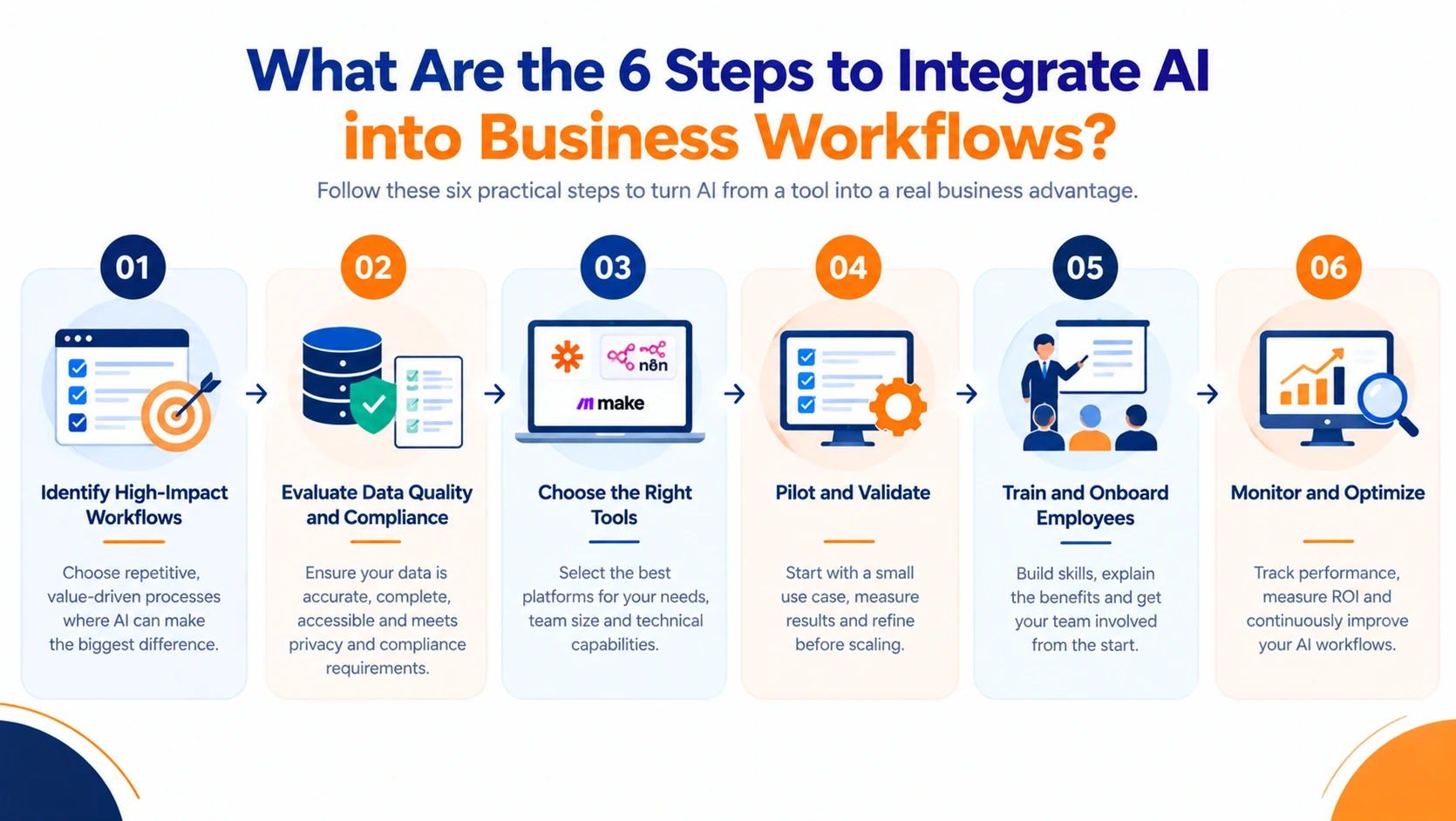
Pick the lightest form that solves the problem. A six-step sequence covers the rest:
- Identify high-impact workflows. Repetitive work that still needs judgment: ticket triage, lead enrichment, document review.
- Evaluate data quality and compliance. Clean input and customer data handling that meets your privacy obligations.
- Choose tools. Use out-of-the-box tools for speed, and custom APIs where you need control.
- Pilot and validate—small group, measured against the current process.
- Train and onboard. Start with one team, a named owner, and structured feedback.
- Monitor and optimise. Track results and refine.
Asked how businesses can effectively integrate AI into their workflows, select two answers that matter above the rest: define the use case precisely before choosing anything, and pilot before you commit. Nearly every stalled AI business integration skipped one of those.
What Does an AI Strategy Framework Actually Contain?
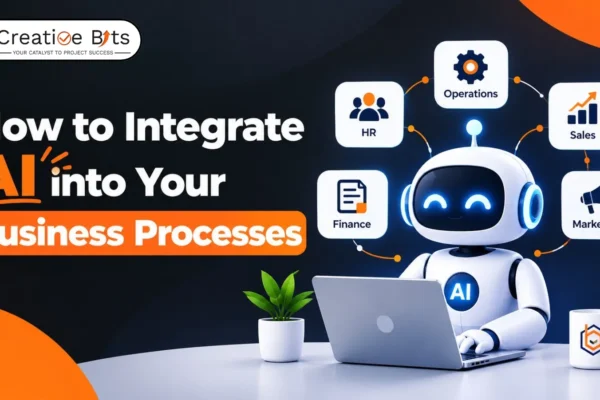
Before the tooling conversation, there’s a strategy conversation. Any credible framework for AI business integration covers six areas, and using AI for business strategy work starts here:
Business objectives. How AI supports goals you already have. Assess readiness honestly: adoption, architecture, and capability are three separate things, and most organisations overestimate at least one.
A data audit. Quality, accessibility, governance, and the departmental silos that quietly block everything downstream.
An ethical framework. Privacy standards, fairness, algorithmic transparency, backed by actual data governance policy rather than intent.
Technology choices. Start with the problem, test small, then scale. Technology is the fourth question here, not the first.
Skills development. Identify gaps in machine learning, data science and data engineering, then upskill or hire.
Employee buy-in. Communicate the vision and explain what it means for individual roles. Skip this and people route around the system.
Whether you’re reading an AI strategy framework McKinsey published, a Harvard model, or a vendor’s version, the substance is largely the same. That’s worth knowing before you pay for a template.
A note on shortcuts. An artificial intelligence strategy PDF downloaded from a vendor site is marketing with useful structure attached, fine as a checklist, weak as a plan, because it knows nothing about your data. An AI business strategy generator has the same limitation: it produces a competent generic outline that still needs your actual constraints poured into it. If you want to go deeper, an AI strategy for business leaders Harvard free course or any reputable AI business strategy course free of charge will teach the fundamentals better than a downloaded template.
What Should You Prioritize When Incorporating AI into Your Workflow?
In order, because in AI business integration the sequence matters more than the list.
- Data readiness. AI business integration depends more on data quality and architecture than on which model you pick. Poor data or non-standardised processes mean limited value regardless of spend.
- Measurable goals. Name the business need, the target, and how success gets measured. “Improve efficiency” is not a goal.
- Governance and risk. Privacy regulations, security, and transparency with users. Assess risks before investing, not during the rollout.
- Deterministic core logic. Keep business rules rule-based. Let AI classify and process the data feeding those rules rather than making final calls on anything consequential.
- Expertise. Build an internal capability or bring in specialists until in-house skills mature. Most teams need both at different stages.
- Vendor diligence. Review responsible AI and data privacy policies before partnering with anyone.
The common AI business integration challenges are predictable: fragmented data, legacy systems with no APIs, skills gaps, absent governance, resistance to workflow change, and inadequate model monitoring after launch. Plan for all six.
How to Optimize Workflow with AI?
Optimisation starts with measurement, and four metrics tell you nearly everything about an AI business integration.
Time saved against your pre-launch baseline. Accuracy on real cases, not test data. Adoption as a share of eligible cases. Manual override rate: how often someone steps in and corrects the output.
That last metric is the most diagnostic. A high override rate doesn’t mean the AI business integration failed; it means the task was defined too broadly. Narrow it, test again, and the number usually drops.
Published AI integration examples show what the ceiling looks like. One three-person IT team runs an automated help desk that classifies tickets automatically and resolves close to 28% of them without a human, saving a reported 600-plus hours a month. A customer support team built a workflow drafting replies grounded in store policy, with a human approving each one; around 70% of drafts now go out unedited, reportedly saving 1,500 hours and $40,000 a year.
Both figures are vendor-reported, so treat them as directional. The structural lesson holds regardless: both kept a human in the loop, both measured against a baseline, and both automated a narrow, well-defined task rather than an entire function.
Strategy Beats Tooling, Every Time
AI business integration reshapes your business model and your culture, not just your tech stack. Strategies fail when leaders treat the cultural and organisational side as someone else’s problem, and core business fundamentals still apply, even as AI changes how they’re executed.
Build AI business integration capability gradually rather than attempting transformation in one quarter. One workflow, measured properly, teaches your organisation more than a roadmap nobody can execute.