monday.com Services
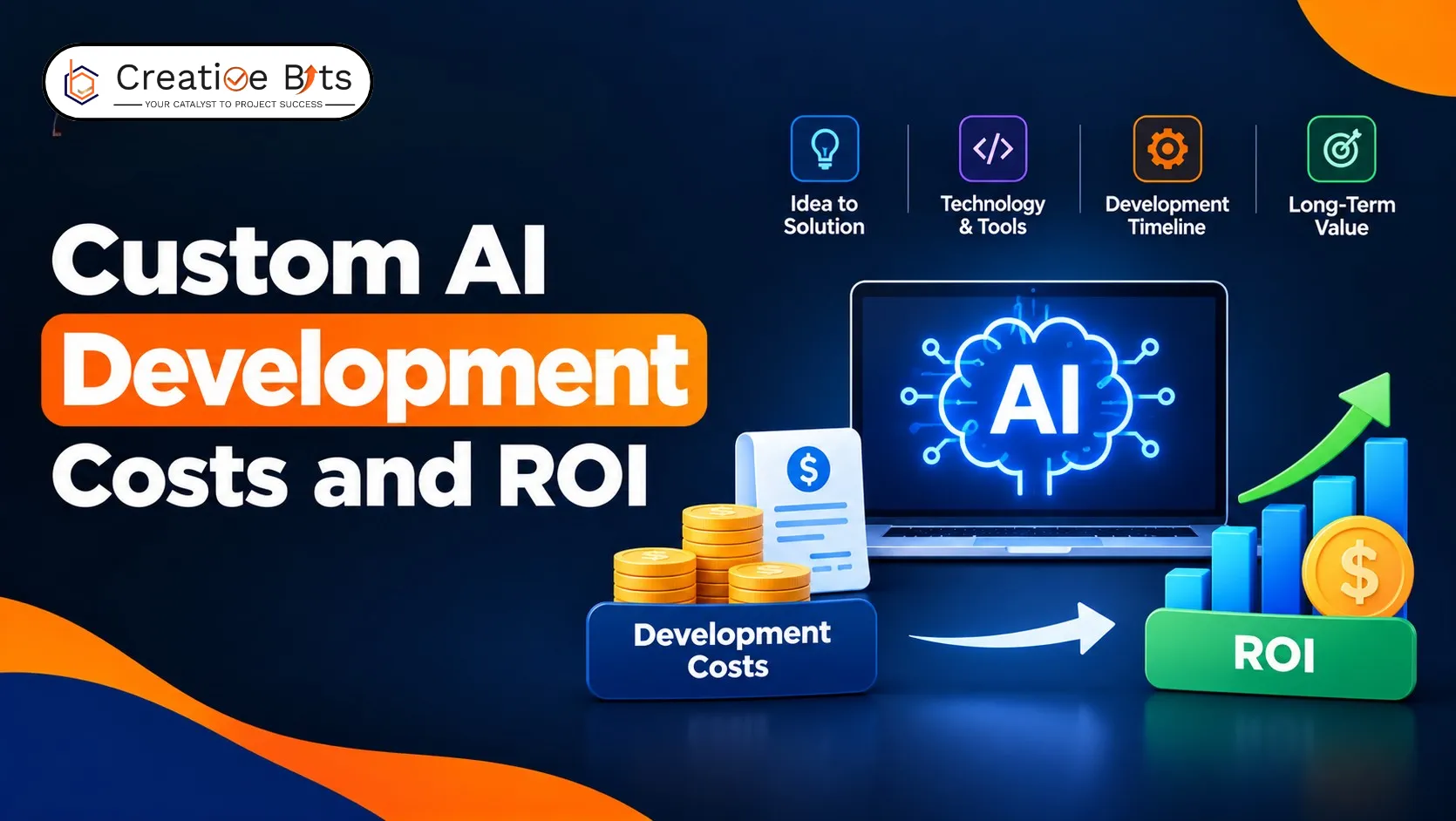
What Does Custom AI Development Really Cost in 2026?
The quote is the smallest number you will ever see on an AI project.
That’s not cynicism about custom AI development; it’s arithmetic. Published analysis puts three-year total ownership at roughly 1.5 to 2 times the initial build, and some estimates put first-three-year spend at two to three times. One 2025 survey found most organisations misestimate AI costs by more than 10%, with nearly a quarter underestimating by 50% or more.
So here’s an honest breakdown of custom AI development pricing in 2026: what the tiers actually cost, where the money goes, and the ongoing costs that rarely appear in a proposal.
All figures below are published market ranges from industry analyses, not quotes. Treat them as orientation.
How Much Does It Cost to Develop a Custom AI System in 2026?
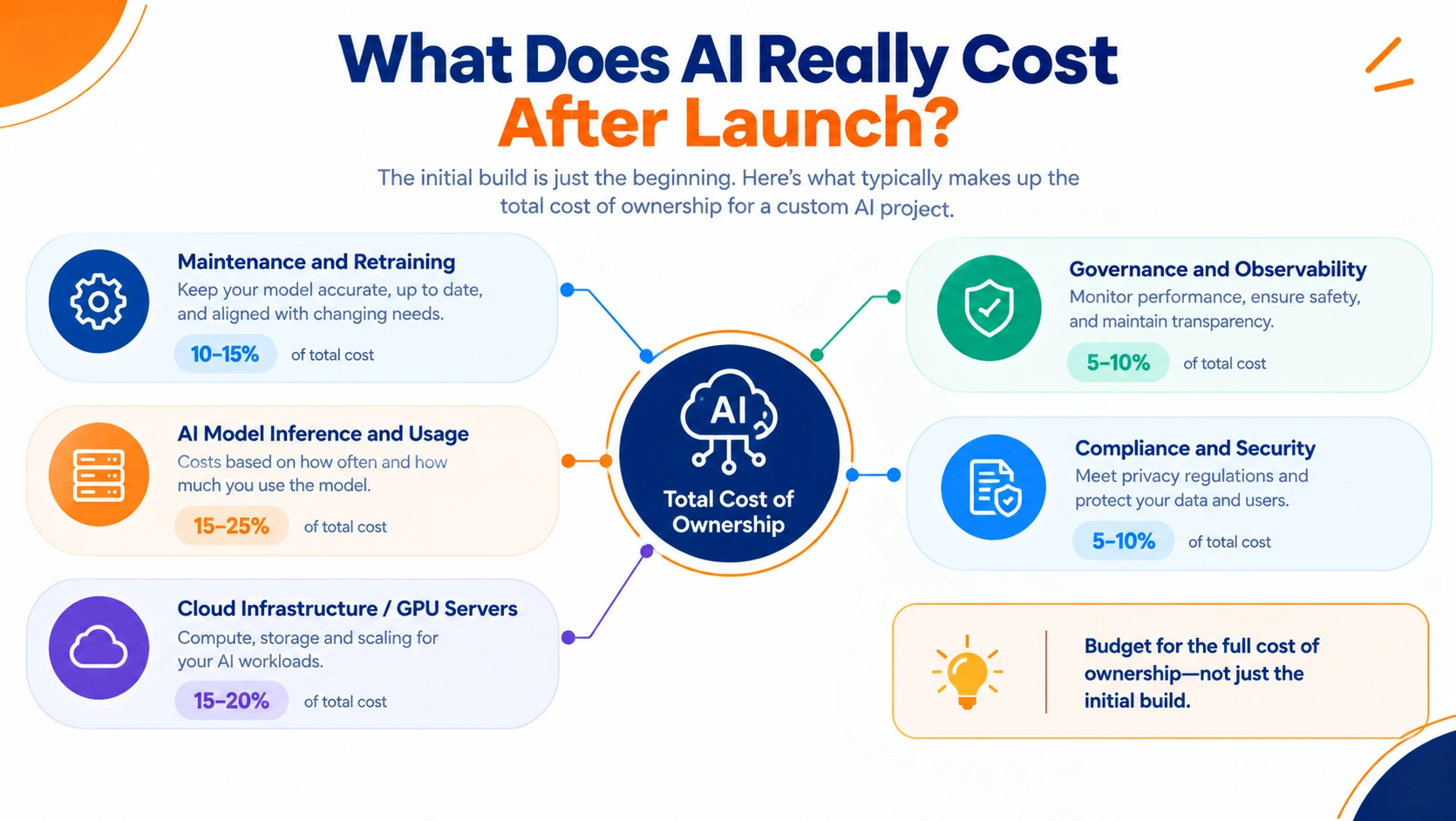
Custom AI development cost scales with ambition, and the tiers are reasonably consistent across published sources.
| Project type | Typical range | Timeline |
| AI feature on an existing model API | $10,000–$40,000 | 3–8 weeks |
| Chatbot or RAG assistant | $25,000–$120,000 | 1–4 months |
| AI agent with tools and workflows | $40,000–$150,000 | 2–6 months |
| Custom ML model | $40,000–$250,000 | 3–9 months |
| Enterprise or multi-agent platform | $500,000–$2,000,000+ | 6–18 months |
Smaller starter projects for SMBs can land between $5,000 and $50,000 over two to six weeks, which is where most first custom AI development engagements should begin.
The single biggest swing factor in custom AI development is data readiness. Clean, accessible data can cut 30–50% off a project. Fragmented data pushes it the other way, and no amount of model sophistication compensates.
How Much Will It Cost to Develop AI in 2026?
Two things changed the cost of AI development recently, and both work in your favour on a custom AI development budget.
Foundation model APIs collapsed the entry price. You no longer train from scratch for most business problems; you build on an existing model, which removed the largest single line item. Retrieval-augmented generation became the cost-efficient default for anything knowledge-based.
What got more expensive is everything around the model. Integration with enterprise systems adds 20–50% to a budget, at roughly $5,000–$25,000 per connection. Governance, explainability, and compliance now consume budget that used to go to model training.
Industry matters too. Published estimates put healthcare custom AI development at $300,000–$600,000 and up, finance at $300,000–$800,000, retail at $200,000–$500,000, and manufacturing at $400,000–$800,000. Regulated sectors carry premiums of roughly 25–35% in financial services and 30–50% in healthcare.
How Much Does It Cost to Develop a Custom AI System? The Breakdown
AI development cost analysis and returns properly means knowing which line items dominate a custom AI development budget. A representative split:
- Model complexity: 30–40% of total cost
- Data collection and preparation: 15–25% of cost, but 50–70% of project time
- Infrastructure and technology: 15–20%
- Compute budget: 15–25%
- Testing, validation, and maintenance: 10–15%
- Regulatory and compliance: 5–10%
Two items inflate budgets dramatically when they apply. Explainable AI can add 20–40% upfront. Privacy-preserving techniques such as federated learning can roughly double custom AI development cost.
Talent dominates every other line item. Published salary ranges put data scientists at $130,000–$250,000, ML engineers at $140,000–$280,000, and AI architects at $160,000–$300,000. A team of five to eight specialists over six to twelve months reaches $500,000–$1,500,000 in labour alone. Geography shifts this meaningfully: Eastern European teams are cited at 30–55% below US agency rates, with Asian markets lower still, against time-zone trade-offs.
A quality training dataset runs $10,000–$90,000, with annotation at roughly $0.10–$5 per data point.
What Is a $900,000 AI Job?
You’ll have seen the headlines: AI researchers at frontier labs commanding packages approaching, and sometimes exceeding, $900,000. These are senior research roles at organisations building foundation models, where a handful of people meaningfully affect a multi-billion-dollar product.
The useful question is whether that market affects your own custom AI development budget. Mostly, it doesn’t, and understanding why saves real money.
You are not competing for frontier research talent, because custom AI development for business doesn’t mean building a foundation model. It uses models that already exist. The skills that actually determine whether your project succeeds are data engineering, systems integration, and process design. Those people cost a fraction of research salaries and are considerably easier to find.
The practical implication: if a proposal is priced as though it requires research-grade talent for a RAG assistant, ask what specifically requires it.
What Return Should You Expect, and When?
A widely cited market study puts average return on AI investment at around 3.5x, with roughly 5% of companies reporting up to 8x. Published analyses place typical ROI realisation at 18 to 36 months.
Set against that: about 60% of AI projects exceed their original cost estimates by 30–50%.
Both figures can be true because variance in custom AI development is enormous, which is why discipline matters more than the forecast. Run a proof of concept before full deployment. Set specific, measurable targets rather than “improve efficiency.” Capture baseline numbers before anything launches, because without them the return is unprovable. Involve stakeholders from leadership to end users, since adoption determines whether any of it materialises.
The Hidden Cost of AI
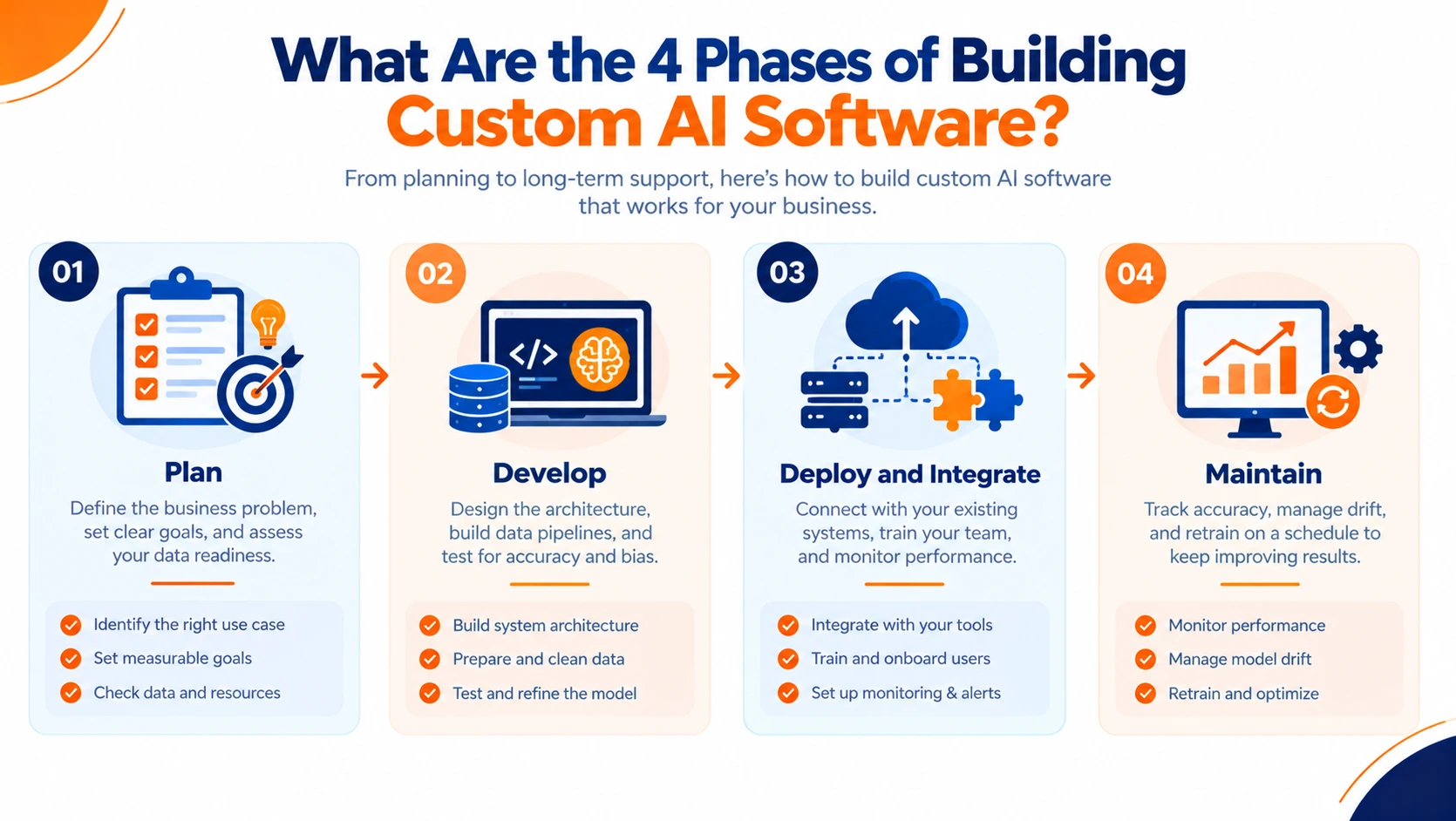
Here’s where custom AI development budgets break. The true cost of AI sits mostly after launch.
Maintenance and retraining. Roughly 15–25% of the initial build cost every year, with some analyses putting it at 20–30%. Each retraining cycle runs $5,000–$50,000.
Cost of running AI models. Inference is an operating cost that scales with usage, around $5,000–$15,000 per month per million requests. One documented AWS deployment for a medium NLP project came to about $23,622 monthly, roughly $283,000 across a year.
AI server cost. Cloud operations typically run $5,000–$50,000 monthly. On-premise GPU servers cost $20,000–$100,000 each before anyone switches them on.
Governance and observability. $50,000–$200,000 and $20,000–$100,000 annually, respectively.
Compliance and security in regulated sectors: roughly $10,000–$100,000 per year.
Worth noting the alternative. Off-the-shelf AI software price points sit at $99–$1,500 per month. For a standard problem, that is the honest recommendation. Custom AI development only earns its premium when your process or data is genuinely unusual.
Build a Real Number Before You Commit
Most online tools promising custom AI development costs and ROI in 2026 calculator functionality only model the build. That’s the smallest part.
Build your own custom AI development figure instead: initial build, plus three years of running costs, plus annual maintenance at 20% of build, plus governance. Set that against hours saved multiplied by loaded hourly cost, annualised. If the payback lands beyond 24 months, scope smaller.