monday.com Services
How Do You Build Custom AI Software That Actually Gets Used?
Most people asking how to build their own AI are picturing the wrong project.
They imagine training a model. What they actually need is a workflow, a trigger, a model call that interprets something messy, and three actions that happen afterwards without anyone touching them. That distinction is the whole reason custom AI software got accessible in the last two years. You are not building intelligence anymore. You are wiring existing intelligence into your own process.
This is a practical guide to building custom AI software for your business: what you can realistically do yourself, what needs help, which tools matter, and what it costs.
How to Build Custom AI Software for Your Business: Steps, Tools, and Costs
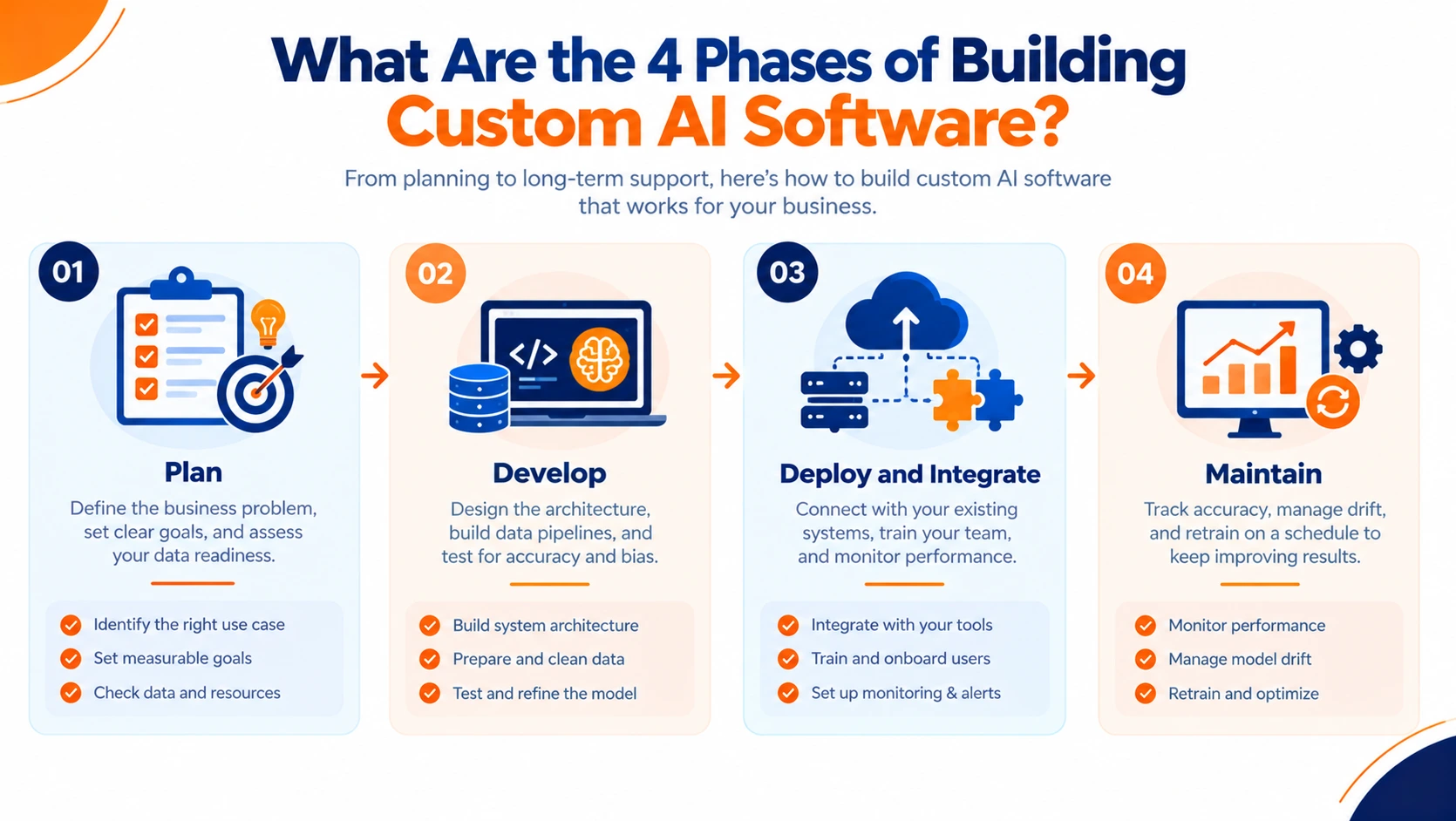
Published build guides converge on roughly four phases, and the order matters more than the tools.
- Plan. Define one specific business problem and the measurable criteria that say it worked. Inventory your data honestly: quality, accessibility, where it lives. Then assess readiness across strategy, infrastructure, governance, and talent before anyone writes a line of custom AI software.
- Develop. Design the architecture, build the data pipelines, then test for accuracy and bias using data kept completely separate from anything used in training.
- Deploy and integrate. Ship with monitoring and a rollback plan. Connect to existing systems through APIs. Train the people who will use it and adjust the workflow around it, because custom AI software nobody opens is not deployed.
- Maintain. Watch for accuracy drift, retrain on a schedule, and budget for it.
On tooling, the useful framing is layers: buy the standardised ones, own the parts that differentiate you:
- Infrastructure: AWS Bedrock, Microsoft Foundry, Google Vertex AI
- Data: Databricks, Snowflake, Microsoft Fabric
- Workflow logic: LangGraph, Temporal, agent frameworks
- No-code orchestration: Zapier, Make, n8n
- Interface: Vercel AI SDK, CopilotKit
Own your business rules, your data definitions, and your security policies. Those are the only parts of custom AI software a competitor cannot simply buy.
Costs scale with scope. Published ranges place a proof of concept at roughly $5,000–$50,000 over one to three months, an MVP at $20,000–$200,000 over three to six months, and a full product at $50,000–$500,000 and up. Simple custom AI software projects take three to six months; medium-scope projects, four to nine; and genuinely complex systems, beyond twelve. Treat all of that as orientation rather than a quote.
Can I Build My Own AI Software?
Yes, more of it than you would expect, and the honest answer depends on which layer you mean.
You can almost certainly build it yourself if the task is a workflow: classify incoming email, extract fields from documents, draft a reply for someone to approve, enrich a lead record. Visual builders handle this, and the five-step no-code process is genuinely learnable in a weekend. Searches for how to build custom AI software solutions for your business free of charge land on exactly this, and the free tiers are real.
You probably need help when custom AI software has to touch several systems that matter, when your data is fragmented across departments, when accuracy carries a compliance consequence, or when outputs need explaining to an auditor.
You almost certainly should not build it if the problem is standard. Off-the-shelf tools already solve it, and custom AI software only earns its premium when your process or data is genuinely unusual.
The build-versus-buy split published in most guides holds up: build internally when AI is central to your competitive advantage, and you can fund the talent long-term; buy when requirements are standard and speed matters; partner when you need something custom but lack the expertise; and go hybrid for everything in between.
What Can You Build Without Writing Code?
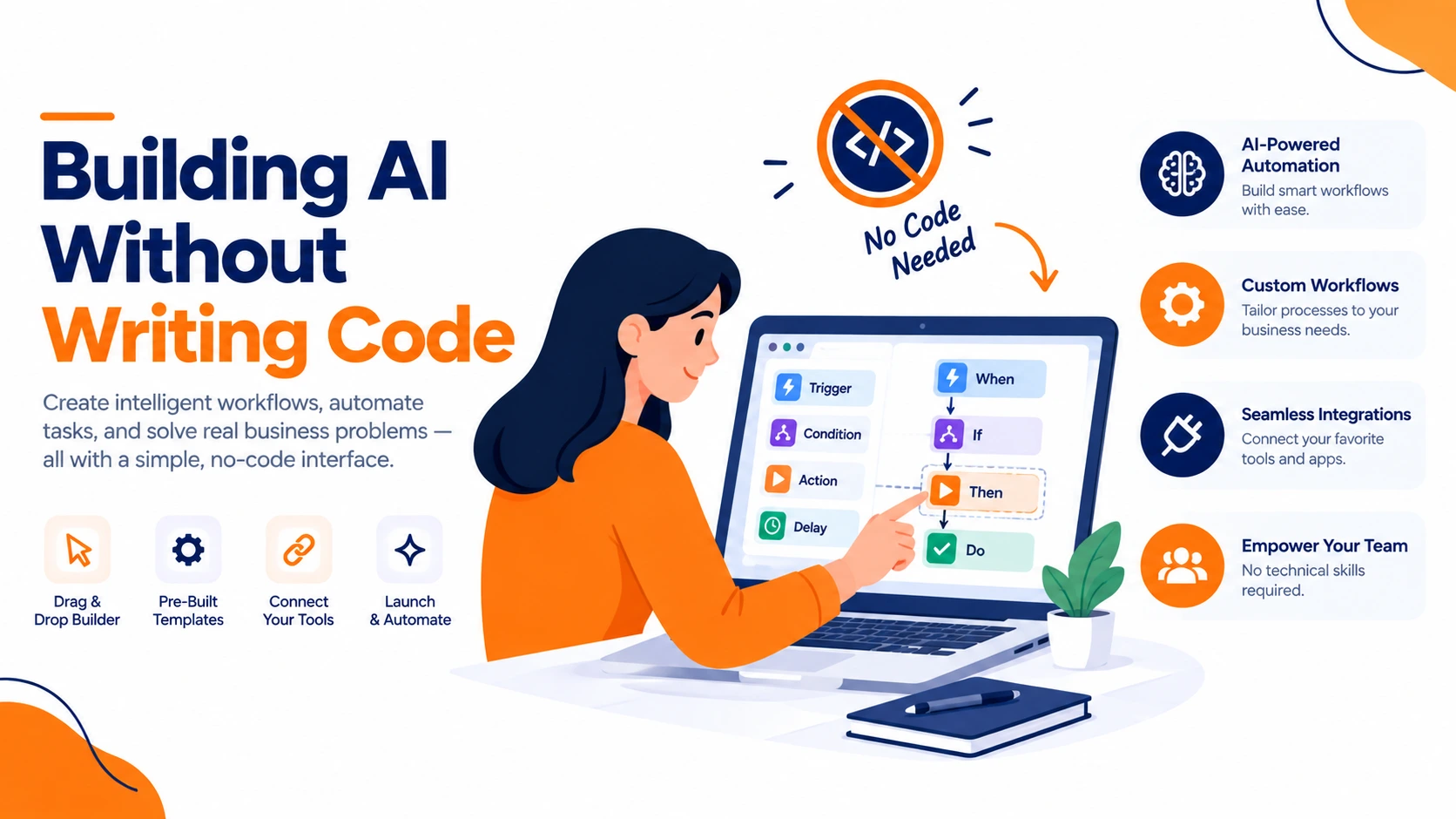
This is where most first custom AI software projects should start, and the ceiling is higher than people assume.
The no-code process is consistent across platforms:
- Define the goal: one repetitive task, one trigger, one outcome, stated in a single sentence.
- Connect integrations, list every app the system reads from and writes to, authorise each connector once.
- Build the workflow: a trigger, a reasoning step driven by a prompt, then action nodes. Keep the first version linear.
- Test with 5–10 real inputs, check every step's output, and refine the prompt against the edge cases you find.
- Add guardrails, then deploy, redact sensitive data, require human approval for anything external, switch on logs and failure alerts.
Zapier, Make, and n8n cover most of this. n8n is free indefinitely if you self-host it, which matters once volume rises. What still needs code: multi-agent orchestration, anything with unusual accuracy requirements, and deep integration with legacy systems that have no API. Those are the boundaries of no-code building, and they are worth knowing before you hit them.
How Do I Build AI for My Business?
Four decisions determine whether custom AI software delivers anything.
Decide what AI is allowed to decide. Use AI for the qualitative work: reading documents, interpreting language, classifying intent. Use ordinary deterministic software to enforce required steps and human approvals. Custom AI software making final calls on consequential things is a system you cannot audit.
Define the meaning of your own data. What counts as revenue, as a qualified lead, as resolved. Buy the data platform, but own those definitions inside it.
Measure outcomes, not activity. Not how many times the model ran, but whether the customer's problem was actually solved.
Check portability before committing. Can you swap models without a rewrite? Export your logs and evaluation data? Move your data out in open formats? Vendor lock-in is the quiet cost of custom AI software, and it is cheapest to avoid at the start.
Then start small: one high-value workflow, the smallest stack that makes it reliable.
How to Make $1000 a Day with AI?
Worth answering plainly, because the internet is full of worse answers.
AI does not create demand. What custom AI software changes is your cost base and delivery speed. The paths to meaningful revenue look like ordinary business arithmetic: a handful of retainer clients a small team can serve without proportional headcount, or a productized workflow with enough subscribers. Both are slow, and both work.
What does not work: generating volume content and hoping. That market is saturated with output from the same prompts everyone else is using.
For most operators, the real return on custom AI software is on the cost side. Remove twenty hours a month of billable-equivalent work, and it drops straight to margin. Less exciting than new revenue, considerably more reliable.
Build One Thing, Properly
Pick the highest-volume task where someone currently reads something and decides what happens next. Map it on paper. Build exactly that, measure it against how long it took before, and only then move on.
That is the entire method. The teams that end up with custom AI software worth having are not the ones who started with the most ambitious plan.