monday.com Services
What Are Business Process Automation Services?
In today's fast-paced digital economy, organizations are constantly looking for ways to improve efficiency, reduce operational costs, and enhance customer experiences. One of the most effective ways to achieve these goals is through business process automation services. By automating repetitive tasks, streamlining workflows, and integrating intelligent technologies, businesses can focus more on innovation and strategic growth instead of manual operations.
Whether you're a startup or a large enterprise, business process automation services help eliminate bottlenecks, improve collaboration, and ensure that business processes run consistently across departments. From finance and human resources to customer service and project management, automation has become an essential part of modern business transformation.
Today, companies are adopting business automation strategies to simplify complex workflows using intelligent technologies such as workflow automation, Artificial Intelligence (AI), and Robotic Process Automation (RPA). These technologies not only reduce human error but also increase productivity by allowing employees to concentrate on high-value tasks.
A successful automation strategy combines technology, process optimization, and business goals. Rather than replacing employees, automation empowers teams by handling repetitive work while improving decision-making and operational visibility.
At Creative Bits, we help organizations modernize their operations through customized automation solutions, AI-powered workflows, project management automation, and enterprise integrations. Our approach focuses on delivering scalable, secure, and measurable results that align with each client's business objectives.
Why Businesses Need Business Process Automation Services
Manual processes often create delays, inconsistencies, and operational inefficiencies. As businesses grow, these challenges become more significant.
Professional business process automation services help organizations:
- Eliminate repetitive manual tasks
- Reduce operational costs
- Improve employee productivity
- Accelerate business processes
- Increase workflow accuracy
- Enhance customer satisfaction
- Improve compliance and audit readiness
- Scale operations efficiently
- Enable data-driven decision-making
- Strengthen collaboration across teams
By automating routine operations, businesses create more agile and resilient organizations capable of adapting to changing market demands.
What Is Business Process Automation?
Business process automation services refer to the use of software, workflows, and digital technologies to automate repetitive business tasks, reduce manual intervention, and improve operational efficiency. Instead of relying on paper-based or manually managed processes, businesses automate routine activities to ensure speed, accuracy, and consistency.
In simple terms, business automation meaning is the practice of using technology to perform recurring business processes with minimal human effort. This enables organizations to save time, reduce costs, improve compliance, and enhance overall productivity.
Business Process Automation (BPA) is commonly used to automate:
- Employee onboarding
- Invoice processing
- Customer support workflows
- Purchase approvals
- Document management
- Sales follow-ups
- Leave management
- Expense approvals
- Project tracking
- Reporting and analytics
Rather than functioning as isolated software, modern Process Automation Solutions connect multiple business applications such as Customer Relationship Management (CRM), Enterprise Resource Planning (ERP), project management platforms, accounting systems, and communication tools into one seamless workflow.
How Business Process Automation Works
A typical automation project follows several stages:
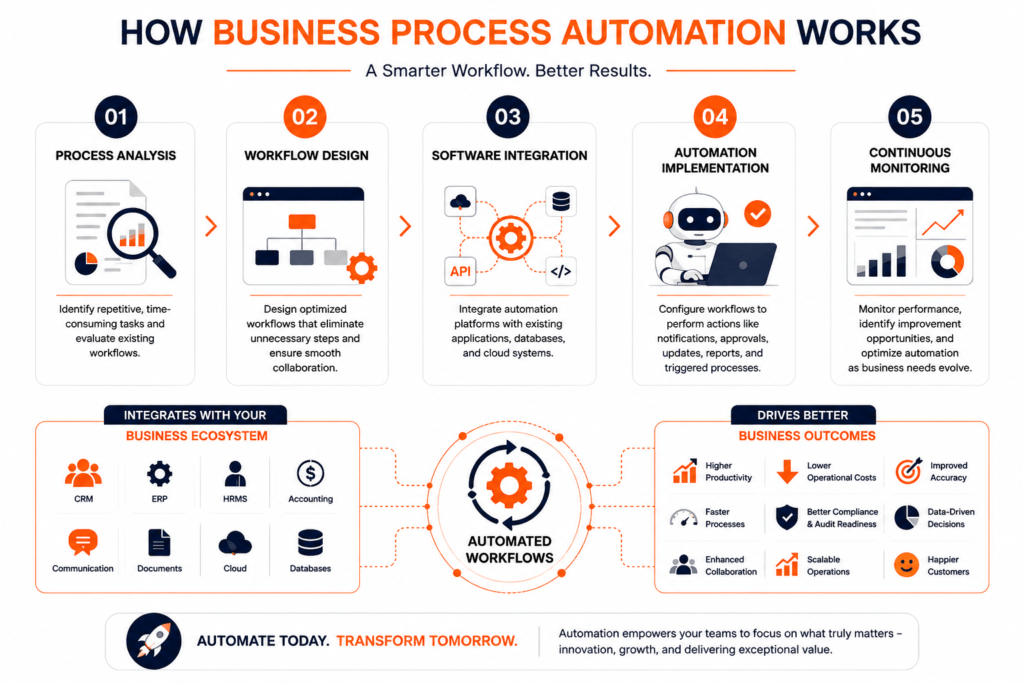
1. Process Analysis
The first step is identifying repetitive, time-consuming tasks that can be automated. Businesses evaluate existing workflows to understand inefficiencies, delays, and opportunities for improvement.
2. Workflow Design
Automation experts design optimized workflows that eliminate unnecessary steps while ensuring smooth collaboration between departments.
3. Software Integration
Automation platforms are integrated with existing business applications, databases, and cloud systems. This ensures that information flows automatically between different software solutions without manual data entry.
4. Automation Implementation
The automated workflow is configured to perform predefined actions such as sending notifications, updating records, routing approvals, generating reports, or triggering other business processes.
5. Continuous Monitoring
After implementation, organizations monitor workflow performance, identify improvement opportunities, and optimize automation for changing business needs.
Business Process Automation Services Examples
Understanding real-world applications helps businesses identify automation opportunities within their own organizations. Here are some practical business process automation service examples:
Finance and Accounting
- Automated invoice processing
- Expense approvals
- Payment reminders
- Financial reporting
- Budget tracking
Human Resources
- Employee onboarding
- Leave request approvals
- Payroll processing
- Performance review reminders
- Recruitment workflows
Customer Service
- Ticket routing
- AI-powered customer support
- Service request management
- Customer feedback collection
- Automated email responses
Sales and Marketing
- Lead assignment
- Email nurturing campaigns
- Proposal generation
- CRM updates
- Customer segmentation
Operations
- Inventory tracking
- Procurement approvals
- Vendor management
- Workflow notifications
- Quality assurance reporting
These examples demonstrate how automation improves efficiency across multiple departments while ensuring consistent business operations.
Choosing the Right Business Process Automation Company
Selecting the right business process automation company is critical for long-term success. Businesses should look for a partner that understands both technology and operational challenges.
Key factors to consider include:
- Experience with enterprise automation
- Workflow optimization expertise
- AI and automation capabilities
- Integration with existing software
- Scalability of solutions
- Security and compliance standards
- Ongoing technical support
- Industry-specific knowledge
We combine workflow automation, AI development, project management expertise, and enterprise integrations to help businesses automate operations efficiently while maintaining flexibility for future growth.
What Are the 4 Types of Automation?
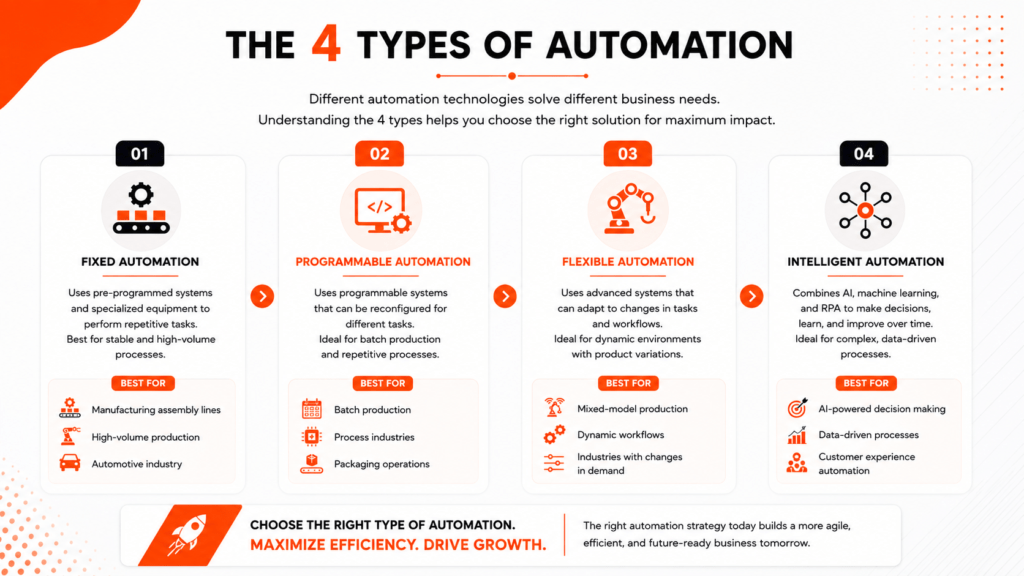
Automation is not a one-size-fits-all solution. Depending on business goals and operational requirements, organizations can implement different types of automation to improve efficiency and reduce manual effort. Professional business process automation services often combine multiple automation technologies to create intelligent, end-to-end workflows.
1. Fixed Automation
Fixed automation is designed for repetitive, high-volume tasks that follow predefined rules. It is commonly used in manufacturing and production environments where the same process is repeated continuously.
Examples include:
- Assembly line operations
- Packaging systems
- Barcode scanning
- Production monitoring
- Industrial robotics
This type of automation delivers high speed and consistency but offers limited flexibility.
2. Programmable Automation
Programmable automation allows businesses to modify workflows based on changing requirements. Unlike fixed automation, these systems can be reconfigured to perform different tasks.
Common applications include:
- Batch production
- Inventory management
- Scheduling systems
- Production planning
- Custom workflow configurations
Businesses benefit from improved adaptability while maintaining operational efficiency.
3. Flexible Automation
Flexible automation enables organizations to quickly switch between different processes without significant downtime. It is ideal for businesses managing multiple products, services, or customer requirements.
Typical use cases include:
- Multi-product manufacturing
- Customized order processing
- Dynamic workflow routing
- Omnichannel customer service
- Intelligent inventory allocation
This approach supports business agility while maintaining high productivity.
4. Intelligent Automation
Intelligent automation combines Artificial Intelligence (AI), machine learning, workflow automation, and Robotic Process Automation Services to automate complex business processes.
Unlike traditional automation, intelligent automation can:
- Analyze data
- Make recommendations
- Learn from historical information
- Predict outcomes
- Automate decision-making
- Improve continuously over time
Modern business process automation services increasingly rely on intelligent automation to deliver long-term business value.
What Are the Three Main RPA Tools?
Robotic Process Automation (RPA) allows software bots to perform repetitive digital tasks that traditionally require human interaction. These bots can log into applications, copy data, process transactions, generate reports, and communicate with other systems.
While there are many RPA platforms available, the industry generally recognizes three leading enterprise solutions:
1. UiPath
Ui Path is widely used for enterprise automation due to its user-friendly interface, extensive integrations, and AI capabilities. It supports both attended and unattended automation for organizations of all sizes.
Common use cases include:
- Invoice automation
- Customer onboarding
- Data migration
- Report generation
- Document processing
2. Automation Anywhere
Automation Anywhere provides cloud-native RPA solutions that help organizations automate repetitive business processes while integrating AI and analytics into workflows.
Businesses often use it for:
- Finance automation
- HR operations
- Compliance monitoring
- Customer support
- Supply chain automation
3. Blue Prism
Blue Prism focuses on secure, enterprise-grade digital workforce automation. It is particularly popular among large organizations requiring scalable, governed, and compliant automation solutions.
Typical applications include:
- Banking operations
- Insurance claims processing
- Healthcare administration
- Government services
- Enterprise back-office automation
While these platforms are widely adopted, the success of any automation initiative depends on selecting the right technology for your specific business requirements and integrating it effectively into existing workflows.
What Are the Top 10 Automation Tools?
Choosing the right business automation tools depends on your organization's size, industry, and operational goals. The following categories represent the most commonly used automation solutions in modern enterprises.
1. Workflow Automation Platforms
These platforms automate approvals, notifications, task assignments, and business workflows across departments.
2. Robotic Process Automation Software
RPA software automates repetitive rule-based tasks such as:
- Data entry
- Invoice processing
- Form completion
- File transfers
- System updates
3. Customer Relationship Management (CRM) Automation
CRM automation streamlines:
- Lead management
- Customer communication
- Sales pipelines
- Marketing campaigns
- Customer follow-ups
4. Project Management Automation
Project automation solutions simplify:
- Task allocation
- Deadline tracking
- Resource planning
- Progress reporting
- Team collaboration
5. Document Automation Software
These tools automate:
- Document creation
- Digital approvals
- Contract management
- File organization
- Electronic signatures
6. Email Automation Platforms
Businesses automate:
- Welcome emails
- Customer follow-ups
- Marketing campaigns
- Internal notifications
- Appointment reminders
7. AI-Powered Automation Platforms
AI-enabled platforms enhance automation by providing:
- Predictive analytics
- Intelligent recommendations
- Natural language processing
- Smart decision-making
- Conversational assistants
8. Business Intelligence Automation
These solutions automatically generate:
- Dashboards
- Reports
- KPI tracking
- Data visualizations
- Performance analytics
9. HR Automation Systems
HR automation includes:
- Recruitment workflows
- Employee onboarding
- Attendance management
- Payroll processing
- Performance evaluations
10. Enterprise Integration Platforms
These platforms connect multiple business applications, ensuring seamless data flow between CRM, ERP, finance, HR, customer support, and project management systems.
Process Automation Software: Choosing the Right Solution
Selecting the right process automation software is one of the most important decisions in any automation initiative. The software should not only automate repetitive tasks but also integrate seamlessly with your existing technology ecosystem.
When evaluating automation software, businesses should consider the following features:
- User-friendly interface
- Low-code or no-code capabilities
- AI integration
- API connectivity
- Cloud compatibility
- Data security
- Scalability
- Real-time reporting
- Workflow customization
- Role-based access controls
A scalable automation platform allows organizations to expand automation across multiple departments without disrupting daily operations.
Robotic Process Automation Services: Beyond Simple Task Automation
While traditional automation focuses on predefined workflows, Robotic Process Automation Services use software bots to mimic human actions across digital systems. These bots interact with applications just as employees do, completing repetitive tasks with speed and accuracy.
Common RPA applications include:
- Data migration
- Invoice processing
- Claims management
- Employee onboarding
- Customer account updates
- Order processing
- Compliance reporting
- Document validation
- Financial reconciliation
- Inventory synchronization
When combined with Artificial Intelligence, RPA evolves into intelligent automation capable of handling more complex business scenarios.
Why Businesses Are Investing in Business Automation
The demand for business automation continues to grow because organizations are under increasing pressure to improve efficiency while reducing operational costs. Automation enables businesses to standardize processes, eliminate repetitive work, and create a more agile operating model.
Organizations investing in automation typically experience:
- Faster service delivery
- Improved process accuracy
- Better employee productivity
- Enhanced customer experiences
- Greater operational transparency
- Lower administrative costs
- Easier regulatory compliance
- Scalable business growth
At Creative Bits, we help businesses implement tailored Process Automation Solutions that combine workflow automation, AI development, enterprise integrations, and project management expertise. Our goal is to help organizations automate intelligently, improve collaboration, and achieve sustainable business growth through technology-driven transformation.
What Is the RPA Salary?
One of the most common questions from professionals entering the automation industry is, "What is the RPA salary?" The answer depends on factors such as experience, location, industry, certifications, and technical expertise.
Professionals with skills in Robotic Process Automation Services, workflow automation, AI integration, cloud technologies, and business process optimization are in high demand across industries.
Typical RPA-related job roles include:
- RPA Developer
- Business Process Automation Consultant
- Automation Engineer
- Intelligent Automation Specialist
- RPA Solution Architect
- Business Analyst
- Process Consultant
- Workflow Automation Engineer
- AI Automation Specialist
- Digital Transformation Consultant
Entry-level professionals can begin with implementation and support roles, while experienced specialists often lead enterprise automation projects, design automation strategies, and manage digital transformation initiatives.
As organizations continue investing in business process automation services, career opportunities are expected to expand across healthcare, finance, manufacturing, retail, logistics, education, and technology sectors.
What Are the 7 Steps of BPR?
Business Process Reengineering (BPR) is a structured methodology used to redesign business processes for improved efficiency, productivity, and customer satisfaction. It complements business process automation services by ensuring that organizations optimize workflows before automating them.
The seven commonly followed BPR steps are:
1. Identify Existing Processes
Document current workflows and identify repetitive tasks, bottlenecks, delays, and inefficiencies.
2. Analyze Business Objectives
Define clear goals such as reducing costs, improving customer experience, increasing productivity, or accelerating service delivery.
3. Map Current Workflows
Create detailed process maps to understand how information, approvals, and tasks move throughout the organization.
4. Redesign the Process
Remove unnecessary steps, simplify approvals, eliminate duplicate work, and improve workflow efficiency.
5. Implement Automation
Deploy Process Automation Solutions, workflow automation, AI technologies, and Robotic Process Automation Services to execute the redesigned workflows efficiently.
6. Test and Optimize
Evaluate workflow performance, gather feedback, measure KPIs, and make necessary improvements before full deployment.
7. Monitor and Continuously Improve
Business requirements evolve. Continuous monitoring ensures automation remains effective, secure, and aligned with organizational goals.
What Are 10 Advantages of Automation?
Organizations adopting business process automation services experience benefits that extend beyond cost savings. Automation improves efficiency, employee satisfaction, customer service, and overall business performance.
Here are ten major advantages of automation:
1. Increased Productivity
Employees spend less time on repetitive administrative work and more time on strategic initiatives.
2. Reduced Operational Costs
Automation minimizes manual effort, helping organizations reduce labor-intensive processes and operational expenses.
3. Improved Accuracy
Automated workflows reduce human errors, ensuring consistent and reliable process execution.
4. Faster Process Execution
Tasks that previously required hours or days can often be completed within minutes.
5. Enhanced Customer Experience
Automated workflows improve response times, service quality, and communication with customers.
6. Better Compliance
Automation creates standardized processes, maintains audit trails, and simplifies regulatory compliance.
7. Greater Scalability
Businesses can handle increasing workloads without proportionally increasing staffing requirements.
8. Real-Time Visibility
Automation platforms provide dashboards, reporting, and analytics that help leaders monitor business performance.
9. Improved Employee Satisfaction
Employees can focus on creative, strategic, and customer-focused work rather than repetitive administrative tasks.
10. Better Decision-Making
Automation generates reliable data and performance insights that support faster, data-driven business decisions.
Is ServiceNow a BPM Tool?
A common question among organizations evaluating enterprise automation platforms is whether ServiceNow is a BPM (Business Process Management) tool.
The answer is yes—but with broader capabilities.
ServiceNow includes robust Business Process Management (BPM) and workflow automation features that enable organizations to:
- Automate business workflows
- Manage approvals
- Route service requests
- Integrate enterprise applications
- Track business processes
- Improve operational visibility
- Support IT and business service management
In addition to BPM functionality, ServiceNow offers capabilities for IT service management, customer service operations, HR workflows, governance, risk management, and enterprise automation.
For organizations implementing business process automation services, platforms like ServiceNow can play an important role when combined with AI, workflow automation, and enterprise integrations.
Why Choose Creative Bits for Business Process Automation Services?
Successful automation requires more than software—it requires a deep understanding of business processes, technology, and organizational goals.
We help businesses transform manual operations into intelligent, automated workflows that improve efficiency and support long-term growth.
Our expertise includes:
- Custom Business Process Automation Services
- AI-powered workflow automation
- Enterprise application integration
- Process optimization and consulting
- Project management automation
- Business workflow design
- Custom software development
- Cloud-based automation solutions
- Ongoing optimization and support
Whether you're automating internal operations, customer-facing processes, or enterprise workflows, our team designs scalable solutions that integrate seamlessly with your existing technology stack.
By combining automation, AI, and digital transformation expertise, we enable organizations to reduce operational complexity, improve collaboration, and accelerate business outcomes.
Conclusion
Digital transformation is no longer optional—it's a competitive necessity. Organizations that embrace business process automation services gain the ability to streamline operations, eliminate repetitive tasks, reduce costs, and improve overall business performance.
From workflow automation and Robotic Process Automation Services to intelligent Process Automation Solutions, businesses can create faster, more efficient, and scalable operations while enhancing employee productivity and customer satisfaction.
The future of automation lies in connecting people, processes, and technology through intelligent workflows. With the right strategy and implementation partner, organizations can unlock new levels of efficiency and innovation.
We deliver tailored automation solutions that help businesses modernize operations, integrate AI, optimize workflows, and achieve measurable results. Our commitment to innovation and customer success ensures that every automation initiative aligns with your business objectives and supports sustainable growth.
2. What is business automation?
Business automation is the use of software and digital technologies to perform recurring business processes with minimal manual intervention.
3. What is the difference between BPA and RPA?
Business Process Automation (BPA) focuses on optimizing end-to-end workflows, while Robotic Process Automation (RPA) automates repetitive, rule-based tasks performed across digital systems.
4. Which industries benefit from business process automation services?
Healthcare, finance, manufacturing, logistics, retail, education, insurance, and professional services all benefit from automation.
5. What are process automation solutions?
Process Automation Solutions are technologies that automate workflows, approvals, data movement, and business operations to improve efficiency and accuracy.
6. How do robotic process automation services improve productivity?
RPA software bots complete repetitive tasks faster and with fewer errors, allowing employees to focus on higher-value work.
7. How do I choose the right business process automation company?
Look for experience in workflow automation, AI integration, enterprise software integration, security, scalability, and ongoing support.
8. What are business automation tools?
Business automation tools are software platforms that automate workflows, approvals, communication, reporting, project management, and repetitive operational tasks.