monday.com Services
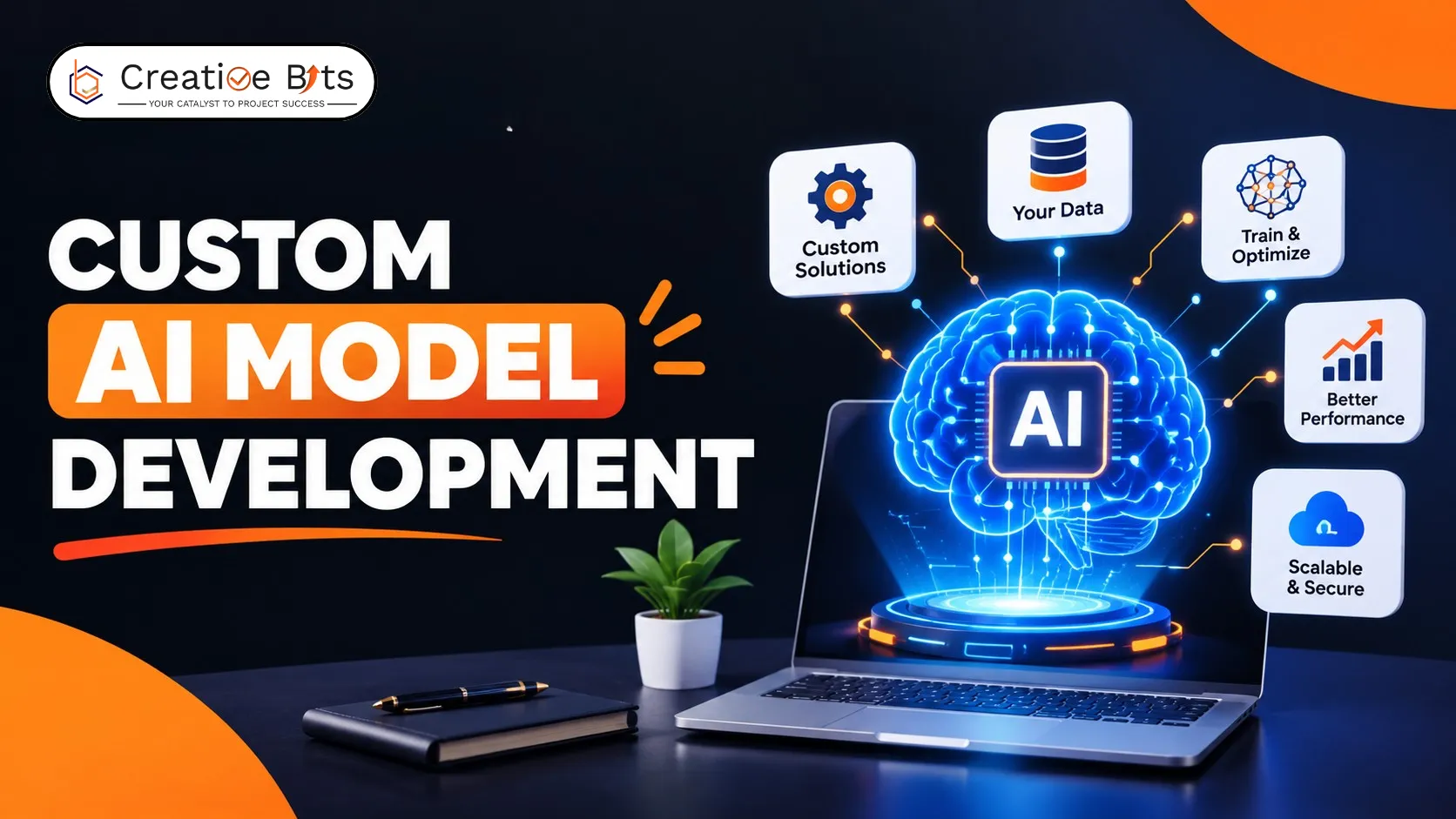
Which 7 Stages Make AI Model Development Actually Deliver?
Integration usually costs more than the model itself.
That single fact reorders most enterprise AI budgets and is the clearest signal that AI model development is an engineering discipline rather than a data science experiment. Published guides repeatedly agree on this: training a model is rarely the hard part. Wiring it into systems people already use, keeping it accurate as data shifts, and proving to a regulator why it made the decisions it made—that is where the work lives.
This is a practical guide to AI model development for enterprises: the seven stages, what you need before you start, what it costs, and what happens after launch.
What Are the 7 Stages of AI Model Development?
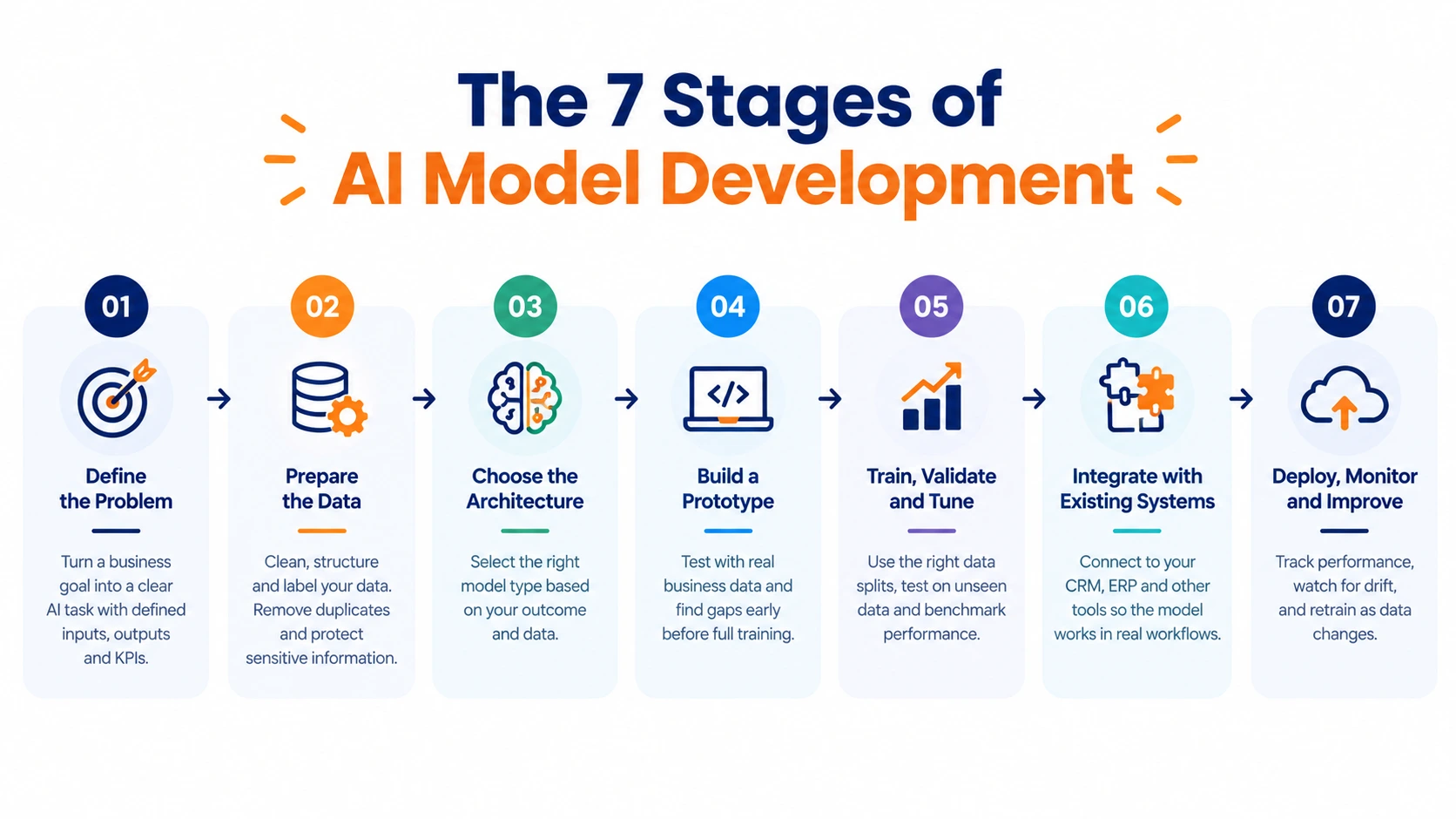
Published AI model development processes vary in wording but converge on the same seven stages. Skipping any of them is where projects stall.
- Define the problem. Convert an operational goal into a measurable machine learning task. One use case: churn prediction, demand forecasting, fraud detection, with named inputs, outputs and KPIs. Vague objectives produce unprovable AI model development.
- Audit and prepare the data. Inventory sources, check completeness, remove duplicates, standardise and label. Anonymise anything sensitive. Several years of representative history is the usual expectation, and this stage routinely consumes more time than anyone plans for.
- Choose the architecture. Match the approach to the outcome: gradient boosting and supervised learning for structured predictions, unsupervised methods for segmentation, transformer-based language models for text. Architecture planning belongs at the feasibility stage of AI model development, not after data prep.
- Build a prototype. Test on real business data rather than a benchmark set. This is where dataset gaps and undocumented business rules surface, and it is cheaper to find them here.
- Train, validate, and tune—split data into training, validation, and test sets. Validate against genuinely unseen data to catch overfitting, then benchmark against a baseline and stress-test edge cases.
- Integrate with existing systems. Connect to CRM, ERP, e-commerce, support queues, BI dashboards. The most common failure in enterprise AI model development is a model that works in a notebook and reaches nobody's workflow.
- Deploy, monitor, and improve. Track accuracy, confidence, drift, and latency in production. Retrain on a schedule as data changes.
Treat this as iterative rather than linear. Real AI model development loops back through stages two, five and seven permanently.
How Do You Keep Enterprise Data Secure in an AI Project?
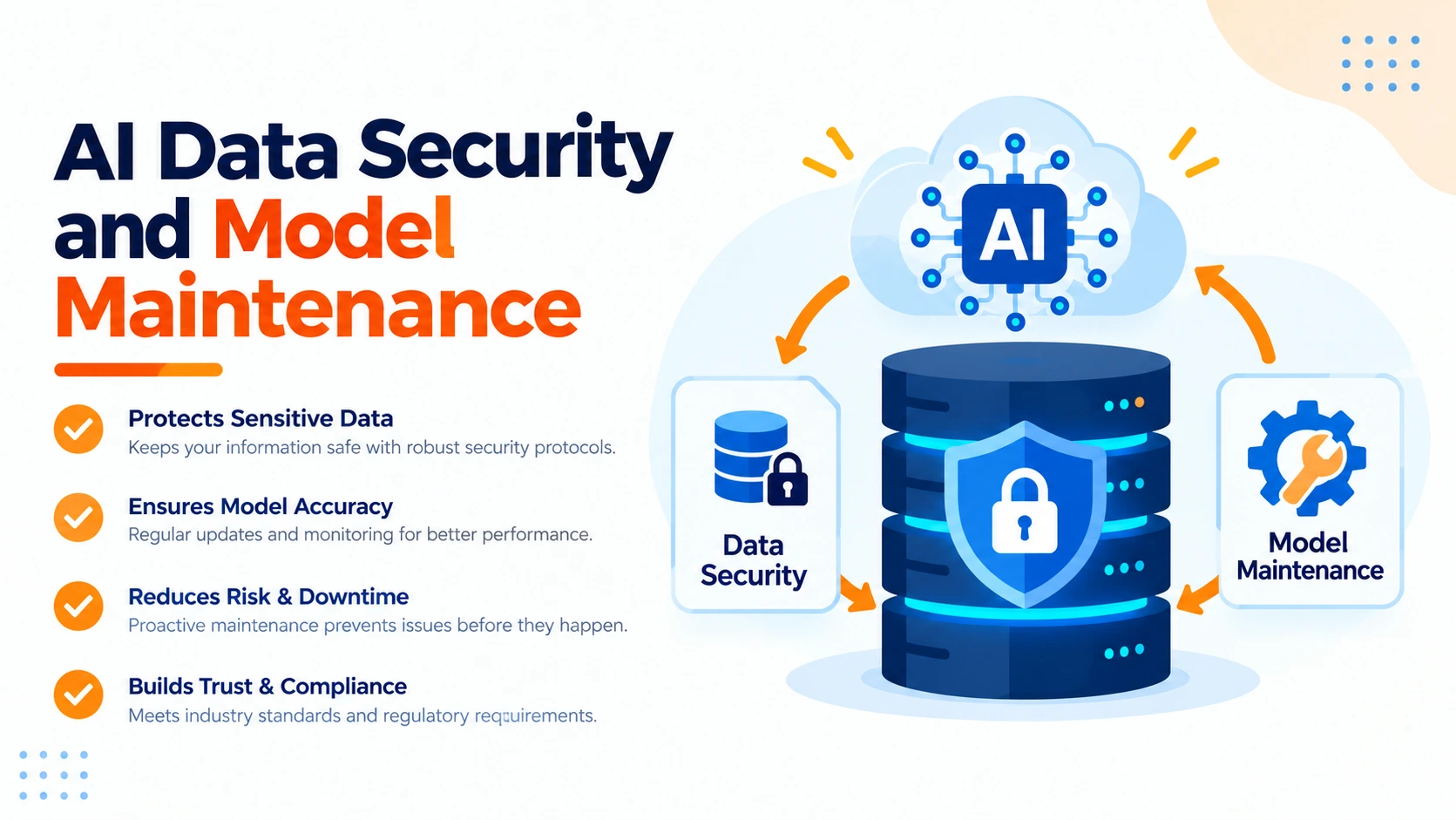
Data security in AI projects is usually the question that decides whether custom AI solutions for enterprises get approved at all, and it has concrete answers.
Anonymise and minimise. Strip or mask sensitive records before training. Differential privacy adds mathematical protection against re-identification.
Consider federated learning. It trains across distributed data without ever centralising raw records, useful when data cannot legally leave a jurisdiction or a business unit.
Control where it runs. This is the structural advantage of custom AI model development over vendor platforms: deployment can sit on-premises, in a private cloud, inside a VPC, or air-gapped. Data usage, retention, and lineage stay yours.
Build the audit trail from day one. Full telemetry, custom guardrails, bias monitoring, and explainability mechanisms. Regimes including GDPR, CCPA, the EU AI Act, and the NIST AI Risk Management Framework all expect traceability of how a model was trained.
Assign ownership at kickoff. Define who is accountable for compliance before AI model development begins, not during the audit.
What Do I Need to Build My Own AI Model?
Seven prerequisites, and most organisations are missing at least two.
- A measurable business goal with a stated accuracy target that is good enough for the decision it supports
- High-quality representative data with governance attached, clean, consistent, ideally labelled.
- A structured data pipeline connecting your core systems, not a one-off export
- People: data scientists plus cross-functional input from technical leaders, legal advisors and domain specialists
- Compute and secure storage, GPU capacity for training, infrastructure that scales for inference.e
- MLOps pipelines for deployment, versioning and monitoring
- A baseline model to benchmark every later improvement against
The honest filter: AI model development makes sense when you have a repetitive, data-driven decision where errors are costly. If the process is occasional or the errors are cheap, tailored machine learning models are the wrong instrument. This raises the build-or-buy question. Published decision matrices compare the two paths across cost of ownership, speed to market, talent requirements, data control, scalability, risk and IP ownership. Buying pre-built tools can cut time-to-market by up to 50% and ship in weeks. Building takes months to years; one published estimate puts a mid-size manufacturer's custom build at 12–18 months and $500,000-plus. Fine-tuning an existing foundation model sits usefully between the two and is where most sensible AI model development now starts.
What Does AI Model Maintenance Actually Involve?
Launch is the midpoint of AI model development. AI model maintenance and support is the recurring cost most budgets miss entirely.
Drift management. Model accuracy degrades as the world changes. Monitoring catches it; scheduled retraining corrects it.
Error analysis and bug fixes. Outliers and unexpected classifications need investigating rather than ignoring.
Performance reporting against KPIs. Not model metrics, business metrics. Whether the decision the model supports got better.
Documentation and training. End users and administrators both need it, and AI model development that skips this produces a system people route around.
On AI model cost estimation, no source offers a fixed price, and that is the honest position. The drivers are consistent: data readiness is the largest variable, build approach matters enormously, use case complexity drives compute, the final few percentage points of accuracy are the most expensive, and integration depth determines a lot. The AI deployment timeline stretches most often because of data preparation and integration, not training.
Who Needs to Be in the Room for an Enterprise AI Project?
Business AI implementation fails on organisational grounds far more often than technical ones, and the fix is who you involve.
An executive sponsor who owns the outcome and can resolve cross-departmental data access.
Domain specialists who know what the data actually means and which edge cases matter. No amount of machine learning consulting substitutes for this.
Legal and compliance, early, not at the pre-launch review.
The people whose work changes. Adoption determines whether any of it materialises.
An enterprise AI strategy worth the name sequences capability rather than announcing transformation. One narrow model, properly measured, teaches an organisation more about AI model development than a three-year roadmap nobody can execute.
Start Narrow, Measure Honestly
Pick the repetitive, high-volume decision where mistakes cost real money. Capture baseline numbers before anything launches, because without them the return on AI model development is unprovable.
That is the whole discipline. AI model development rewards organisations that finish one thing properly over those that start five.