monday.com Services
What Should You Expect From a Proven AI Development Company?
The gap between companies that got value from AI and companies that got a demo is rarely budget.
It's whether anyone connected the AI to a process that was already costing money. That sounds obvious until you look at how projects are actually scoped: model first, problem second. A good AI development company inverts that order, and it is the single most reliable predictor of whether the thing works a year later.
Here's what AI genuinely delivers in business right now, what to look for in an AI development company, and seven projects worth building in 2026.
10 Examples of Artificial Intelligence in Business That Drive Growth and Efficiency
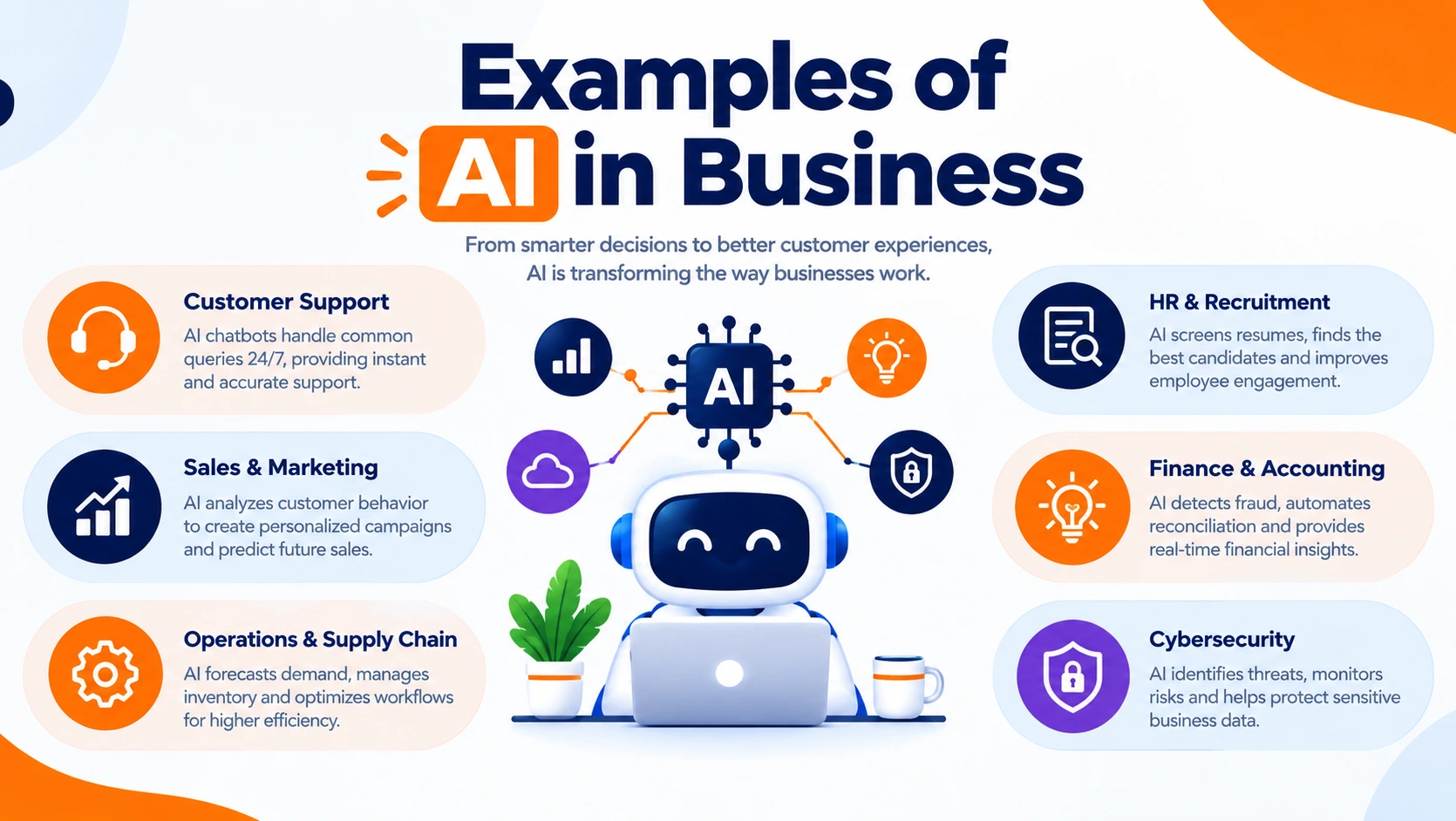
Organised by function, because that's how the bottlenecks are organised too.
- Diagnostics and medical documentation, imaging support, and administrative paperwork in healthcare.
- Demand forecasting, predicting inventory needs from store, supplier, and transportation data. Walmart reported fewer out-of-stock items after deploying it.
- Dynamic pricing and personalisation: retail offers tuned to individual behaviour, a common first brief for an AI development company.
- Fraud detection: PayPal's machine learning reviews transaction data to flag account takeovers before they complete.
- Loan processing and risk assessment: faster underwriting with consistent criteria.
- Predictive maintenance: equipment failures caught before a line stops.
- Route and fleet optimisation: logistics scheduling that accounts for real constraints.
- Résumé screening and interview scheduling: Unilever uses AI tools to support recruitment decisions at scale.
- Conversational support: KLM's assistant handles bookings, flight status and travel questions, passing complex cases to human agents.
- Recommendation engines: Amazon uses purchase history, browsing, and search to surface products.
The efficiency pattern underneath all ten is consistent: less repetitive manual work, fewer errors, faster decisions from real-time data, lower operating cost, and the capacity to absorb more volume without proportional headcount. That last one is what any credible AI development company should be aiming at.
What Should You Look For in an AI Development Company?
Searches for the best AI development companies or the top 10 AI development companies in the USA produce directories, not answers. Use criteria to evaluate an AI development company instead of rankings.
Do they start with your process or their stack? An AI development company that asks what the model should do before asking what the workflow currently costs has the sequence backwards.
Can they name a measurable outcome? Hours saved, error rate reduced, cycle time cut. Artificial intelligence development services priced against a deliverable with no metric attached are difficult to evaluate afterwards.
What happens after launch? Model accuracy degrades as data shifts. Ask what monitoring, retraining, and support from the AI development company actually cover.
Do they integrate, or just deliver? Connection to your CRM, ERP, and existing tools is where most of the engineering time goes. An AI development company that treats integration as an afterthought will miss the timeline.
Is the full range in-house? Custom machine learning, chatbots, NLP, predictive analytics, computer vision, and generative AI are different disciplines.
Are the timelines honest? Published figures put a simple chatbot at roughly four to eight weeks and a complex enterprise platform at three to nine months or longer. Anyone promising materially faster on a complex build is either very good or not being straight with you.
On generative AI specifically: evaluating a generative AI development company follows the same logic. The question isn't who has the most impressive demo; it's who can tell you which of your processes should not use generative AI.
How Can I Use AI to Make My Business More Efficient?
Five mechanisms account for nearly all of it, and knowing which one you're buying prevents a lot of disappointment.
Automate the repetitive. Support that runs outside office hours, data entry, routing work between systems.
Decide from data instead of instinct. Pattern analysis across volumes no person could read, then forecasting on top of it, the most requested brief any AI development company receives.
Allocate resources properly. Scheduling and inventory tools that factor in availability, skills, and real demand.
Reduce errors by moving people off error-prone work. Accuracy improves because the task changed, not because people tried harder.
Scale with demand—capacity that expands and contracts rather than being hired and fired.
The signals that you specifically need custom work, rather than off-the-shelf tools, are well established. Generic software has hit its ceiling for what you need. Your workflow is genuinely complex. Your data is proprietary, so generic models can't use it well. You operate under industry-specific compliance requirements. Or your competitive advantage depends on owning the solution rather than renting it. If none of those apply, a good AI development company will tell you to buy something instead.
Practically: pick one process, map it on paper, capture baseline numbers, then automate exactly that. AI development services USA buyers most often regret are the ones scoped as a programme rather than a first workflow.
What Does Generative AI Change About How Your Team Works?
Roles shift before they disappear, and the shift is specific rather than general.
An AI development company will frame this correctly: generative tools move people from producing first drafts to editing them, copy, code, documentation, proposals, summaries. Agentic systems move them further, from doing work to directing and auditing it. What expands is exception handling, quality review, client relationships, and the judgment calls someone has to be accountable for. What shrinks is first-draft production and shuttling information between systems.
So you're redesigning roles, not just installing software. Any AI development company worth engaging raises this before you sign, because adoption determines whether the efficiency materialises. Teams who believe a system is coming for their job quietly refuse to use it, and no amount of model quality survives that.
Say what's changing early, and name who owns the new version of the work.
What Are 7 Real-World AI Projects I Can Build in 2026?
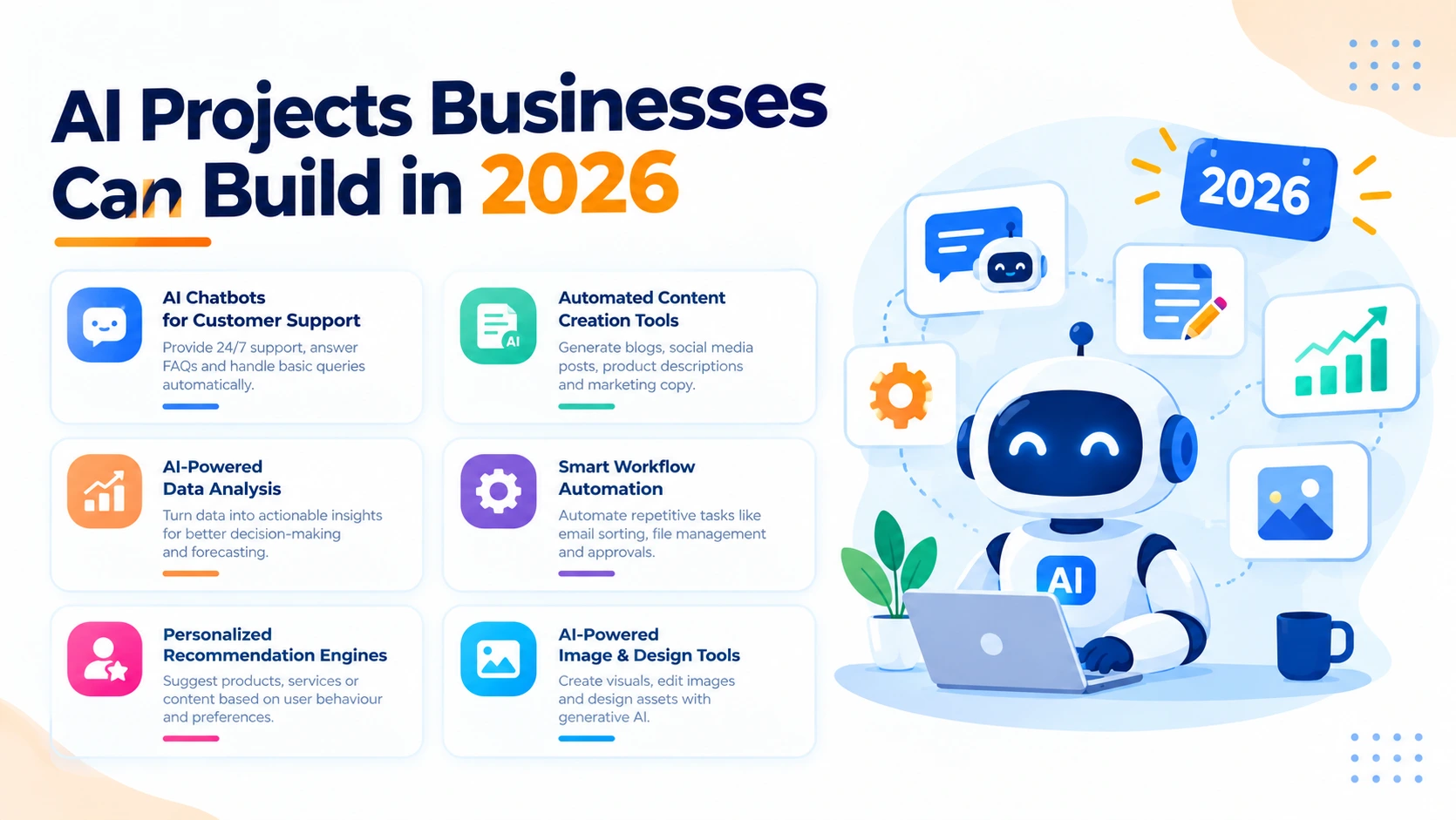
Ordered by how quickly they tend to pay back, and all seven are standard scope for an AI development company.
- Document extraction. Invoices, contracts, forms, unstructured input becomes structured fields that feed existing rules.
- Support triage. Incoming tickets classified and routed automatically, with drafted replies for human approval.
- Demand or churn prediction. Supervised learning on historical data you already hold.
- Visual inspection. Computer vision for defect detection and safety compliance, proven in manufacturing, and increasingly in sectors like agriculture and infrastructure maintenance.
- Conversational assistant on your own knowledge base. Multi-step conversations grounded in your actual documentation rather than general web content.
- Lead scoring and enrichment. Engagement signals converted into a priority order your sales team trusts.
- An agentic workflow. Autonomous multi-step execution across tools, with human approval gates on anything consequential. The newest category, and the one where partnering with an experienced AI development company saves the most time.
Start with one. The right AI development company will push you toward the narrowest version of it that still produces a measurable number.
Pick the Process, Then the Partner
Published surveys put roughly a third of organisations already using AI. The ones getting returns aren't those who bought the most; they picked a process that was already expensive and fixed it properly.
Map your most costly repetitive decision. Measure it. Then choose an AI development company that wants to talk about that before anything else.