monday.com Services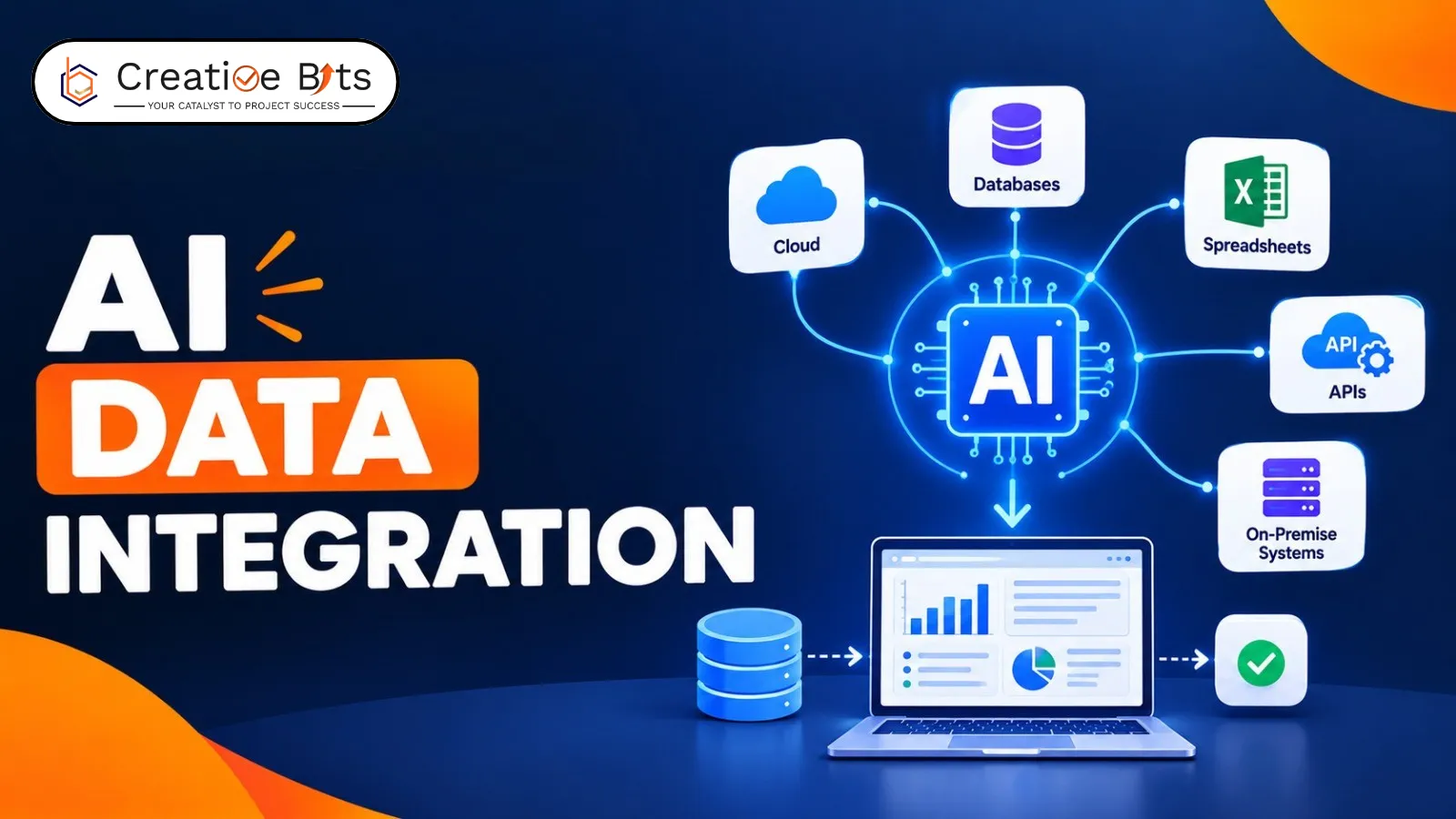
Why Does AI Integration Live or Die on Your Data Quality?
The model is rarely the problem. When an AI integration stalls, the post-mortem usually lands in the same place: data scattered across six systems, three of them disagreeing, and nobody owning the definition of an "active customer." The algorithm was fine. It just had nothing reliable to learn from.
This is the part of AI integration that gets the least attention and causes the most failures. Here's what AI integration actually demands from your data, and how to get there without a two-year transformation programme.
Key AI Concepts Every Business Should Understand Before Integrating Data
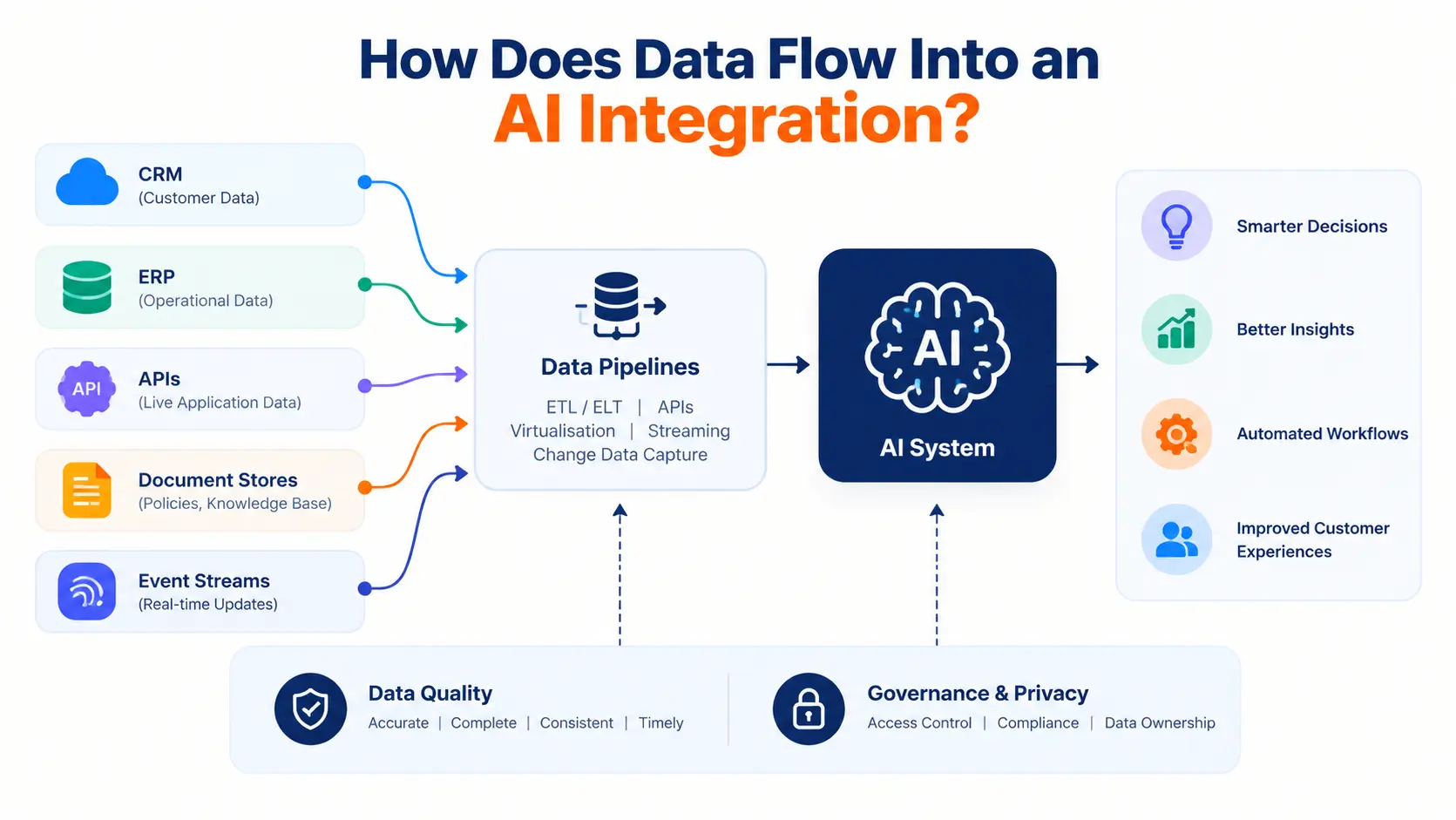
A handful of concepts explain most of what a technical team will propose on an AI integration project. Knowing them makes you a far better buyer.
Retrieval-augmented generation (RAG). Instead of relying on what a model learned during training, RAG retrieves relevant information from your own documents first, then uses it to answer. Your content is stored as vector embeddings so the system can find passages by meaning rather than exact keywords. This is how an AI integration answers questions using your policies instead of the open internet.
Agentic AI. Models that reason step by step and call tools, databases, APIs, and applications to complete multi-step tasks with limited human input.
Data fabric. A layer connecting sources across departments while each team keeps ownership of its own data. It avoids the usual AI integration trap of trying to centralise everything into one warehouse before anything useful can ship.
Integration techniques. ETL and ELT move and reshape data in batches. API-based integration connects applications directly. Data virtualisation queries sources in place without copying. Streaming and change data capture keep things current in near real time.
So how does AI collect data in a business setting? Not by scraping. It arrives through those pipelines: connectors pull records from your CRM and ERP, APIs expose live application data, document stores feed knowledge bases, and event streams capture changes as they happen. Ask how AI collects personal data and the answer is the same: whatever your systems already hold about customers. That is precisely why governance belongs at the start of any AI integration rather than bolted on at the review stage.
What Are the 7 C's of AI?
One widely cited framework breaks AI into seven dimensions, though you'll find competing versions of this list, so check which one someone means before building a plan around it.
Cognition. How the system processes information and reaches decisions.
Context. Its ability to understand a situation and return something relevant rather than generically correct.
Computation. The processing power behind it, and the cost and energy that come with it.
Creativity. Generating content, text, images, code, designs.
Collaboration. Working alongside people, handling routine work so teams can focus elsewhere.
Communication. Natural language understanding: chatbots, transcription, translation, sentiment analysis.
Consciousness and ethics. Bias, fairness, privacy, and accountability: the governance questions.
For most businesses, context and communication deliver the earliest returns from AI integration, and ethics determines whether that AI integration survives its first compliance review.
What Are the Best Practices for Implementing AI Effectively?
The practices that separate an AI integration that ships from one that stalls are unglamorous and consistent.
Start with a focused proof of concept. Pick one high-impact use case for AI integration, use existing data and workflows, define measurable KPIs, and test under realistic conditions rather than curated examples.
Monitor data quality at every connected source. Poor data from one system spreads to every other system it touches. Build validation checks in from the beginning, not after the first bad output reaches a customer.
Test against production-like data. Use copies of real data in test instances of every system involved. Edge cases don't appear in sample files.
Watch resource usage. Track response times, memory and load so integrations don't quietly degrade the live systems people depend on.
Start small. Skip the comprehensive unified data model. Begin with the minimum data the business actually needs and expand from there.
Build in explainability. Stakeholders, regulators, and your own team all need to understand why the AI integration decided what it decided.
Treat AI data collection privacy as a design constraint. Access controls, retention rules, consent and compliance obligations such as GDPR shape the AI integration architecture. Retrofitting them is expensive and sometimes impossible.
There's a human side too. Data preparation work has created a whole category of AI data collection jobs: labelling, annotation, validation and quality review, much of it distributed, which is why AI data collection job listings have grown so quickly. A typical AI data collector job description covers sourcing and cleaning datasets, applying labelling guidelines consistently, and flagging edge cases. Smaller teams usually buy this in through AI data collection services rather than hiring, and there are AI data collection tools free at entry level that handle basic annotation well enough to test an idea.
How Much of Your Workflow Should AI Actually Own?
This sits behind most AI integration decisions, and the honest answer is: less than the pitch deck suggests, and more than most teams are comfortable with.
Automate the execution, the repetitive, rules-based steps where the right answer is knowable. Keep people on the judgment calls, the exceptions, and anything with consequences attached. The boundary isn't a percentage; it's a set of checkpoints.
A workable test for any step: if the system gets this wrong, who notices, how quickly, and what does it cost? Where the answer is "nobody, eventually, and a lot," that step needs a human in the loop regardless of how confident the model is.
What Are the Top Five Key Principles to Consider When Implementing AI?
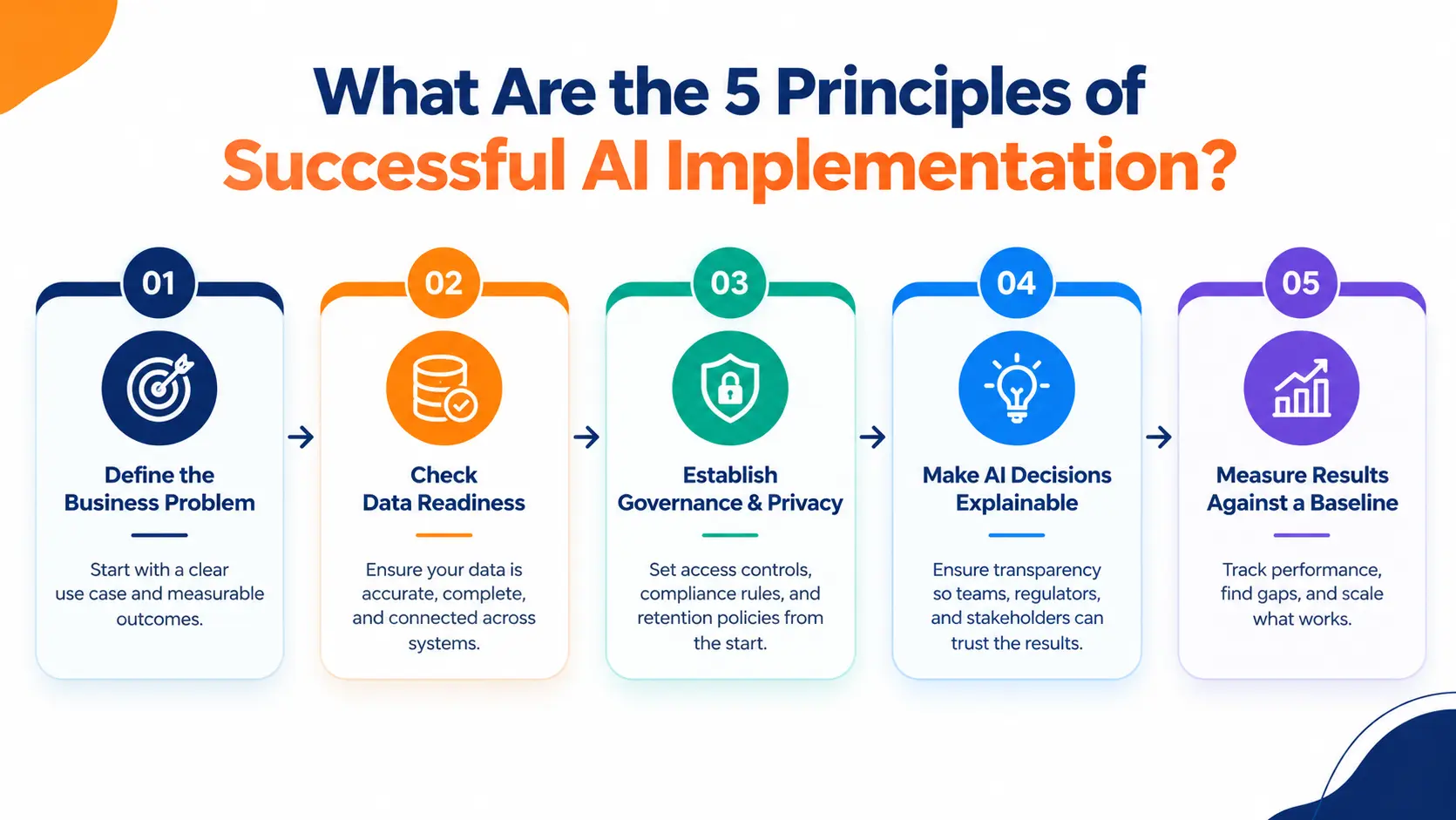
If you keep only five things from all of this:
- Business problem first. Name the process and the measurable outcome before choosing any technology. Projects that start with a tool rarely find a problem worth solving.
- Data readiness before architecture. Accuracy, completeness, consistency, timeliness, and bias. No AI integration outperforms the data feeding it, whatever the model.
- Governance and privacy from day one. Access controls, lineage tracking, retention policies, and bias detection designed in, not added later.
- Explainability as a requirement. If nobody can explain an output, nobody will trust it, and an untrusted system goes unused.
- Measurement against a baseline. Capture current-state numbers before launch. Without them, every claim about improvement is a guess.
Start With the Data, Not the Demo
The businesses getting real value from AI integration aren't the ones that moved fastest. They're the ones that spent the first few weeks on data, finding it, cleaning it, agreeing who owns it, before anyone built anything.
Pick one process, get its data in order, connect it properly, and measure the result. One working AI integration teaches you more than any amount of planning.