monday.com Services
How Do You Request a Quote for AI Integration Services With Confidence?
Three quotes land in your inbox. One says $18,000. One says $140,000. One says "let's discuss."
They're not describing the same work, and nothing in any of them tells you that. This is the normal experience when you request a quote for AI integration services without first defining what you're asking for, and it's why so many AI projects start with a comparison that was never valid.
Here's what AI integration services actually cover, how to tell a serious provider of AI integration services from a merely confident one, and exactly what to specify so the numbers you receive mean something.
Generative AI Development Services and Their Business Applications
Generative AI is where most buying conversations now start, so it's worth knowing what sits inside the category before you request a quote for AI integration services built on it. Most AI integration service proposals lead with this work.
Generative AI development services typically cover:
Assistants and chatbots grounded in your own documents, so answers reflect your policies rather than the open internet.
Document processing, extraction, classification and summarisation across contracts, invoices, claims and reports.
Content generation for product descriptions, proposals, reports and first-draft marketing copy.
Conversation analytics turning support transcripts into themes, sentiment and escalation triggers.
Code assistance for engineering teams, which shortens delivery on every other project you run.
The business applications that pay back fastest share a trait: high volume, repetitive, and currently done by a person reading something and deciding what happens next. That's the sweet spot. Generative AI applied to genuinely creative or high-judgment work tends to disappoint, because the review burden eats the time saved.
What Are the Top 5 AI Services?
Most providers of AI integration services organise their offering around five categories, and a quote should name which ones it covers.
- AI strategy and readiness assessment. Where AI will pay back, whether your data can support it, and what the roadmap looks like. Often sold as an audit or workshop before anything gets built.
- Generative AI development services. Assistants, RAG systems, document intelligence and content generation, as above.
- Machine learning and predictive analytics. Forecasting, scoring, churn prediction, fraud and anomaly detection, trained on your historical data.
- Computer vision. Image and video analysis, defect detection, OCR and object recognition.
- AI integration and deployment. Connecting all of the above into your live systems, the stage where AI integration services either realise the value or lose it.
Artificial intelligence and machine learning services are usually bundled together in proposals, which is fine, but ask which parts are actually in scope. "AI/ML capability" in a deck is not the same as a named deliverable in a contract.
Which 5 Jobs Will Survive AI?
A fair question, though "survive" is slightly the wrong frame. Most jobs change rather than disappear, and the roles under real pressure are the ones made up entirely of predictable, screen-based tasks.
Work that holds up well:
- Skilled trades and hands-on technical work. Electricians, plumbers, field engineers: physical environments, unpredictable conditions.
- Healthcare delivery and care roles. Direct patient contact combines judgment, dexterity and trust in ways AI assists but doesn't replace.
- Roles carrying professional accountability. Where a named human signs and is answerable: audits, clinical decisions, legal advice, safety-critical engineering.
- Relationship-led sales and negotiation. Complex deals rest on trust and reading a room.
- People who design, direct and audit AI systems. Prompt and AI engineers, data engineers, and the governance roles that review what the systems produce.
The pattern is consistent: tasks get automated, roles get redesigned around what's left. Remember that when you scope AI integration services, you're buying a change to how work happens, not just software, and good AI integration services will plan for the human side of it.
Who Are the Top AI Development Services Providers?
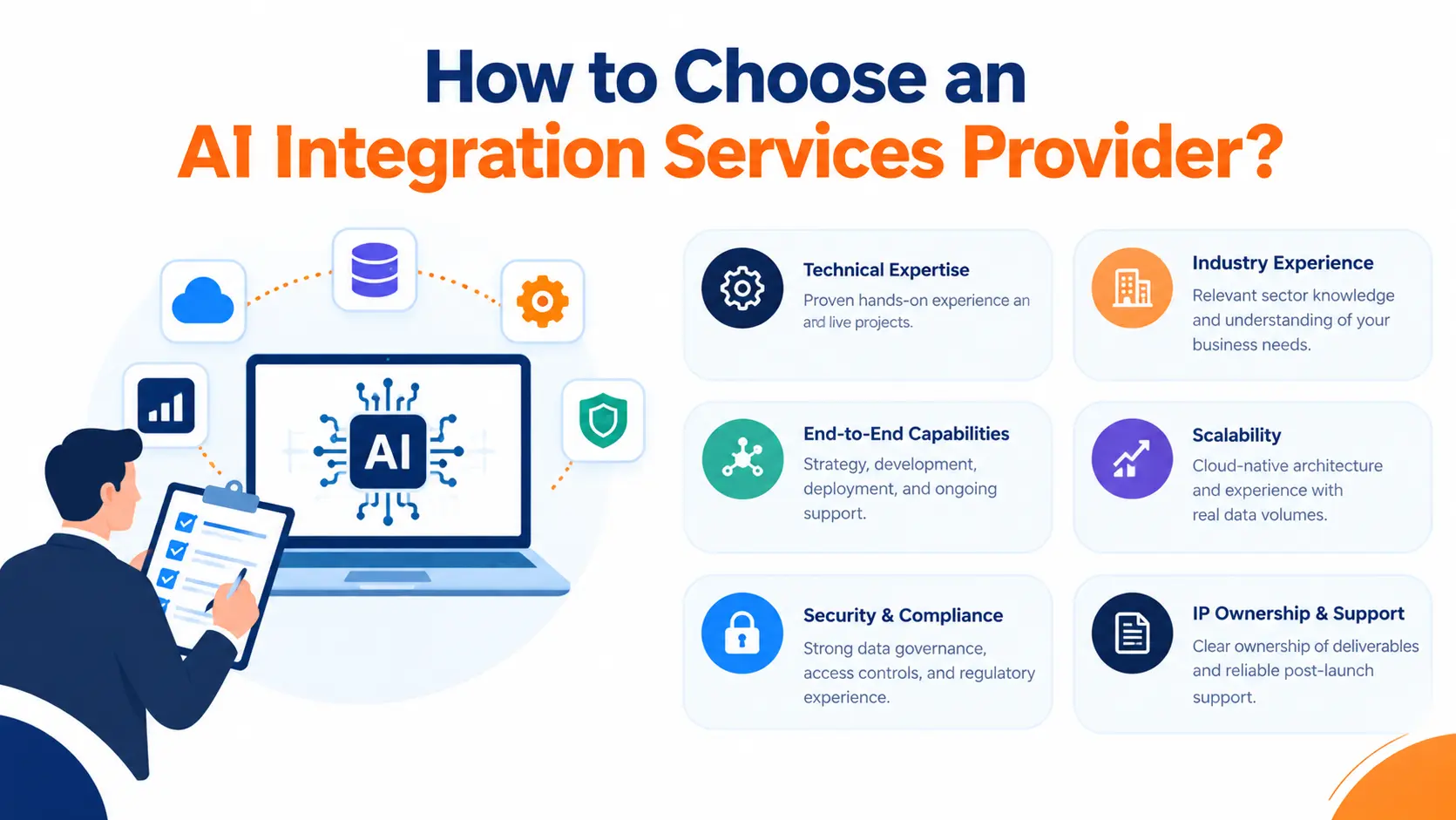
You'll find plenty of ranked lists. Most are paid placements or directory listings, and an AI development services coalition or vendor directory is a reasonable way to discover options but a poor way to choose one.
A better approach is scoring every provider of AI integration services against the same five criteria:
Technical depth. Hands-on production experience, not just framework familiarity. Ask what they've shipped that's still running.
Industry experience. Relevant sector work, knowledge of your regulations, familiarity with your typical data sources.
End-to-end capability. Strategy, data engineering, model development, deployment, monitoring and ongoing optimisation, or a clear statement of where they stop.
Scalability. Cloud-native architecture and experience with real data volumes, not pilot-sized datasets.
Security and compliance. Data governance, access controls, and demonstrable experience with the standards you're bound by.
Add two commercial criteria most AI integration services lists omit: who owns the intellectual property at the end, and what the engagement model is. Whether you're evaluating AI development services in USA providers or teams elsewhere, those two answers tell you more than any case study. An agentic AI development company building autonomous workflows should also show you its escalation and human-review design; that's the part that keeps an agent from quietly making expensive mistakes.
Which AI Platforms Will You Actually Be Building On?
Worth asking early, because it shapes the cost and flexibility of any AI integration services engagement.
Your provider will build on foundation models from one of the major AI labs, usually accessed through a cloud platform. The right answer isn't a particular vendor; it's that your provider benchmarks a couple of candidates against your actual data and builds the integration so a model can be swapped later without a rebuild.
Be wary of AI integration services whose architecture only works with one provider's stack. Custom AI solutions should be portable, because the frontier shifts every few months and you don't want a rewrite each time it does.
What to Include When You Request a Quote for AI Integration Services
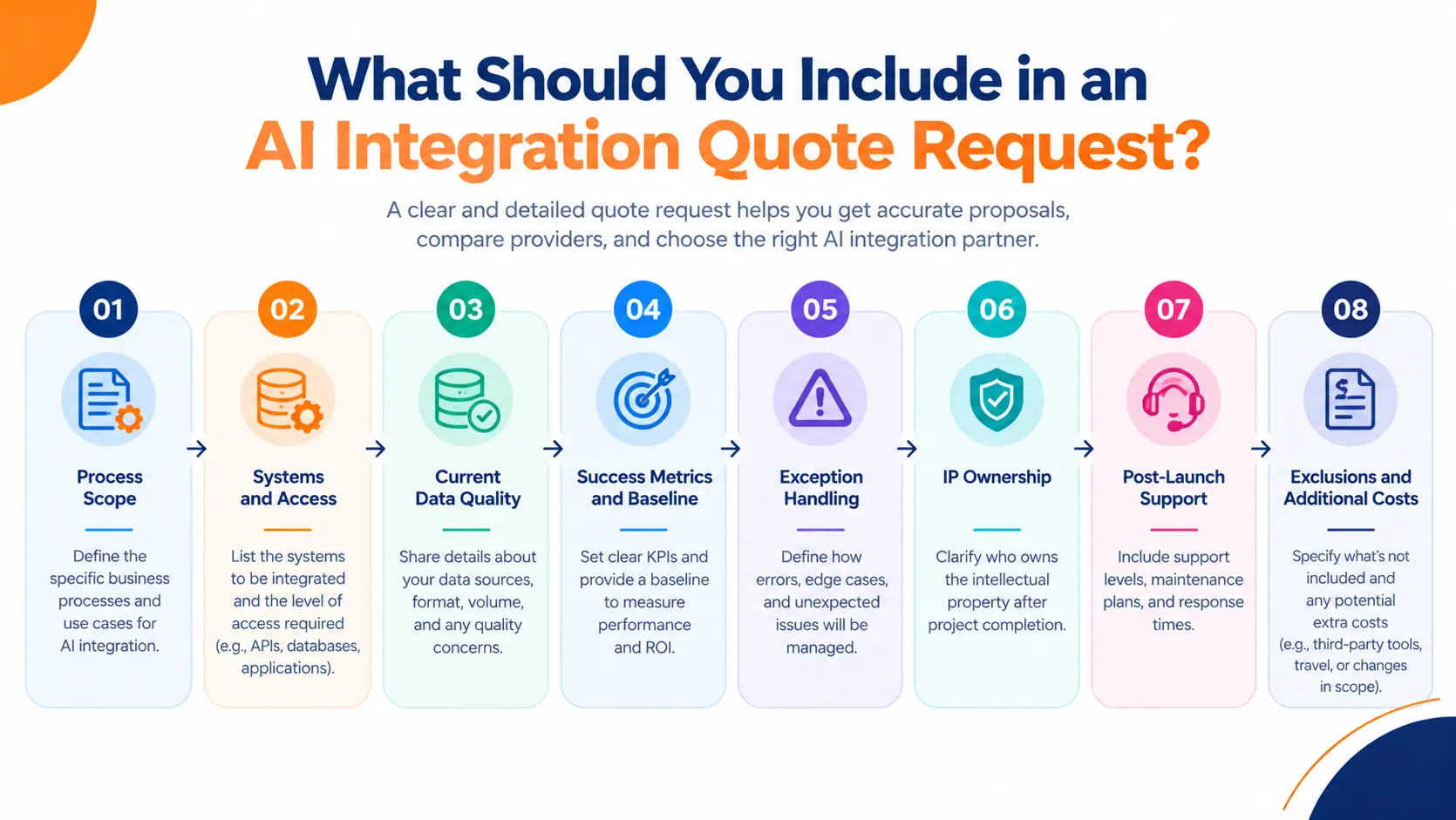
This is where comparable proposals come from. Whoever you ask for AI integration services, specify all eight:
- The process, named start step to named end step
- Systems and access required, and who grants them
- Current data state, where it lives, how clean it is
- The success metric plus your pre-project baseline
- Exception handling and the human review path
- IP ownership of models, code and prompts
- Post-launch support, monitoring, retraining, response times
- Exclusions, licences, data cleanup, custom development
For rough calibration, published industry ranges put a proof of concept around $5,000 to $50,000 over one to three months, an MVP at $20,000 to $200,000 over three to six months, and full production builds from $50,000 upward, sometimes well beyond, across six to twelve months. Treat these as orientation, not a price list.
Make the Quotes Comparable First
The single highest-return thing you can do before requesting AI integration services proposals is to write down the eight items above. It takes an afternoon and turns three incomparable numbers into a real decision.
Then start small. One process, scoped tightly, measured against a baseline, the narrowest useful slice of AI integration services you can buy.